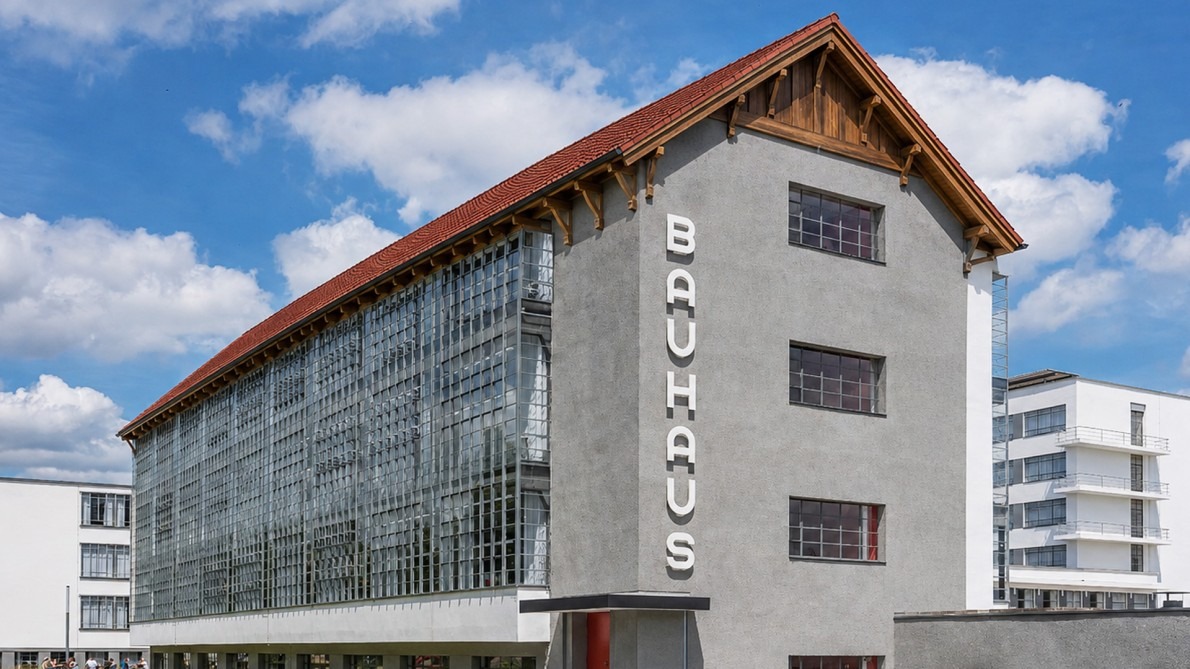
On the Election Campaign in Saxony-Anhalt and the AfD,
on National Socialism and Cultural Policy
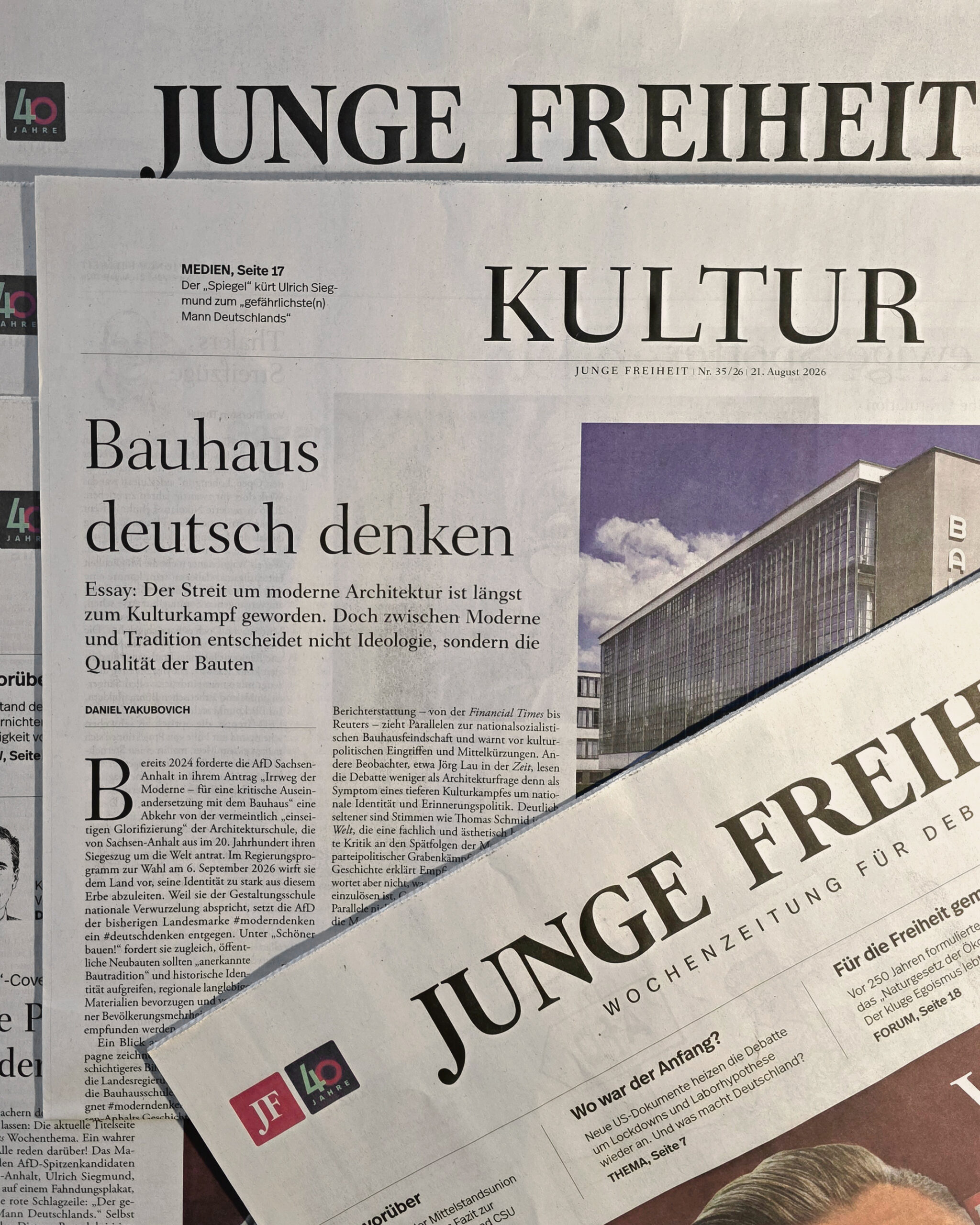

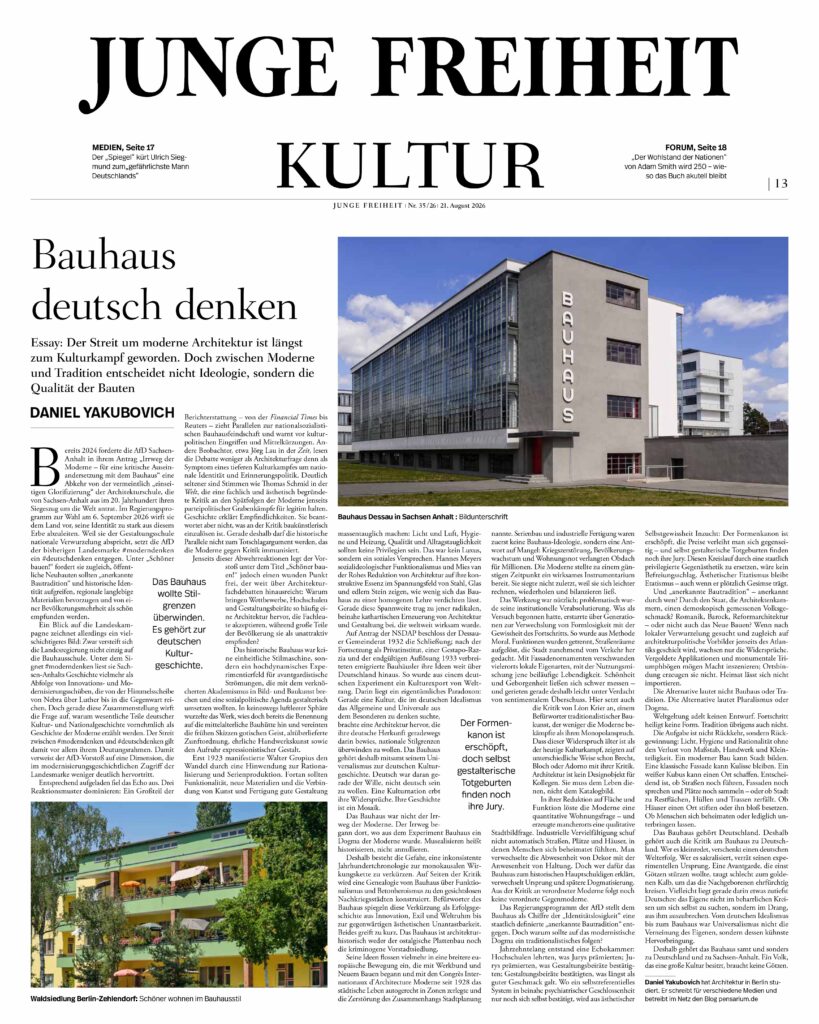
As early as 2024, the AfD in Saxony-Anhalt called for a departure from the supposed “one-sided glorification” of the architectural school in its motion “Modernism’s Wrong Turn — Towards a Critical Engagement with the Bauhaus”. From Saxony-Anhalt, the school had gone on to conquer the world in the twentieth century. In its manifesto for the election on 6 September 2026, the party accuses the state of drawing its identity too heavily from this legacy. Denying the design school’s national roots, the AfD counters the state’s existing slogan #moderndenken (“think modern”) with #deutschdenken (“think German”). Under the heading “Build More Beautifully!”, it also demands that new public buildings draw on “established architectural traditions” and historical identity, favour durable regional materials, and be considered beautiful by a majority of the population.
A closer look at the state’s campaign, however, reveals a more nuanced picture. The state government does not focus exclusively on the Bauhaus school. Under the banner of #moderndenken, it instead presents Saxony-Anhalt’s history as a succession of waves of innovation and modernisation, stretching from the Nebra Sky Disc through Luther to the present day. Yet this very juxtaposition raises the question of why substantial parts of German cultural and national history are narrated primarily as a history of modernity. The dispute between #moderndenken and #deutschdenken thus centres above all on the framework through which that history is interpreted. The AfD’s initiative thereby points to a dimension less clearly expressed in the state brand’s emphasis on modernisation.
The response was correspondingly charged. Three patterns dominate: much of the coverage — from the Financial Times to Reuters — draws parallels with National Socialist hostility towards the Bauhaus and warns of political interference in cultural affairs and funding cuts. Other observers, such as Jörg Lau in Die ZEIT, read the debate less as a question of architecture than as a symptom of a deeper culture war over national identity and the politics of memory. Far rarer are voices such as Thomas Schmid’s in Die Welt, which regard criticism of modernism’s long-term consequences on architectural and aesthetic grounds as legitimate beyond partisan trench warfare. History explains these sensitivities. But it does not establish which aspects of the criticism hold up in architectural terms. Precisely for this reason, the historical parallel must not become a rhetorical weapon that shuts down debate and renders modernism immune to criticism.
Beyond these defensive reactions, however, the initiative’s call to “Build More Beautifully!” exposes a sore point that reaches far beyond specialist architectural debate: why do competitions, universities and design review panels so often produce architecture that professionals accept, yet large sections of the public find unattractive?
The historical Bauhaus was no monolithic style machine, but a highly dynamic testing ground for avant-garde movements seeking to break with ossified academicism in the arts and architecture and to give form to a social and political agenda. Its work was far from rootless: the very name evoked the medieval masons’ lodge, while the early sketches brought together the Gothic spirit, age-old guild traditions, honest craftsmanship and the tumult of Expressionist form.
Only in 1923 did Walter Gropius give explicit expression to this shift by turning towards rationalisation and mass production. From then on, functionality, new materials and the integration of art and manufacturing were to make good design accessible to all: light and land, hygiene and heating, quality and everyday practicality were no longer to be privileges. This was no luxury, but a social promise. Hannes Meyer’s ideologically driven social functionalism and Mies van der Rohe’s reduction of architecture to its structural essence through the interplay of steel, glass and fine stone demonstrate how little the Bauhaus can be distilled into a homogeneous doctrine. It was precisely this breadth that contributed to the radical, almost cathartic renewal of architecture and design whose influence spread across the world.
In 1932, Dessau’s municipal council voted to close the Bauhaus on a motion tabled by the NSDAP. After its continuation as a private institute, a Gestapo raid and its final dissolution in 1933, émigré Bauhaus members spread its ideas far beyond Germany. Thus a German experiment became a cultural export of global stature. Herein lies a curious paradox: the very culture that, in German Idealism, had sought to conceive the general and the universal through the particular produced an architecture that demonstrated its German origins precisely in its ambition to transcend national boundaries of style. The Bauhaus, universalism and all, therefore belongs to German cultural history. What made it German was precisely the will not to be German. A cultural nation inherits its contradictions. Its history is a mosaic.
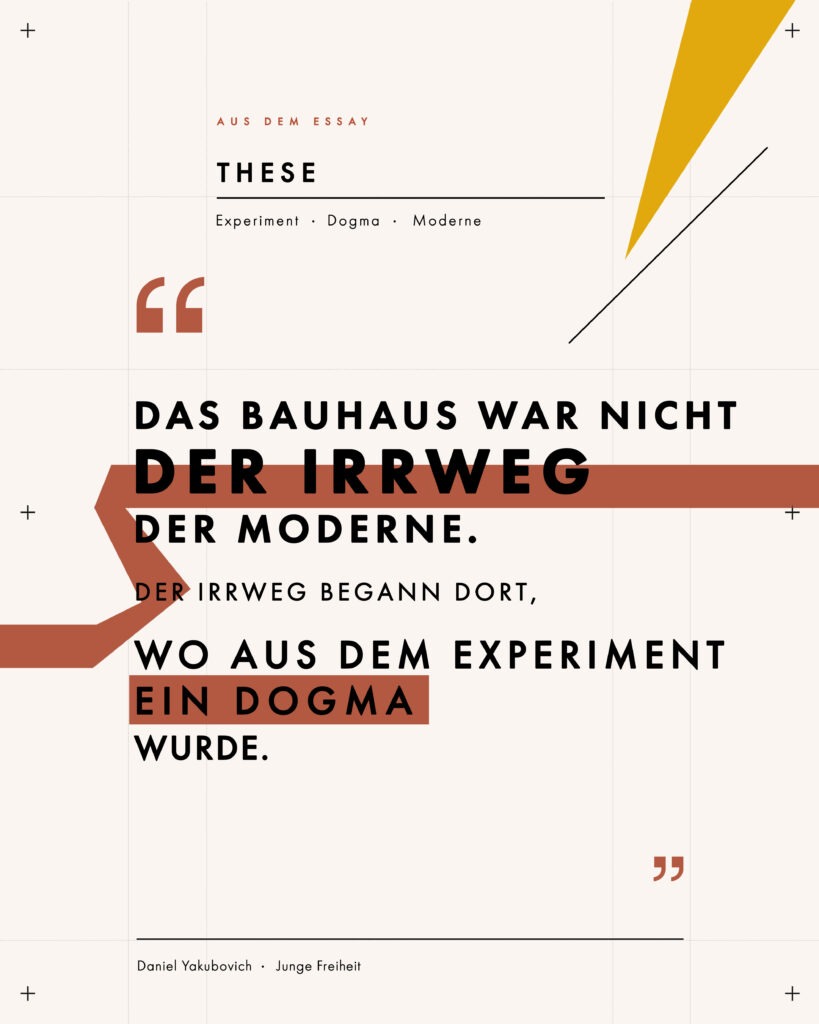
Das Bauhaus war nicht der Irrweg der Moderne. Der Irrweg begann dort, wo aus dem Experiment Bauhaus ein Dogma der Moderne wurde. Musealisieren heißt historisieren, nicht annullieren.
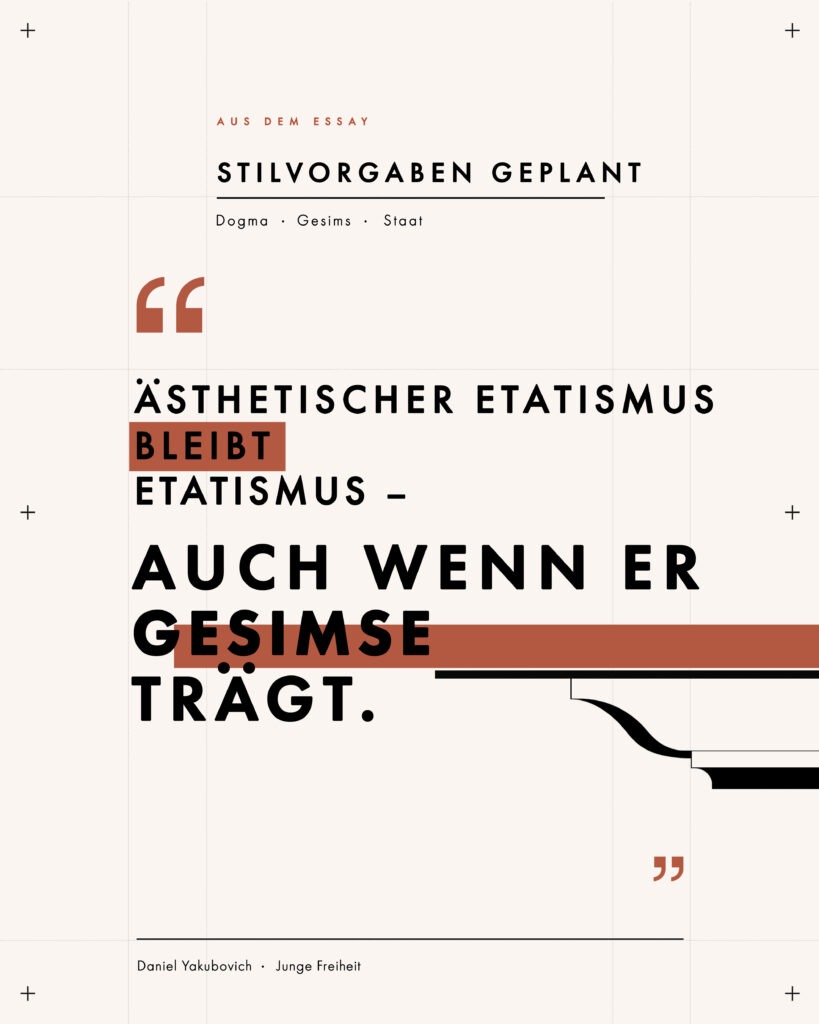
Aesthetic statism remains statism — even when it sports cornices.
The Bauhaus was not modernism’s wrong turn. The wrong turn came when experiment became dogma.
There is therefore a danger of reducing a century’s uneven history to a chain of cause and effect driven by a single factor. Critics construct a genealogy leading from the Bauhaus through functionalism and concrete heroics to the faceless cities of the post-war era. Bauhaus advocates mirror this simplification with a success story of innovation, exile and worldwide acclaim, culminating in its present immunity from aesthetic criticism. Both accounts fall short. In architectural history, the Bauhaus is neither the prefabricated housing block of East German nostalgia nor the crime-breeding suburban estate.
Its ideas instead fed into a broader European movement that began with the Werkbund and Neues Bauen and, through the Congrès Internationaux d’Architecture Moderne from 1928 onwards, sliced space into zones and styled the shattering of synergy as ‘urban planning’. Standardised construction and industrial production were not initially Bauhaus ideology, but a response to scarcity: wartime destruction, population growth and housing shortages demanded shelter for millions. Modernism supplied an effective set of tools at an opportune moment. It triumphed not least because it was easier to cost, replicate and account for.
The tool was useful; the problem arose when institutions elevated it into an absolute. What had begun as an experiment hardened over generations into a confusion of formlessness with the certainty of progress. Method thus became morality. Functions were separated, streets lost their spatial definition, and the city was increasingly conceived around traffic. In many places, local distinctiveness disappeared along with façade ornament, and the unselfconscious vitality of everyday life vanished with mixed uses. Beauty and a sense of belonging were hard to measure — and for that very reason easily fell under suspicion as sentimental excess. This is also where the critique of Léon Krier comes in: an advocate of traditionalist architecture, he opposed modernism’s claim to a monopoly more than modernism itself. That such dissent predates today’s culture war was already evident, in different ways, in the criticism of Brecht, Bloch and Adorno. Architecture is no design object for fellow professionals. It must serve life, not the catalogue image.
By reducing architecture to floor area and function, modernism solved a quantitative housing problem — and in some places created a qualitative problem of urban character. Industrial replication did not automatically create streets, squares and houses in which people felt at home. The absence of decoration was mistaken for the presence of conviction. Yet to cast the Bauhaus as the chief historical culprit is to confuse origins with later dogmatisation. Criticism of imposed modernism does not in itself justify imposing a counter-modernism.
The AfD’s manifesto counters the Bauhaus, cast as a cipher for a “lack of identity”, with a state-defined “established architectural tradition”. But why should modernist dogma give way to traditionalist dogma?
Over decades, an echo chamber took shape: universities taught what juries rewarded; juries rewarded what design review panels endorsed; design review panels endorsed what had long passed for good taste. When a self-referential system retreats into an almost psychiatric state of insularity, affirming only itself, aesthetic self-certainty becomes inbreeding: the formal vocabulary is exhausted, prizes are awarded to one another — and even stillborn designs find a jury of their own. Replacing this cycle with a state-privileged counter-aesthetic would be no act of liberation. Aesthetic statism remains statism — even when it suddenly sports cornices.
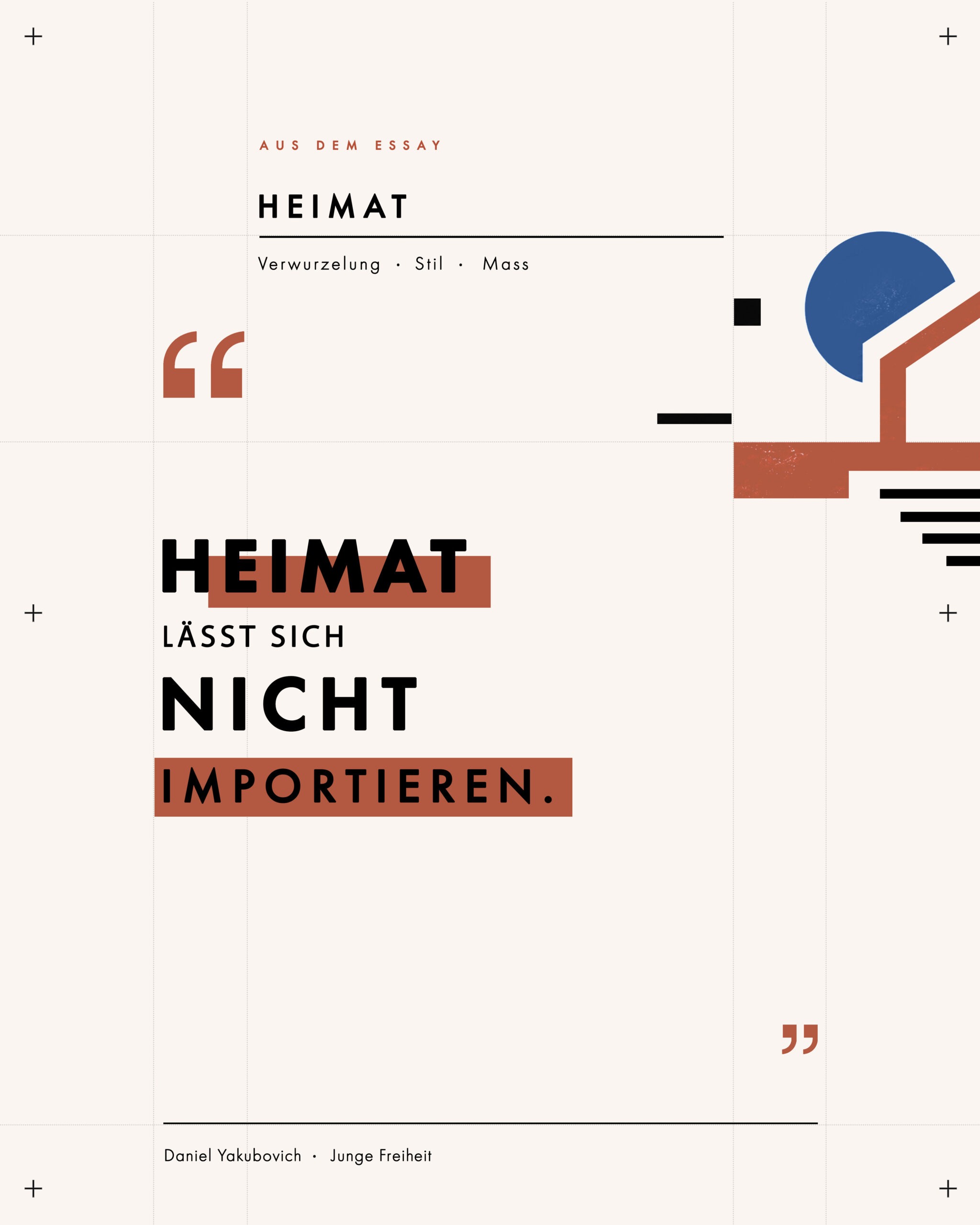
And “established architectural tradition” — established by whom? By the state, the chambers of architects, public taste as measured by opinion polls? Romanesque, Baroque, reform architecture — or perhaps Neues Bauen too? Seeking local roots while casting an eye towards architectural policy models across the Atlantic only compounds the contradictions. Gilded embellishments and monumental triumphal arches may stage a spectacle of power; they do not create a sense of place. A homeland cannot be imported.
The choice is not between Bauhaus and tradition. It is between pluralism and dogma.
Global acclaim ennobles no design. Progress sanctifies no form. Neither, for that matter, does tradition.
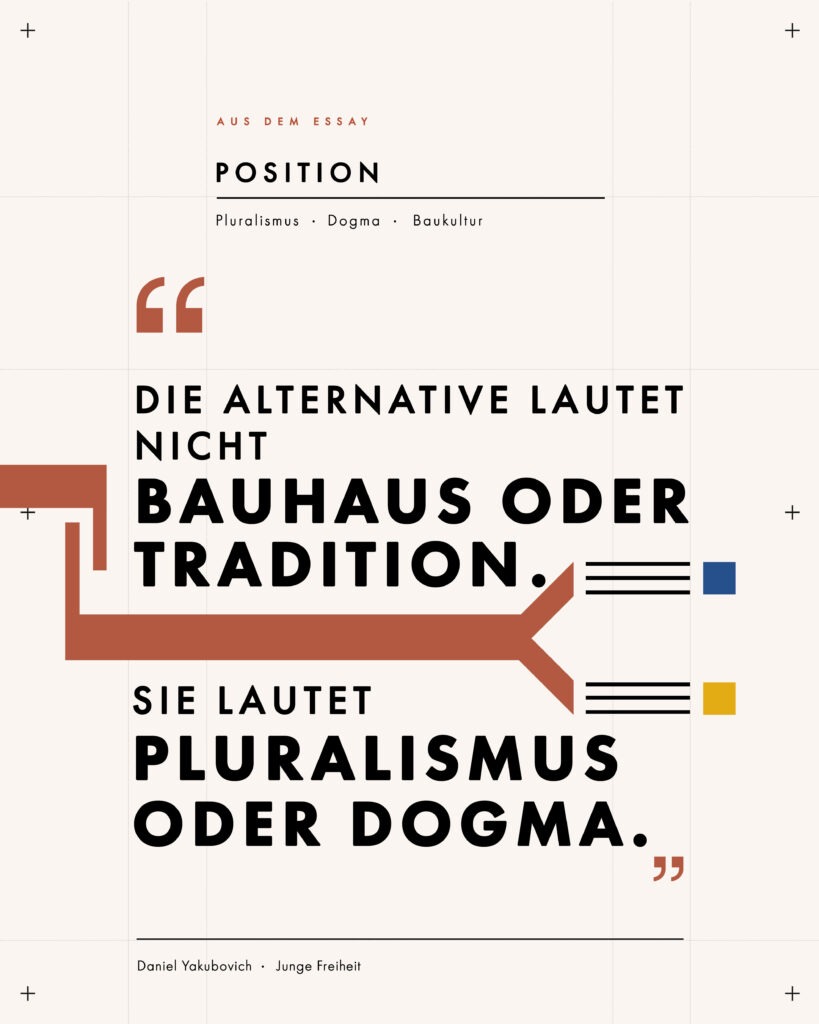
The choice is not between Bauhaus and tradition. It is between pluralism and dogma.
A homeland cannot be imported.
The task is not to return, but to reclaim: light, hygiene and rationality without sacrificing scale, craftsmanship and fine-grained urban fabric. A modern building can help make a city. A classical façade can remain mere scenery. A white cube can create a sense of place. What matters is whether streets still guide, façades still speak and squares still gather people — or whether the city disintegrates into leftover spaces, shells and transport corridors. Whether buildings establish a place or merely occupy it. Whether people make themselves at home or are merely housed.
The Bauhaus belongs to Germany. So does criticism of the Bauhaus. Those who belittle it squander a German success of global stature. Those who sanctify it betray its experimental origins. An avant-garde that once sought to topple idols makes a poor golden calf for later generations to circle in reverence. Perhaps there is something profoundly German in this very impulse: to seek one’s identity not by endlessly circling around oneself, but through the urge to break free. From German Idealism to the Bauhaus, universalism was not the negation of that identity, but its boldest expression.
That is why the Bauhaus, in its entirety, belongs to Germany and to Saxony-Anhalt. A people with a great culture has no need of idols.
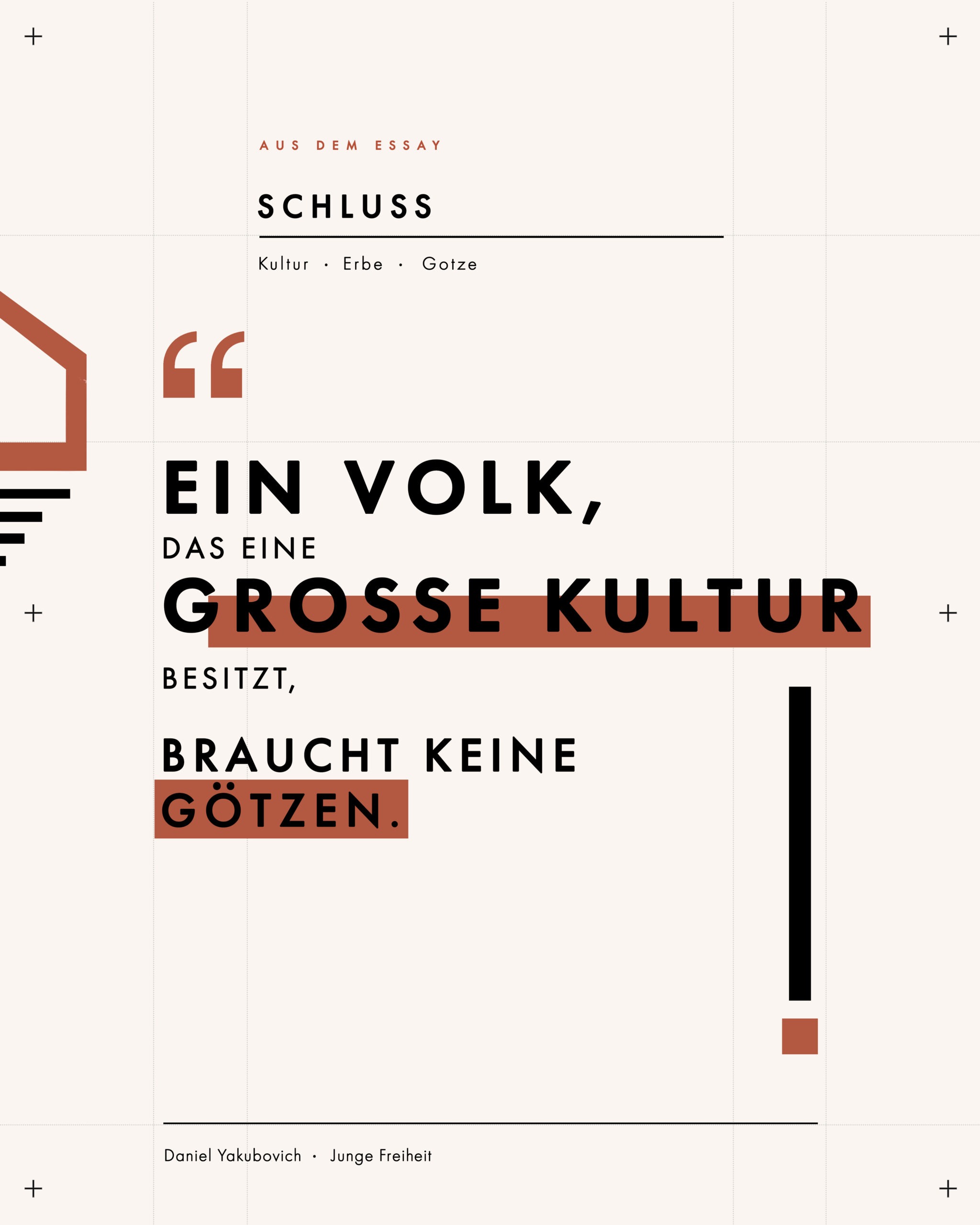
A people with a great culture has no need of idols.
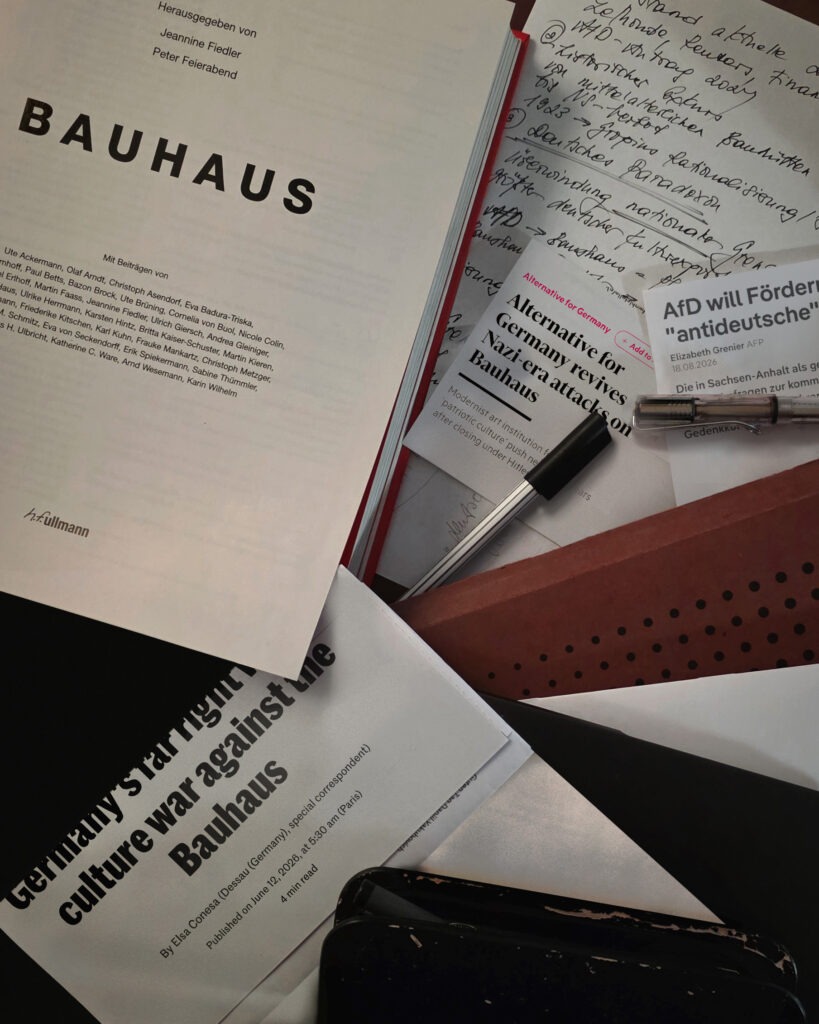
Between architectural history and the culture war: research materials for this essay.