



The promise is obvious. If bureaucracy consists of forms, audit notes and official decisions, artificial intelligence ought to be its natural enemy. What takes weeks today could be sorted, checked and decided in minutes. Applications would no longer languish, files would no longer be passed from desk to desk, citizens would no longer wait. The machine reads faster, compares more accurately, never forgets an attachment and drafts the decision without a cigarette break. Seen this way, AI seems to offer an alternative to the chainsaw for cutting back an overgrown administrative state.
Yet this very notion is misleading. Bureaucracy is not merely slow information processing, nor a sluggish information service that could be replaced by a faster one. It is a social estate that administers claims to power and moves billions. Its function is not merely to wear down the obvious in endless rounds of review. It distributes responsibility, manages conflicts, fragments authority and turns political decisions into procedurally impeccable processes. Those who understand bureaucracy solely as technical inefficiency mistake its tangible surface for its untouchable core.
Bureaucracy is thus no aberration of the modern state, but one of the organs that brought it into being. The European state emerged not only from the tensions between crowns and wars, confessions and constitutions, but from the enduring union of law and the written record. Power always also meant turning people into lists, property into cadastral registers, levies into revenue, commands into execution and territory into administration. Bureaucracy is therefore not rust on the state, but part of its load-bearing structure. Those who dismantle bureaucracy touch more than a slow service department: they touch the very framework of the state. And no apparatus voluntarily scales itself back when its size is also the basis of its power, its security and its social standing.

01 / 08 — NEW ESSAY AI WON’T ABOLISH BUREAUCRACY.IT WILL ARM IT.
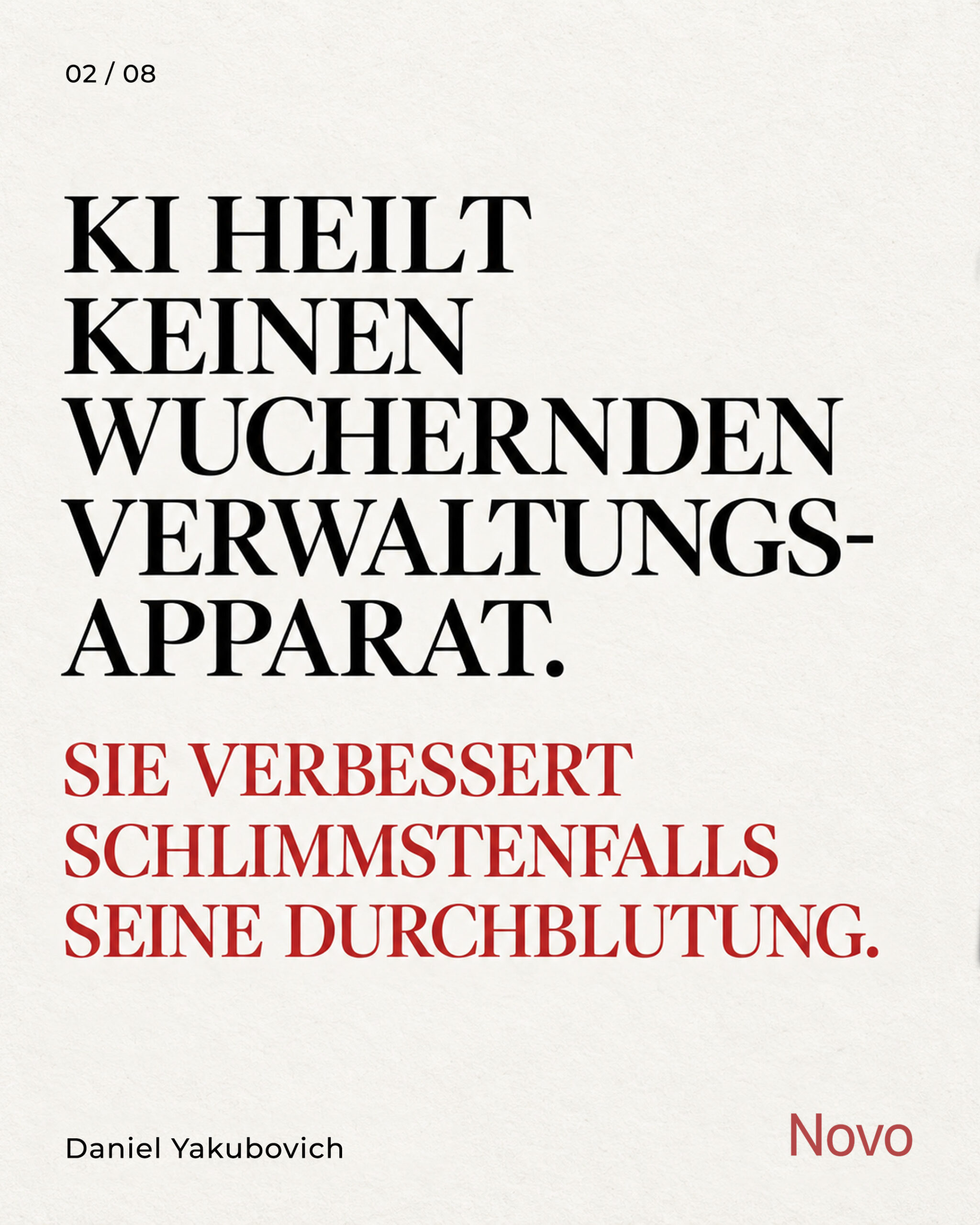
02 / 08 AI WON’T CURE AN OVERGROWN ADMINISTRATIVE APPARATUS.AT WORST, IT WILL IMPROVE ITS BLOOD SUPPLY.
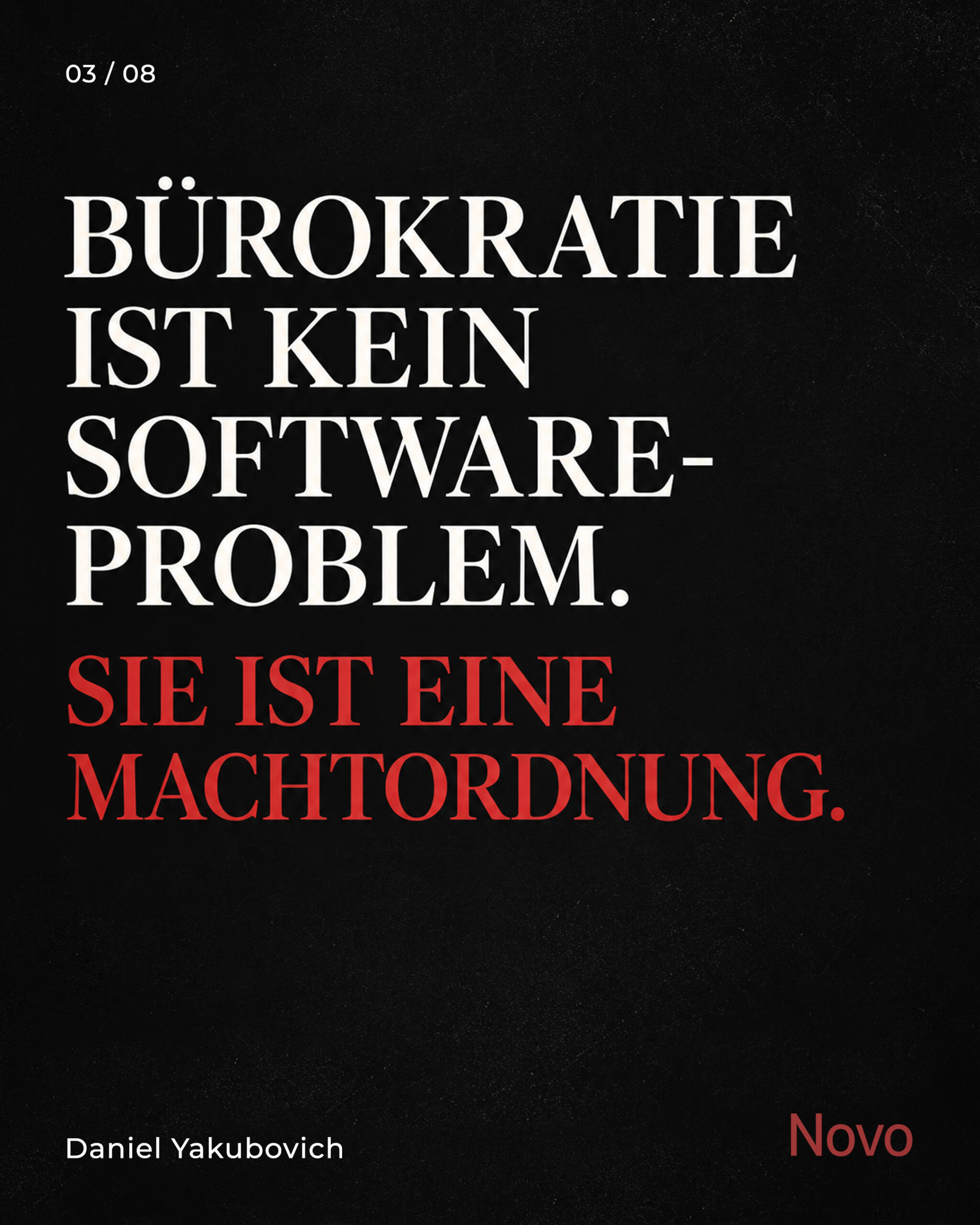
03 / 08 BUREAUCRACY IS NOT A SOFTWARE PROBLEM.IT IS A STRUCTURE OF POWER.
Bureaucracy acts as a catalyst within the state. Without it, power remains inert. No tax assessment, no permit, no register. Only through bureaucracy does the will of the state acquire the capacity to act. It becomes dangerous when the catalyst no longer accelerates the main process, but the side reactions: multiplying jurisdictions, deflecting responsibility and preserving itself.
The point made by Mises and Hayek is not that markets are always wiser than bureaucracies. More precisely, it is that prices, property and profit or loss translate dispersed knowledge into action. Bureaucracies can perform clearly defined, rule-bound tasks. They reach their limits where practical, local and changing knowledge must continually be processed afresh. AI shifts this boundary technologically. It does not abolish it politically.
That is why the prospect of technological salvation is as dangerous as it is seductive. The machine seems to offer the state something it can scarcely achieve on its own: the ability to accelerate without having to submit to political constraints. The cybernetic visions of the state in the twentieth century were already sustained by this hope. The Soviet mathematician and cyberneticist Viktor Glushkov, director of the Institute of Cybernetics in Kyiv from 1962, devised OGAS, a nationwide computer network for managing the planned economy. The Russian acronym stood for a “nationwide automated system” for collecting and processing economic information. Accounting, planning and management of the national economy were to be integrated into a hierarchical network. Chile’s Project Cybersyn likewise sought, under Salvador Allende, to coordinate nationalised industry through rapid flows of data. The dream of ordering power through information predates the digital age.



04 / 08 THOSE UNWILLING TO DECIDE WON’T DECIDE WITH AI EITHER.
05 / 08 THE DANGER IS NOT JUST THAT AI REPLACES PEOPLE. IT IS THAT AI PERFECTS CONTROL.
06 / 08 AN AIRPORT WON’T GET BUILT JUST BECAUSE AI SUMMARISES ITS FILES FASTER.
These very precedents reveal the problem. They failed not only because of technology. They ran up against positions to protect, departmental rivalries and fears of losing power. Soviet officials feared the technology less than the loss of their social standing. To automate information is to intervene in power relations. To shorten decision-making routes is to deprive someone of the space in between, where influence is exerted, responsibility shifted and vested interests asserted. Today’s AI debate thus repeats an older illusion in new language: it treats bureaucracy as an information problem, although it has long since become a form of power.
Routine administrative tasks can certainly be accelerated. Certificates of residence, standard applications, file summaries and draft texts are well suited to automation. AI can shorten queues and support caseworkers. That would be useful. But this is not where a country’s capacity for political action breaks down. The greatest losses occur where public funds, major projects and permits are negotiated among interest groups, public administrations and business interests. There, bureaucracy is not mere slowness. It is the form through which interests are negotiated.
In such cases, the decisive factor is not a lack of information, but the configuration of interests. An airport does not remain unfinished because no one can summarise the file. A school renovation does not become more expensive because a language model is missing. A housing project does not fail because no one can draft a properly worded decision. It fails because of budgetary limits, procurement thresholds, chains of signatures, political priorities and procurement rules. Ultimately, it founders on the question of who bears liability for a decision. That is precisely the question AI cannot resolve. It can only describe it faster.
AI will therefore not abolish bureaucracy. It will first automate it. There is a considerable difference. An administration that disperses responsibility will not become more accountable through AI. An authority that avoids decisions will not become more decisive because a language model assists it. An apparatus that organises its own insulation from responsibility gains a new tool for doing so. The machine does not decide which interests should take precedence. It bears no political responsibility.
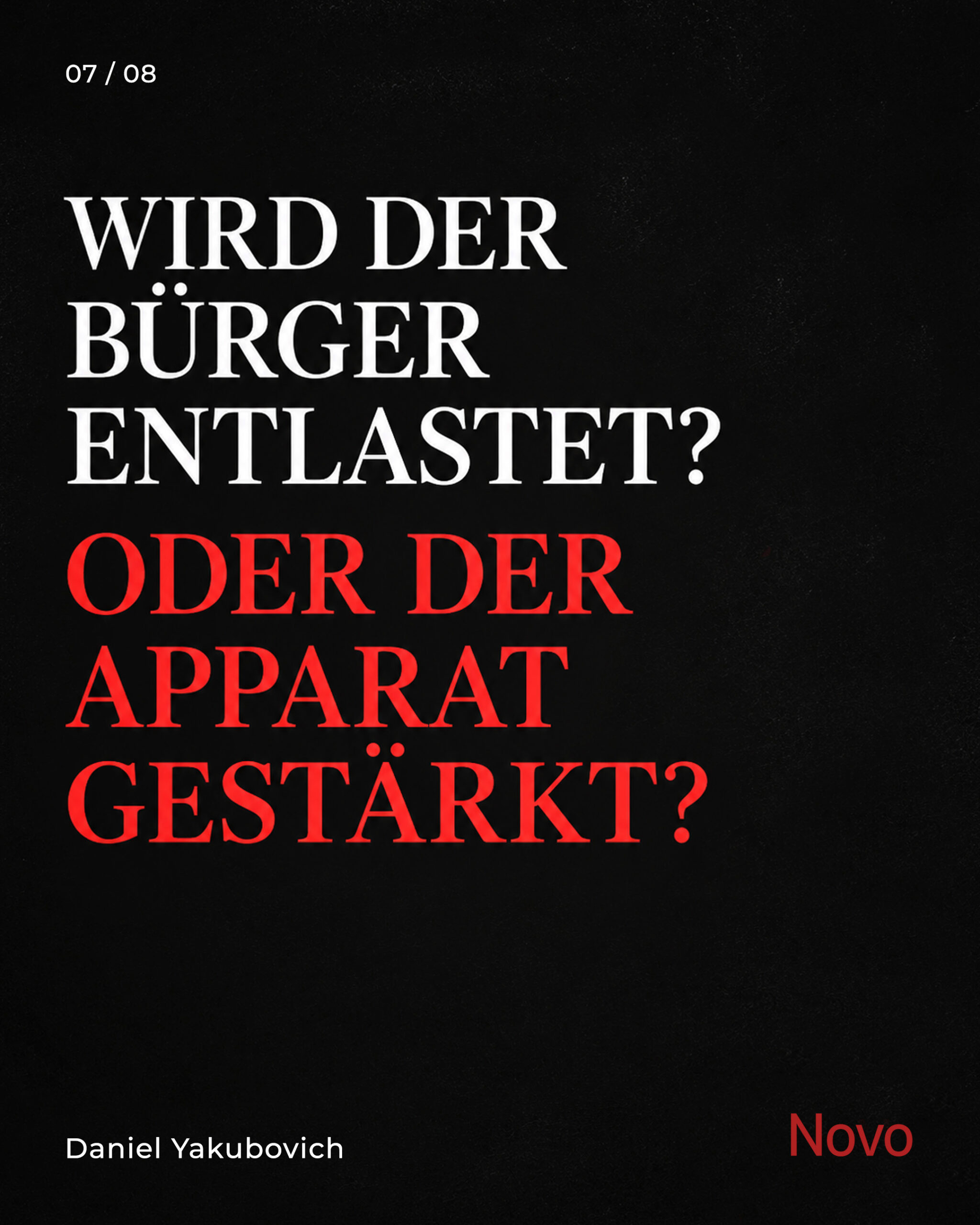


07 / 08 IS THE CITIZEN’S BURDEN EASED? OR THE APPARATUS STRENGTHENED?
08 / 08 AI REPLACES BUREAUCRACY ONLY WHERE BUREAUCRACY IS ADMINISTRATION. IT DOES NOT REPLACE IT WHERE BUREAUCRACY IS THE EXERCISE OF POWER.
LAST PAGE THE PUBLISHED ARTICLE.
The fear of jobs disappearing en masse also falls short. What will disappear above all are tasks that can be broken down into standardised routines. Lift operators pressed buttons, telephone operators connected lines, typesetters arranged letters; what was once a profession became first routine, then technology. Wherever responsibility, selection and sanctions are involved, a person or institution must remain accountable. The danger, then, is not merely that AI will replace people. It is also that it will entrench hierarchies: machine-assisted preparation of decisions at the top; tighter control, more exhaustive documentation and harsher sanctions below. AI is not an actor. It is an amplifier.
The decisive question is therefore not whether AI makes bureaucracy faster. It is which bureaucracy it makes faster. Does it accelerate the path to a decision, or merely the production of supporting records? Does it ease the burden on citizens and businesses, or perfect the documentary defences of an apparatus that has long since lost its ability to move?
At its simpler edges, bureaucracy is a service problem. At its heart, it is an order of power. Where major projects, large sums of money and political responsibility are at stake, language will not replace it. For the apparatus consists of more than sentences. It consists of arrangements, interests and relationships.
No libertarian doctrine of salvation follows from this. Those who believe that dismantling bureaucracy automatically brings liberation underestimate the darker side of political order. Power does not disappear when the state withdraws. It migrates into private and informal spaces.
The future need not, therefore, culminate in the liberal minimal state. It may just as readily lead to a futuristic-archaic order: digital interfaces, algorithmically opaque administrations, feudal enclaves of power, a fully digitised population laid bare to scrutiny.
Nor does this imply faith in the state. Equipping an overgrown administrative apparatus with AI does not remove the tumour. At worst, it improves its blood supply.
The alternative to rampant bureaucracy is not a romantic retreat from statehood, but an order that limits administration without destroying state capacity. The machine does not decide the fate of the state. The state decides whether to use the machine to unlock its structures or to perfect its own inertia.
AI replaces bureaucracy only where bureaucracy is administration. It does not replace it where bureaucracy is the exercise of power.