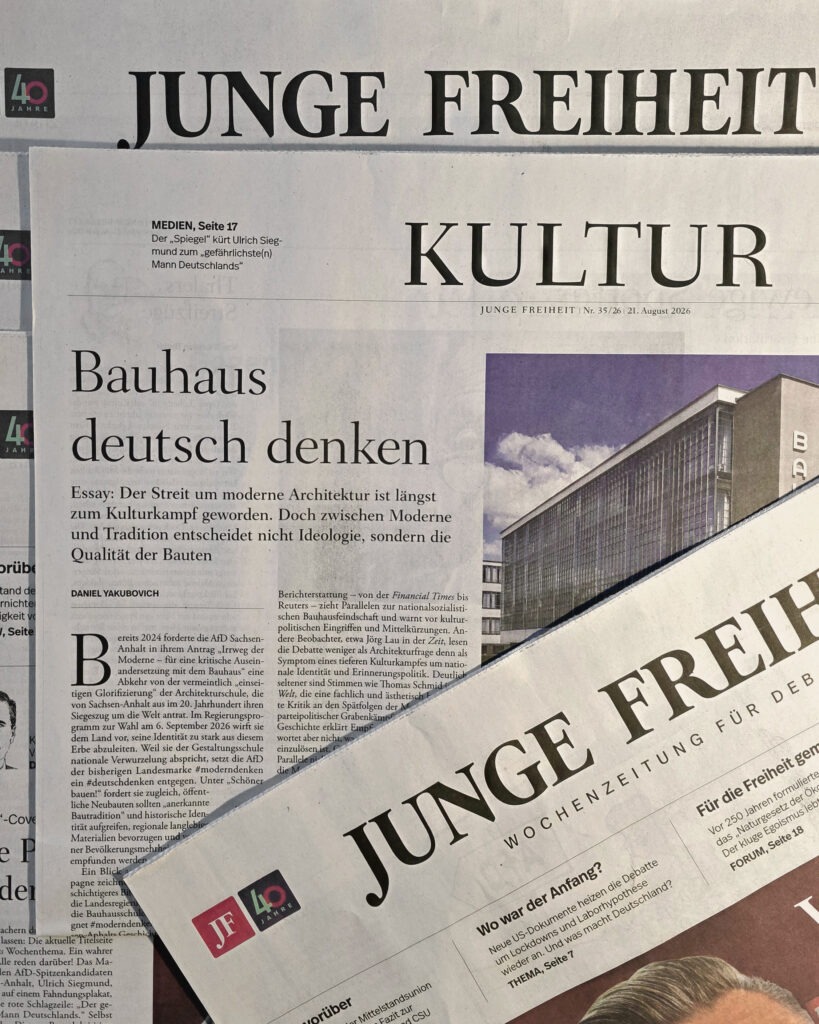
On the Election Campaign in Saxony-Anhalt and the AfD,
on the Bauhaus and Cultural Policy
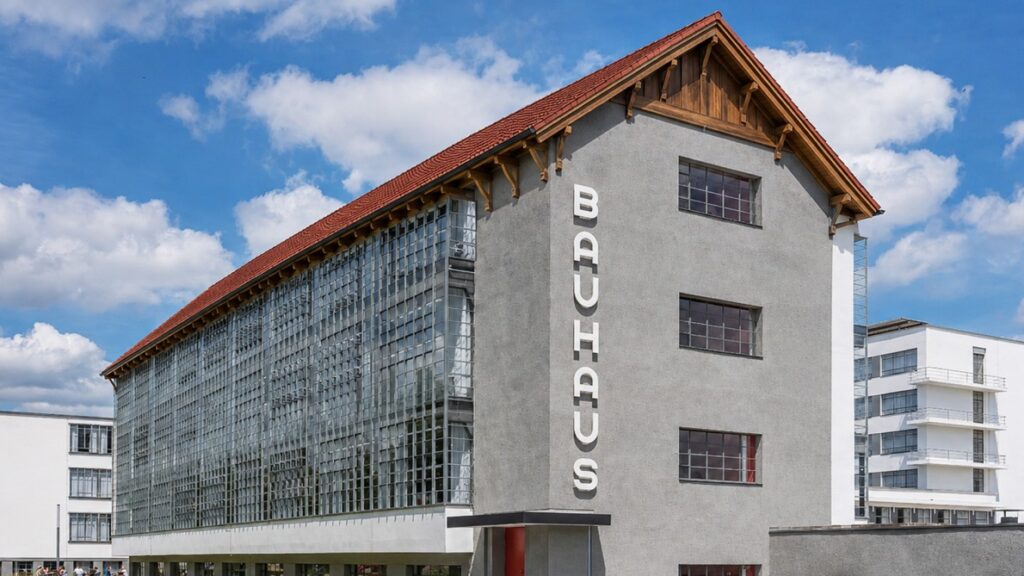

The AfD’s ostentatious rejection of the Bauhaus in Saxony-Anhalt was recently described on Achse des Guten as “stupidity”. A harsh word, but not a misplaced one. Yet the interesting question remains precisely where that verdict leaves off. Defending the Bauhaus against its political opponents does not, in itself, amount to defending good architecture. And anyone who proclaims a political crusade against the aesthetic affronts of the present under the banner “Build More Beautifully!” exposes a conflict lodged deeper in the institutional fabric of architectural culture — one older than the banners under which it is fought today.
How deeply this conflict is embedded in the institutional fabric becomes clear in a circuit of aesthetic authority that has remained closed for decades: universities teach what competition juries reward; competition juries reward what design review panels endorse; design review panels endorse what universities teach.
The result is a hermetic cycle of architectural self-validation. A white museum cube may win three awards and still stand there like the sepulchral administrative shell of a defunct corporation. A façade may “respond sensitively to its context” in the design statement yet refuse all conversation at street level. The public’s judgement is then readily dismissed as an uncultivated impulse, while the experts’ error enjoys the status of theory.
The real problem, then, lies less in the opposition between modernism and tradition than in an institutionally entrenched claim to an aesthetic monopoly. For decades, a particular conception of what befits the times was not merely favoured but invested with moral authority. Reduction was deemed essence, ornament a crime, recognisability sentimentality. A method became an orthodoxy. Its incense smelled of cement dust. The AfD thus touches a real nerve when it points out that very many people want streets, houses and squares different from those the architectural establishment routinely declares appropriate to the times. This discrepancy cannot be resolved by treating every objection to modernism as suspected kitsch. Beauty is not a mathematical quantity, but that does not make it a hallucination. A sense of shelter and belonging cannot be standardised, yet its absence can be felt with remarkable certainty.
Yet the problem begins anew the moment legitimate criticism becomes a state-sponsored counter-creed. The manifesto speaks of “established architectural tradition”. Established by whom? By ministry officials, professional chambers and juries? By design review panels staffed with conservatives and their favourite cornices? Or by public taste, measured in opinion polls, henceforth ruling by plebiscite on eaves heights and window divisions? Those who lament the rule of an aesthetic priesthood should not rush to ordain another.
The majority, too, has no infallible eye for beauty.
Romanesque and Baroque, Neues Bauen and classical modernism all belong to our country’s architectural history. Tradition is not a catalogue from which the state tears out whichever pages suit the parliamentary term. Its vitality lies precisely in each generation’s ability to alter, rediscover and overwrite the palimpsest of history. The moment a government decrees which forms count as “established”, inheritance becomes edict.
Little would be gained. For decades, the architectural establishment has endowed certain forms with the aura of progress; the backlash now threatens to endow others with the aura of homeland. The mechanism remains the same. Only the costume changes. Criticism of imposed modernism does not justify imposing a counter-modernism. Aesthetic statism remains statism — even when it suddenly sports cornices. Here lies the seductive trap of the culture war. Both sides secretly dream of the same instrument: the power to move their own taste from the realm of argument into the realm of decree. One side has professorial chairs, competition juries and advisory panels at its disposal; the other would like decrees, funding rules and catalogues of tradition. Between them stands the citizen, wondering why the very people who speak of beauty are so fond of discussing who has authority over it.
The state can certainly help shape good cities. But not by christening façade styles. It can organise land so that individual buildings once again take the place of monolithic blocks; it can safeguard plots, streets and squares, encourage mixed uses, bring ground floors to life, reward durability and require materials that age rather than decay after twenty years. It can enforce competition where insular circles now validate one another. It can ensure that a building does more than satisfy a catalogue of guidelines: that it shapes the cityscape and creates a sense of identity.
Then a modern building may be modern, and a traditional one traditional. A white cube can create a sense of place. A classical façade can remain mere scenery. A modest house can possess dignity; an ornamented one can rise into a stone wedding cake, as though a confectioner had taken over the building site. Style alone redeems nothing.
What matters is whether architecture respects scale, creates transitions and anchors everyday life; whether buildings foster neighbourhoods or barricade themselves as isolated objects; whether people can make a place their own or are merely accommodated between parcels of usable floor space.
Perhaps that is the real stupidity: seeking to construct a new dogma out of legitimate criticism of aesthetic dogmatism. The Bauhaus needs no preservation order shielding it from criticism; tradition needs no state-appointed guardian. Good architecture arises neither from sanctification nor from revenge. The choice is not between Bauhaus and tradition. The choice is between pluralism and dogma.