Sigrid Hoff from RBB Kultur in conversation with Daniel Yakubovich about reconstruction, memory and Jewish presence
Source: RBB Kultur, broadcast “Schalom”, 9 September 2022. Editor: Sigrid Hoff. Moderator: Almut Engelien. Discussion with Daniel Yakubovich about the planned reconstruction of the synagogue on the banks of Fraenkel in Berlin-Kreuzberg.
Note on the text shape
The following article is based on a conversation broadcast on the radio. No literal transcript of the broadcast, but an independent account of its content by the author. This text is not a publication of RBB Kultur; editorial responsibility rests with this website.
For copyright reasons, the statements of the parties are mainly paraphrased and in indirect speech sequence, selection and formulations follow the content structure of the conversation, not the technical editing of the original broadcast.
When Berlin’s SPD politician Raed Saleh proposed that the large synagogue on the banks of the Fraenkel in Kreuzberg be restored as faithfully as possible, this seemed like good news at first: a widely visible Jewish church as a sign against oblivion. Since then, a funding association and a board of trustees have been driving forward the reconstruction plans. While prominent supporters publicly support the project, the reconstruction estimated at many million euros has hardly been discussed in the wider public – certainly not from the perspective of those who are supposed to actually pray, learn or live there in the future.
The master’s thesis by Jewish architecture graduate Daniel Yakubovich pushes into this void. He does not simply take the reconstruction as a “historical opportunity”, but rather subjects the reconstruction plans to a fundamental examination. In the context of a radio talk for the RBB cultural programme “Schalom” he outlined his considerations and the counter-project which he developed in the course of his final project.
Reconstruction as a repetition of a past state
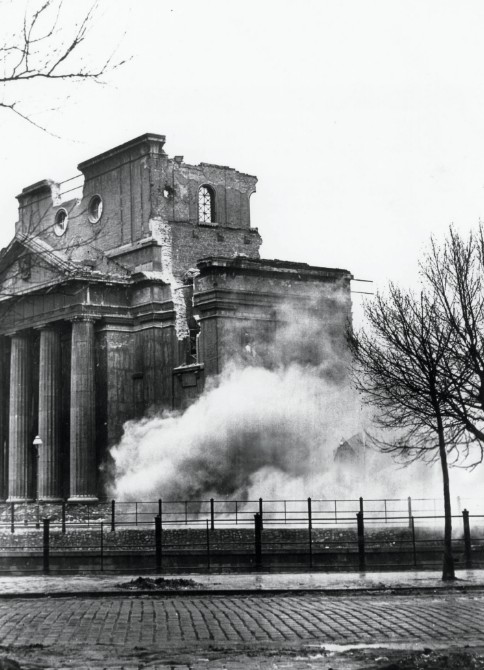
Yakubovich’s starting point is radically simple: “He who reconstructs a synagogue, thus inevitably reconstructs the social and political context of their time of origin – in this case the imperial period. Such a reconstruction today would suggest that nothing has happened in the last hundred years of human history: as if the overcoming of National Socialism, the Holocaust, the reunification and even the demise of the GDR could be reversed architecturally.
Instead of a nostalgic repetition as a historicizing mimicry, Yakubovich pleads for a design that takes the present situation seriously and is built for a living, diverse Jewish community, which is located in a district with a heterogeneous, Muslim-migrant to left-intellectual-bourgeois population – while at the same time not concealing the destroyed building, but visibly enrolling it in the new architecture.
From the municipal synagogue to the open building block
“On the one hand, the building is undoubtedly intended for the local community. On the other hand, it fulfils religious purposes – for example through a synagogue and a mikwe. In addition, the disclosure of the earth’s hills, among which the historical cellar remains are supposed to be an architectural sign of memory,” says Yakubovich.
For his work, Yakubovich spoke with members of the community on the banks of the Fraenkel, determined the concrete space requirements and asked residents for their wishes. At the same time, he followed the historical traces on the property, on which the cellar remains of the original main synagogue are supposed to be buried. From these researches, a concept emerged that combines community synagogue, memorial site and open house for the neighbourhood.
The planned ensemble meets three levels:
- It provides the local community with rooms for worship and religious life – including a new feast synagogue and a mikwe.
- The alleged basement ruins of the pre-war building are not hidden museumly, but marked by an architectural setting: the earth embankments remain legible as a topographical layer of memory.
- At the same time, the building consciously opens up in the district: with library, cafés, flexibly usable concert halls and office rooms, which can also be rented externally.
Thus, no sealed sacral building is to be created, but a city building block that naturally intertwines religious practice, culture and neighbourhood.
A Palimpsest from new building and ruin
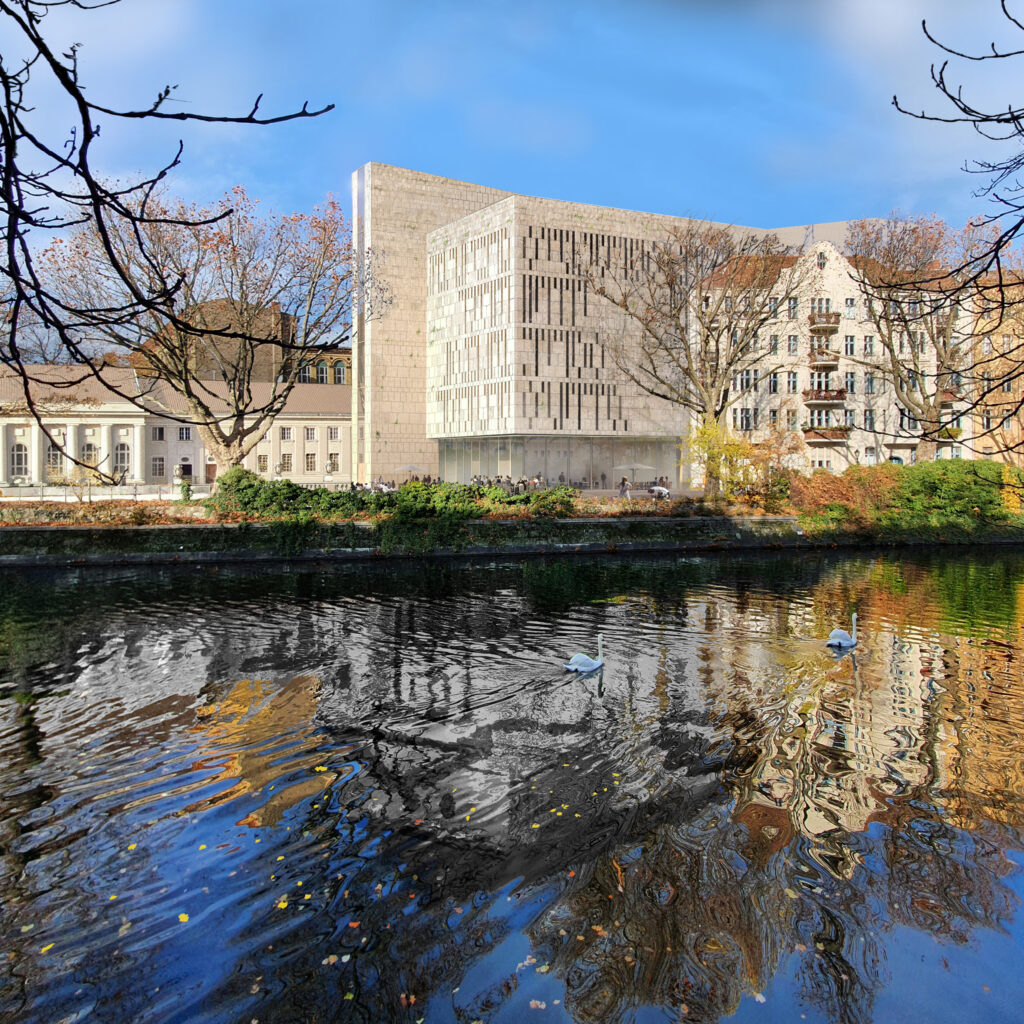
Yakubovich describes his design as “Palimpsest” – that is, as a recycling of old scrolls by overwriting them. The opposite of a smooth new beginning. In concrete terms, he proposes a multi-storey, sand-coloured cube that opens up to the street with a glazed ground floor. Here, event rooms and the library find space; in the upper area, the feast synagogue is planned.
Between this new volume and the preserved side wing of the historical synagogue sits a narrow, high bar with a glazed front. It separates and connects at the same time: it clearly marks the border between old and new – and nevertheless brings both into a tense spatial relationship. The way into the synagogue leads over this intermediate space: stairs and pedestals let the visitors gradually rise to the height before they enter the synagogue over a glass floor looking down on one of the earth’s risings with the presumed remnants of the old basement.
Yakubovich interprets this intermediate building as a kind of “heaven ladder” reminiscent of Jacob’s biblical dream – a spatial metaphor for transition, interruption and the palpable ascent into a new, differently set sacral space.
Jerusalemstein in Berlin
In a conversation Daniel Yakubovich explains that he favored the Jerusalem limestone “Melek”, which was also used on the western wall in Jerusalem, offers an architectural opportunity to initiate a dialogue between different states, societies and religious traditions – especially when combined with local Berlin materials: “The use of Melek stone, which was also used in the construction of the Wailing Wall,” explains Yakubovich, “opens up a special possibility: To initiate an architectural dialogue between states, societies and religions – also through the combination with domestic material.
“Not back to the imperial era” – approval of Kay Zareh
Yakubovich receives support from the Berlin architect Kay Zareh, which is regarded as an important designer of Jewish sacred buildings in Berlin and among other things has restored the synagogue in Rykestraße. Zareh accompanied the master’s thesis in terms of content and emphasized in the discussion that a reconstruction of the original facade on the banks of the Fraenkel would mean one thing above all: the return to a taste dictate shaped by the Kaiserhaus.
The architect of the original synagogue Alexander Beer In the design of the street front, his design could not develop completely freely, but had to be oriented towards the expectations of Emperor Wilhelm II. An exact repetition of this facade today would uncritically repeat these power relations. Instead, Zareh – in line with Yakubovich’s design – pleads for “translating” the pictorial language of a temple building developed in Jerusalem without merely imitating the historical building.
Excluded debate
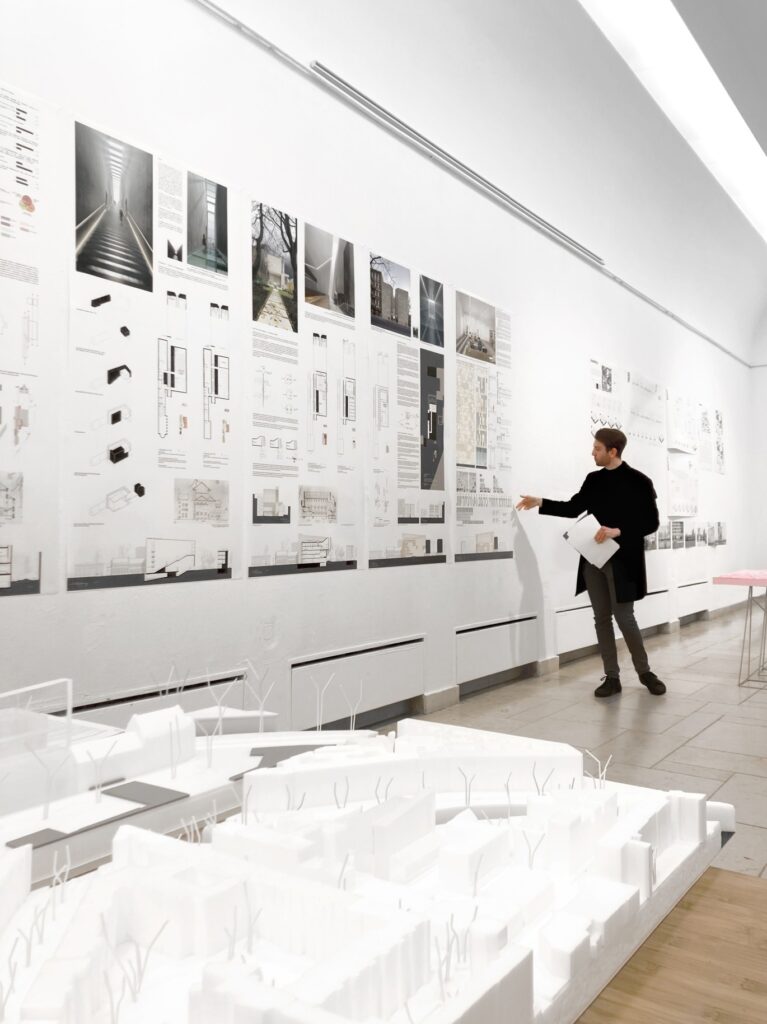
Despite careful research, the clear architectural line and the prominent intercession, the draft has not been officially part of the debate so far: the board of the municipality on the Fraenkelufer initially refused to present the work in a small exhibition. Yakubovich nevertheless hopes to show his plans publicly and to be able to contribute as a constructive contribution to the discussion – precisely because they do not discard the idea of reconstruction as a whole, but question it in its memory-cultural weight.
In essence, he is not only concerned with the external form of a synagogue building to be rebuilt, but also with the Question of what message such a construction sends in today’s Berlin: Is a picture of the prosperous imperial era being reconstructed that blinds the traumatic fractures of the 20th century? Or is there a new architectural form that makes destruction, breakage and new beginning visible side by side – and thus creates space for a Jewish present that is aware of its history without appearing in it?
The radio contribution by RBB Kultur has at least sketched these questions and brought into public the doubts about a faithful reconstruction of the synagogue on the banks of the Fraenkel. However, the actual debate about what Jewish architecture can look like in the 21st century – and who decides with which votes – is still outstanding.
The following statements by Kay Zareh and Daniel Yakubovich are from a conversation in advance of the show, but were not taken into account in the broadcast. They are reproduced here in editorially revised form. Reproduction with the consent of the parties.
Kay Zareh:
“Mr. Yakubovich has approached this task very, very autonomously, very, very confidently and very well and very logically. He first presented several preliminary drafts in order to gain security in the draft, which is right here in this place. After that he then made the investigation to ask in the surrounding area what facilities could be desired and imagined in addition to a prayer room in this area, so that the house is integrated in the neighbourhood and does not only refer implicitly to the Jewish community. Here he developed a space program quite independently; this room program is very extensive, there is even a kindergarten with him, and after that I could only help him if he had questions about the content, which perhaps also continued a little.
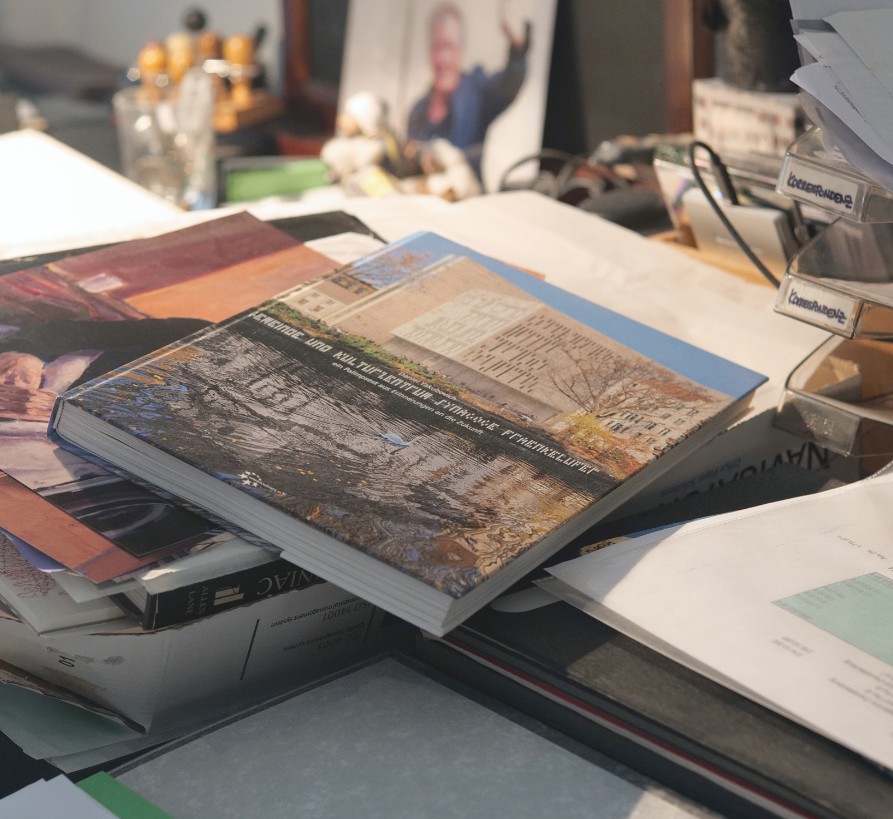
Especially in the area of the synagogue – for example with the idea of Jacob’s leaders – many thoughts arose in dialogue and later were incorporated into the draft. But he referred to the Torah very independently, in every chapter in his book, and then worked on it from this, from which Torah chose the headings, here. I can only say: Every now and then I had small comments, but that was marginal – perhaps even pretentious. I then deliberately withdrew, because what Mr. Yakubovich put forward is thoughtful, precisely formulated and bears all the prerequisites within him in order to create a remarkable synagogue for Berlin. What is very important is the obverse, which had found a classicistic expression by Beer, Alexander Beer at that time, in the sense of Emperor Wilhelm II.“
Sigrid Hoff:
“A temple!“
Kay Zareh:
“Yes, classicistic – because it was in the sense of the Royal House of the Hohenzollern. Alexander Beer is however someone who can and wants to express himself as an architect very much in the style of Mendelsohn, and here he was taken away from this possibility. That’s why the idea was that one does not go back to what an emperor prescribed to you, but rather does something that can be transported from Israel, from the temple in Jerusalem, here to Berlin.“
Daniel Yakubovich:
“Whereas it is not per se a contradiction to refer to Israel in its design – that has been the case for centuries in Germany. What is crucial today is that it means something different to build a synagogue and a Jewish cultural institution today than 100 years ago, and that the construction of synagogues today bears a new meaning: to weigh between what can be preserved from the destroyed and what must be added as a new architectural context.“
Subsequent remark
The RBB broadcast ‘Shalom’ On 9 September 2022, an unusual topic was addressed: the critical examination of the actually positive news about the reconstruction efforts of a Jewish church – from the point of view of a young architect whose master’s thesis formulates an independent counter-project. It is highly imputable to the editorial staff that it has given room to this impulse and thus illuminated a project that has so far been hardly debated publicly from new perspectives. At the centre of the programme are several voices: a precise, in itself argumentative position by Daniel Yakubovich; editorial frames by Sigrid Hoff; affirming comments by architect Kay Zareh. What is transported in terms of content – the criticism of the historical reconstruction of an imperially charged building, the search for a Jewish spatial form in the 21st century – is significant and clear. However, the way in which the contribution is framed, cut and presented leaves questions open.
For example, the political dimension of the reconstruction project, which is largely supported by non-Jewish actors and politically instrumentalized in its memory content, remains uncommented. The fact that Yakubovich’s draft was initially rejected by the community is mentioned, but not questioned. Nor does the program address why a Jewish counter-model remains excluded from the centre of the debate – although it opens up exactly that architectural conversation that was missing until then.
Instead, Yakubovich is framed – quite benevolent but classically – as a “Jewish architectural graduate”, as a “young designer”, as a representative of a subjective counterposition. Ethno-religious labelling for authoritative framing of professional statements was elected in the anmoderation without prior vote and played no role during the conversation. Religious or ethnic labels are used here for the authoritative framing of professional statements and reproduce a shortened identity thinkingNot only Jewish voices can speak about synagogues – no more than any Jewish voice automatically speaks for “Judaism.”
With the second programme, an important, albeit cautious, step towards a overdue debate was initiated. It opens up subject areas but does not enter them. It lets speak without asking. What is missing here is not consent, but confrontation – not in the sense of a media dispute, but in the sense of a journalistic responsibilityThis attribution refers to a more profound pattern of public perception: the idea that Jewish architecture can only be “authentically” designed by Jews themselves – or vice versa, that Jews have to assume a religious-cultural speaking position. Such attribution mechanisms reproduce a shortened identitarian fixation, which already in the 19th century with the construction of a “Jewish architectural style==References==
Thus a supposedly authenticating property, namely: the “Jewishness” to the fig leafThis threatens to devalue the core points of the critique of the design work in its effectiveness. The impression arises that the expertise derives from a biographical origin and not from research, design, theory or contextual understanding. For a left-wing media environment, which reports largely recritically about BLM protests, this may not be surprising.
So the problem is not the thematicization of a Jewish coinage itself, but its selective and asymmetric attribution. It is emphasized where it is supposed to produce supposed authenticity. However, where Jewish perspectives would be structurally necessary – for example in academic and political decision-making and design processes – they are spared except for a few representatives. The crucial question is therefore not who “is Jewish enough to be able to express oneself, but whether a debate is possible that actually confronts the historical responsibility, the present complexity and the plural future of Jewish culture in the German-speaking world. Such a debate does not require symbolic representation, but real participation.


See also: