
If synagogues of the Middle Ages, the Renaissance or the Baroque period were occasionally considered in research, they found, according to the art historian Harold Hammer-Schenk in the 19th century art and architecture historical reflection as the main period of origin of Germany’s largest and most magnificent synagogues, rarely or not at all, because research interest in the 19th century only began in the late thirties.1when it was politically not necessary to deal with Jewish cult and cultural buildings,2 Most of them had already been removed from the image of the German cities after the war.3
However, the fact that the years between 1850 and 1918 can be regarded as the main period of development of most synagogues in Germany – and especially in Berlin – is not least due to the social rise of the Jewish population: the exit from a state of social declassification and the simultaneous entry into bourgeois society, which was accompanied by an increasing differentiation of religious currents in the course of Jewish emancipation.
The attempt to take stock of the lost seems to be loud Hammer Shenk This is hardly possible, since many buildings only pass through in the form of external views and their interior spaces are therefore no longer reconstructable. Even if interior photographs exist, they at most convey an approximate impression of space that does not provide a sufficient basis for an Reconstruction is based on scientific standards – if such a one is at all meaningful or politically opportune.4 Those buildings, which already stood for social acceptance at the time of their creation, appear even more inaccessible today, because of lack of documentary basis – and therefore all the more unapproachable. This underlines the special position of the Jewish communities within building history, as the Zeitschrift für Praktische Baukunst (Magazine for Practical Architecture) (Sp. 303) on the synagogue in Oranienburger Straße stated in 1865, at which “of mysterious, strange solemnity of effect […] little relative […] could be compared [can]“.
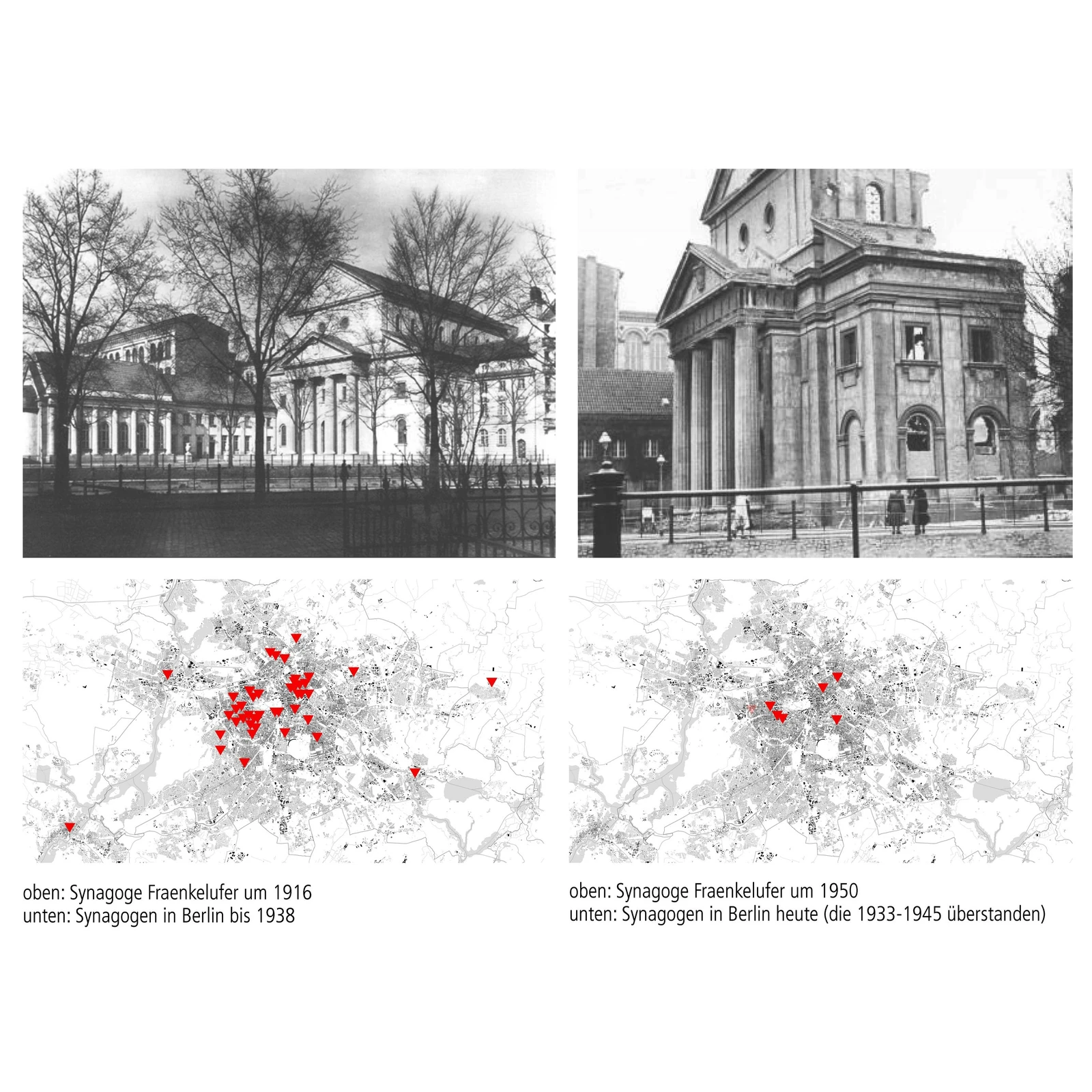
Ruins of the Fraenkelufer Synagogue around 1950. © ullstein picture , ullstein picture.
Graph/Chart: Synagogues before 1930, which were preserved and still serve as such (as of 2022). © Daniel Yakubovich.
Only a few of the large Berlin municipal synagogues that were built before National Socialism are still preserved today: among them the front house of the synagogue in Oranienburger Straße, the synagogues in Pestalozzi and Fasanenstraße, as well as those in Rykestrasse, which with significant participation of the architect Kay Zareh (1943–2025) in over one and a half decades was laboriously renovated, restored and reconstructed – and today is considered the largest synagogue in Germany.
In addition, there is still a part of the former synagogue on the former Kottbusser bank: There the architect and municipality builder left Alexander Beer during the First World War, build Berlin’s largest Orthodox community synagogue – with about 2,000 squares – on a pointed plot.5 After the demolition in 1958, a small outbuilding was preserved, originally used as a youth and weekday synagogue, which, after a reconstruction, became today’s “Synagogue Fraenkelufer” with only 188 seats.6 as the smallest, but full-fledged community synagogue in Berlin. Historical photographs convey the impression of a monumental Greek-Roman temple or a basilica with anticizing Portico – an external effect that could be interpreted as an architectural expression of the community’s emancipation efforts, although its Orthodox members often spoke out against any approach to Christianity. Thus, in the 19th century, a peculiar double movement arises: the national self-image oscillates between the apprehension of Greek classicalism and the desire for exotized ‘orientality’ – synagogue architecture is also drawn into these contradictory projections. Philhellenism of the 19th century, Greek antiquity changed to the spiritual original landscape of one’s own nation.
National Socialism should later radicalize these philhellminism tendencies by explicitly claiming Greece — but also Rome and thus “the ancient world” — as the creations of an Aryan race. Himmler’s “agenic heritage” was to prove with pseudo-scientific means that all important high cultures, including classical antiquity, stem from a Nordic-Aryan origin. In this logic, Greek temple architecture no longer appears as a foreign, admirable high culture, but rather as a supposedly own heritage: antiquity is retroactively integrated into a racist genealogy in which the ‘Aryan’ is elevated to a universal cultural founder.
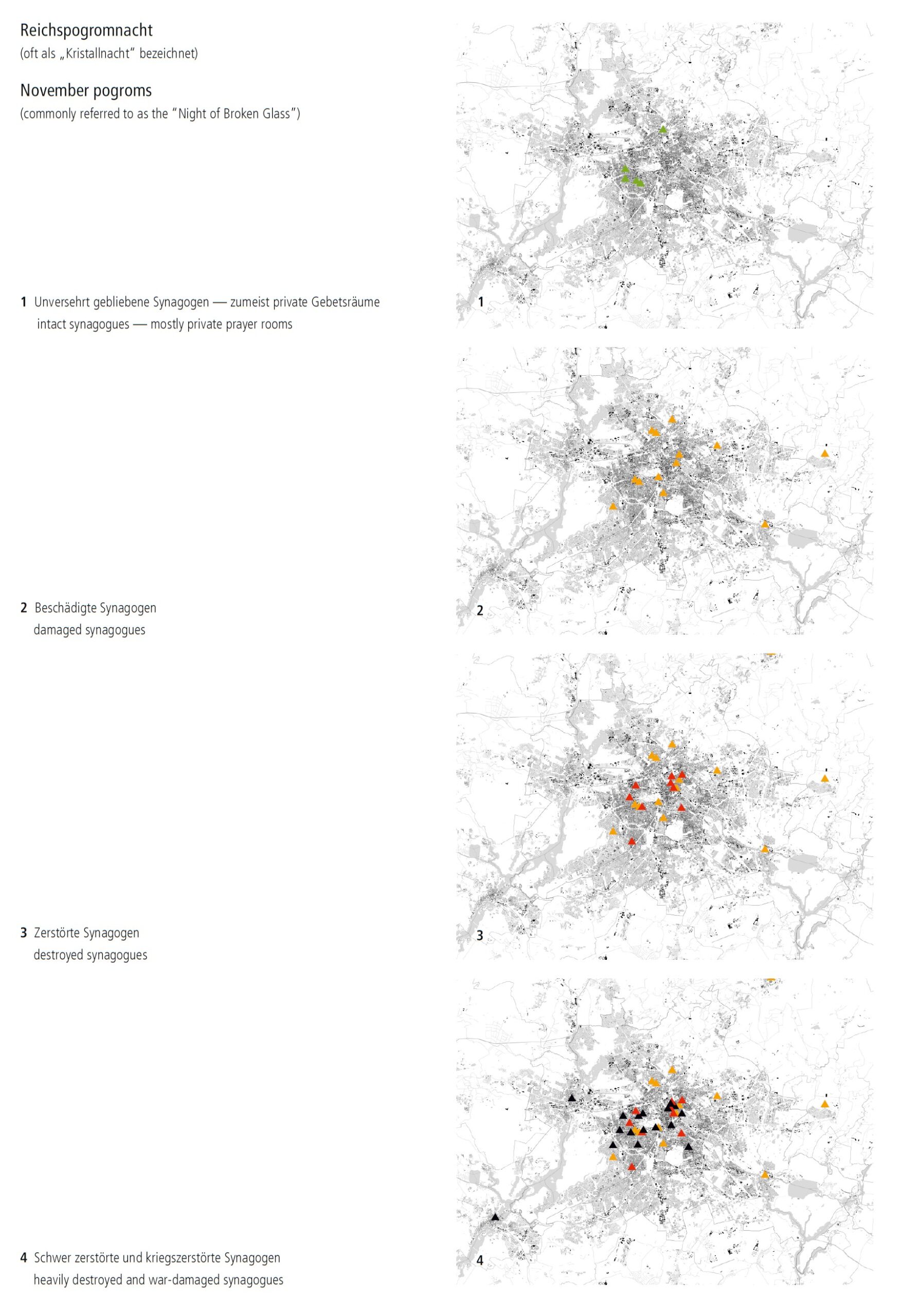
© Daniel Yakubovich.
Mosque outside, organ inside — Stilambivalenz als Ausrichtungsdebatte
The synagogue in Oranienburger Straße, built between 1859 and 1866, can be seen as a counterpart to the synagogue on the banks of today’s Fraenkel. Byzantine-Mauretan style by Eduard Garlic and Friedrich August Stüler and thus formed the stylistic contrast program to the Christian-basilical appearance on the banks of the Fraenkel. In the then Prussia, the choice of style in favour of such oriental phantasms Exotic This form vocabulary, however, was at the same time part of the very normal historicism in which neo-Gothic, neo-Renaissance, neo-Romanism and many other styles were used. Against the background of numerous excavations and the import of objects that inspired European imagination and contributed to the “exotic mode”, it is therefore entirely legitimate to consider this as a background film for the “orientalizing” synagogue construction. Orientalism, Exoticism and the Egyptomania Napoleon’s Egypt campaign (1798) and the multi-volume works such as “Description de l-Egypte” (from 1809 onwards), which brought images and data to Europe like a huge catalogue, were strongly fueled. A synagogue in Moorish-Byzantinizing style may have seemed strange and fashionable in Berlin’s cityscape at the same time.
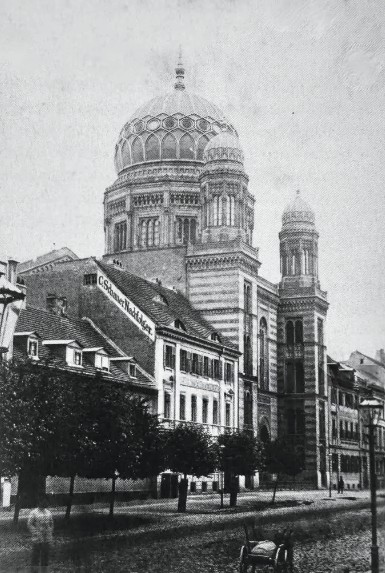
Author unknown, public domain.
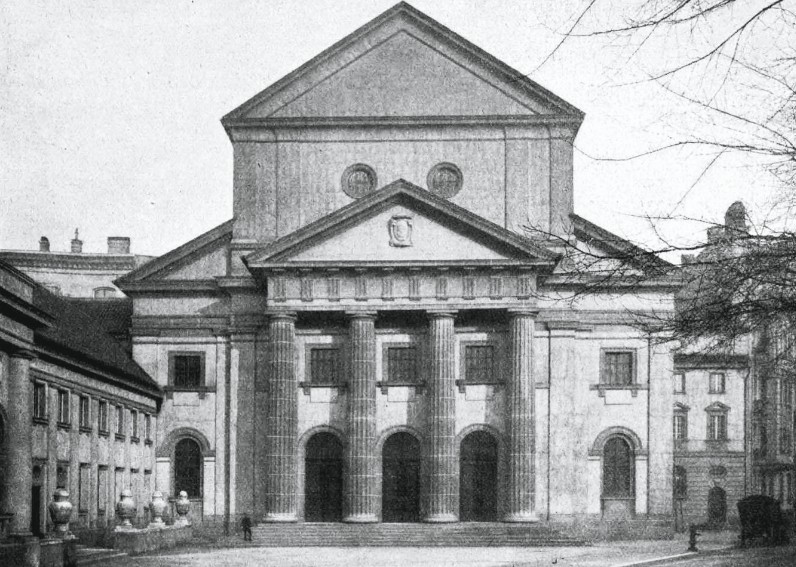
Author unknown, public domain.
For the Jewish community itself, the appearance of its new synagogue may have also been an expression of a sense of tradition – and was often associated with the geographical origin, not least in the form of the time-consuming Alhambra comparison7The choice of the architectural style, however, was not merely an aesthetic confession or a reminiscence to a distant region of origin, but rather an expression of a complex negotiation process between visibility and belonging. At a time when the pursuit of bourgeois equality in the public sphere had long since not been accompanied by social acceptance, architecture was at the same time a medium of representation as well as means of discrete demarcation. Synagogue construction thus became the stage of a double code: on the one hand, it was intended to signal affiliation to an enlightened and artistic nation, on the other hand, to transfer spiritual difference into a formally readable, yet controllable ornament. That this balancing act often became the semantic levit between “Moshee” and “Basilika” was less a coincidence than a symbolic political necessity – because neither complete adaptation nor demonstrative isolation could be carried out within an urban space without ambivalence.
On the inside, however, the synagogue in Oranienburger Straße was functional and clearly tailored to the needs of a liberal community – not least because it had an organ that is otherwise only known from Christian churches.8
The plots and thus the conditions for planning a synagogue were also similarly complex in both cases, because they were embedded in the Berlin block edge and created a reset main prayer room, which in turn required street or bank side protrusions or secondary buildings as architectural attractors in the urban outer space.9
The synagogue in Oranienburger Straße was the first large synagogue building to serve a liberal community, despite its orientalizing appearance, and marked the beginning of the period in which Jewish religious construction could develop as an expression of a new self-image – while the synagogue on today’s Fraenkelufer, which in turn served an Orthodox community despite its basilica façade effect, may be considered one of the last great buildings of this kind: the final chord of an era that, together with God, Emperor and Fatherland, fell into the trenches of World War I and disappeared into the poisonous gas clouds of history.
Already in the choice of architectural style, a contradiction is revealed that touches the essence of Jewish diaspora existence: on the one hand, the need for the visualisation of historical and geographical roots required an orientation to oriental-looking forms – especially in the stylistic 19th century.10 On the other hand, in the course of emancipation, the buildings should mimic as inconspicuously as possible, i.e. rise in their surroundings and thus often resemble churches externally. A clear typology of form history could hardly develop under such conditions, since every form was always renegotiated in the field of tension of historical circumstances. Hammer Shenk In 1927, German-American art historian Richard Krautheimer stated in his work on the construction of medieval synagogues that the history of Jewish religious building was not a linear process of development, but rather a problem of form history – an irregular “jumping from island to island”.11
On the other hand, choosing a style did not mean identification with the mental or ideological content of the model, but served as a general characterization of the building as being in any way related to the Orient.12 That’s why loud Hammer Shenk Synagogues as cult buildings of a minority point out the dependencies and social circumstances of their context of creation. At the same time, this special position also opens up greater creative freedoms and architectural playrooms. Every Jewish new building has – and always becomes – become something special. Only with the inclusion of all social factors of the respective context of origin can the extent and manifestation of that emancipation – or even the latent or manifest anti-Semitism – be measured to which the individual communities were exposed.
The Jewish religious building was thus never merely a space of devotion, but always an architecturally formulated contribution to the question of belonging and tolerance – a built commentary on the position of Judaism in the respective community. In its outer appearance there was often a hope articulated, but an insistence within it; and while one aimed at recognition, the other deliberately refused to adapt. This is precisely the real drama of synagogue architecture: that, unlike churches, it never fed itself out of a dominant consensus, but always under the reservation of others, under conditions which it could not set itself. Their walls had to be fixed because their existence was fragile.
Dominance and Devotion
The first synagogues in Berlin were betstubes of individual merchants in the late 17th century – mostly on the basis of personal permits and thus economically motivated tolerances by the Elector, to whom the loyalty and tax power of Jewish subjects was not unwelcome in wartime and peacetime.13 In the 18th century, however, the Jewish sacral space was limited to purely private places of prayer, and the idea of an equal Jewish bourgeoisie was still a distant play of thought in the Enlightenment, which appeared neither socially capable of majority nor politically opportune.14 Only with the establishment of a more profound reform will following the French Revolution, which was ideally prepared by the Jewish Haskala, a movement began in individual German territories that gradually led to the erosion of special legal regulations and initial approaches to bourgeois equality – for example in the Prussian Edict of 1812, which granted Jews the right of citizenship, but still excluded them from the state service, free residence elections or university careers and thus marked a formal emancipation on revocation. The revolutionary events of 1848, especially the short-term upsurge of liberal constitutional promises, led to a temporary opening, but it was only the constitution of the newly founded German Empire that guaranteed a formal equality of civil rights independent of religion in 1871, without, of course, completely eliminating the factual discriminations.
So the first half of the 19th century was marked by the inner Jewish struggle between liberal reform tendencies and orthodox perseverance – a struggle that permeated and shaped the entire emancipation movement, and which articulated itself both in the liturgical and structural expression of Jewish presence. Parallel to this was the massive immigration of Jewish families from Eastern Europe, whose causes lay in increasing pressure within the tsarist order – such as in the so-called May Laws under Alexander III.15This led, in particular in the petty-bourgeois impoverished Schtetl structures of the periphery, to a lack of hope which drove many young men and entire families to the West, hoping to escape the climate of pogroms as well as political stagnation. Berlin, through its transport-technical connection, its intellectual magnetic power and its economic mood of departure, became a preferred destination for many of these arrivals to the intermediate station or the new focal point – especially since linguistic proximity beyond the Yiddish facilitated the transition.
After 1850, the construction of new community synagogues became more and more urgent because the number of Jewish inhabitants in Berlin doubled to almost 4 percent in just two decades to about 1860 – a demographic dynamic that not only generated new liturgical needs, but also broke out in architectural terms, for example in the form of the representative new building on Oranienburger Straße, which can be understood less as an answer to a single current, because as a structural commitment to a new visibility in the city space and to a strengthened self-image as a bourgeois-religious force within urban society. Initially, this growth was tried to compensate for by expanding and rebuilding old synagogues, until the inauguration of a monumental central building heralded an architectural paradigm shift, which not only responded to the increased number of members, but also to the desire for representation, cultural participation and symbolic equality in a society that had long been unwilling to translate the promise of the Constitution into lived normality.
Stumbling stone and lattice
As Marx rightly noted in his further development of Hegel, history always repeats itself as tragedy at first, then as farce. In this sense, the present situation is strikingly reminiscent of that of the mid-19th century: since 1995 and a large number of Jewish contingent refugees from the former Soviet Union, immigration from the USA, Hungary, Israel, Latin America, and recently the flight of Jews from Ukraine into popular districts such as Kreuzberg, the community has become much more rejuvenated and enlarged.16 The smallest synagogue in Berlin, not far from Kottbusser Tor, is often the only contact point for people who – in the widest sense – associate themselves with Jewish culture and religion and find a shelter there. More and more frequently the place is not enough: For community celebrations the kitchen in the apartment of the caretaker in the attic is used alienated – provided that its strict spouse tolerates this. The parishioners then stand partly as at the “supermarket fund” in front of the classroom-sized Kiddush room in the snow, accompanied by Klezmer music, they have to celebrate and drink outside in the dark in the winter weather – and give their Hanukkah polonaise for the best.17 For exhibitions, external spaces are often searched for and rented for a long time – although they do not satisfy the demands of a Jewish shelter and the intended exchange between religion, culture and society. There is no room for a library, books are stored in a damp cellar. Workshops take place urgently in the prayer room. At the same time, the spatial capacities are lacking – which leads to unstructured processes and often conflicts between representatives of different currents. The social and demographic situation of today is strikingly reminiscent of those of then – shortly before the decision for a comprehensive Jewish cult and cultural new building became inevitable.18
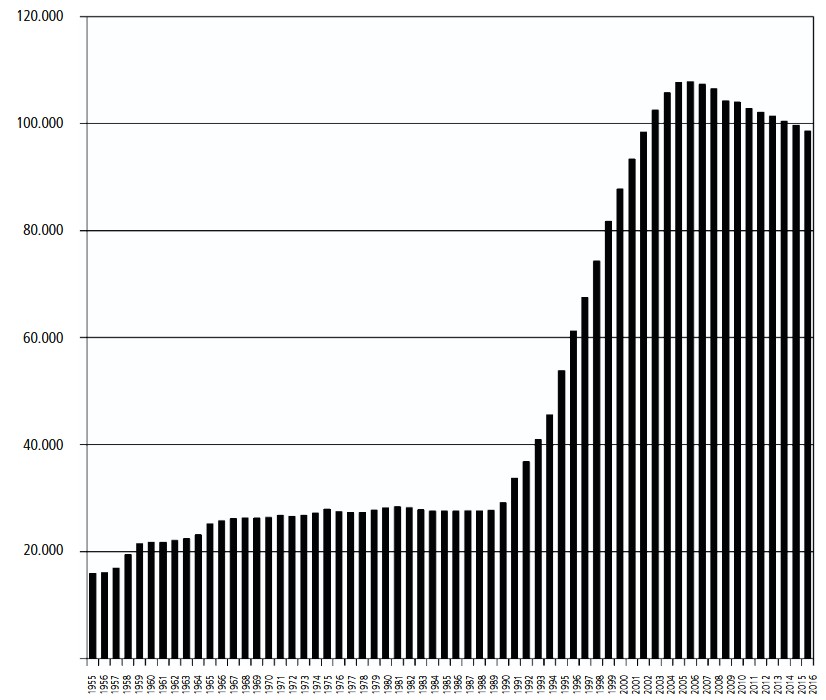
Source: Forschungsgruppe Weltanschauungen in Deutschland (fowid), based on data from the Central Welfare Office of Jews in Germany (ZWST) and the Central Council of Jews in Germany.
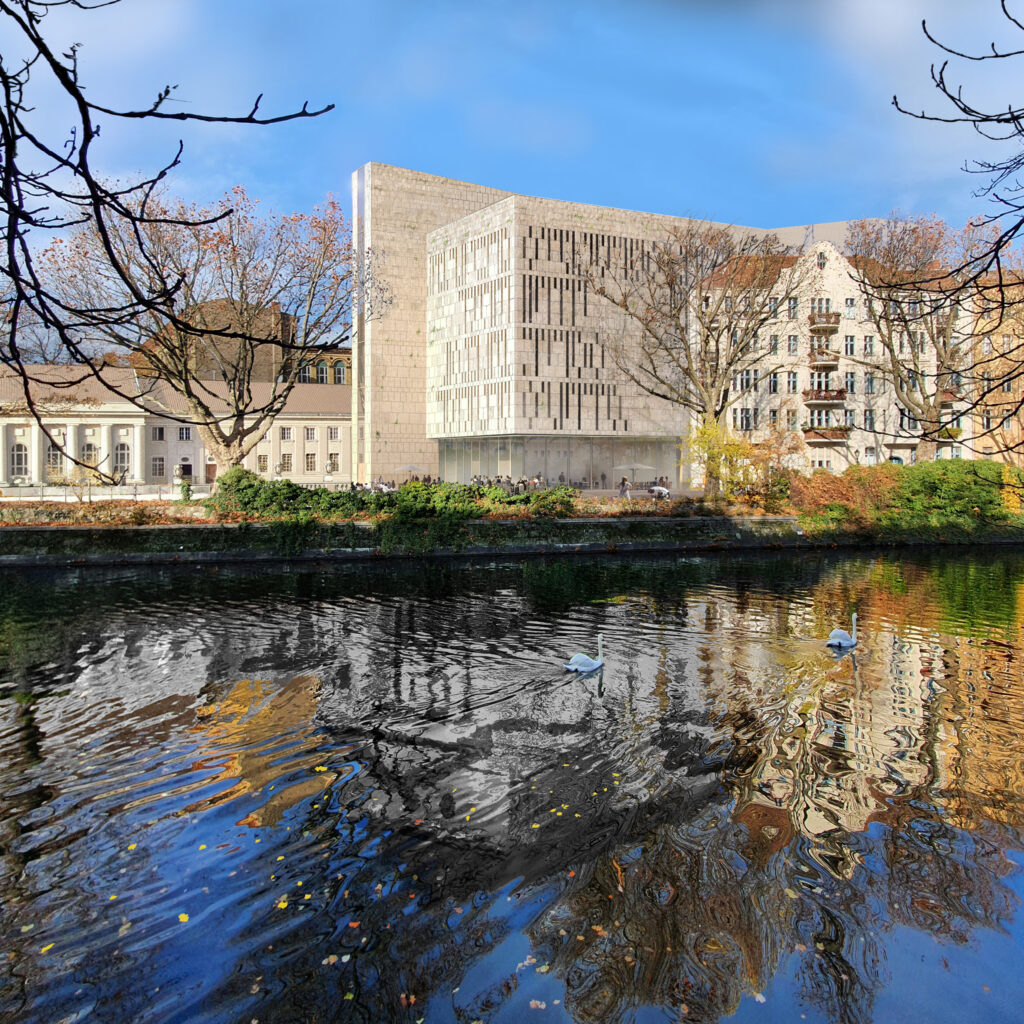
The representatives of the municipality of Fraenkelufer and the board of the construction initiative for a new and expansion building – to which I have worked hard for many months and also met myself personally – turned to politics in view of the increasingly scarce area and the strong growth some years ago and pushed the SPD Group chairman Raed Saleh, a Berliner with Palestinian roots, – God bless, can be said – on unexpected counter-interest. After several talks with the community, Raed Saleh finally in the summer of 2017 itself with a proposal to approach them – The whole old synagogue should be restored immediately.
Just as in the late 19th century the massive immigration of Jewish families from the East fundamentally shifted the religious and social fabric of German communities, so post-Soviet immigration, after the collapse of the Iron Curtain, brought a new orthodoxy into Berlin’s often liberally coloured Judaism. Many of those who came knew little about religious life – and yet, often unconsciously, they carried with them remnants of a sense of tradition that had been traded in the GDR or the late Soviet Union rather by family gestures than by theological education. Thus there arose a tension that continues to this day in liturgical formal questions, in questions of gender segregation or simply in the wearing of head coverings – and which unmasks the seemingly so uniform “Jewish life in Germany” than what it is: plural, fragmentary, sometimes contradictory.
This plurality, however, is threatened today. Not from the inside, but from the outside: through a society that promises security and provides bars, which promotes places of remembrance and saves at the same time on living people, which stumbling blocks are laid and yet looks away when someone is being insulted on the bus today because of his name. Jewish life in Germany, as much as it likes to be summoned, is not a gift, but a daily negotiation process – between visibility and need for protection, between state-proclaimed participation and real exclusion.
Especially in times of increasing anti-Semitism, from attacks such as in Halle 2019, in Pittsburgh 2018, in Paris to a kosher store in 2015, accumulating reports about the word “Jude” as a common insult to German schoolyards and Kippa carriers are beaten on open street with the belt buckle, the re-establishment of a synagogue would be an undeniable sign and a doubtless courageous decision. Moreover: near the Kottbusser Tor – that social focal point where churches of other faiths were expected to be more popular in terms of geography.
The fact that Jewish communities today need security services, shelters and entrance locks in the midst of a city that is so open to the world, says more about the state of society than about the state of Jews. The fact that since 2015 a considerable number of people from countries of origin with state-established Israel-enemy and deeply internal anti-Semitic propaganda came into the country – often without accompanying educational measures – has undoubtedly strengthened a dynamic which was already virulent before, but now creates a new socio-cultural coordinate system. Anyone who talks about the reconstruction of synagogues in 2025 should not only deal with stone fragments of the 19th century, but also with the question of whether a democratic society that claims to protect minority rights endures those conflicts that it has imported itself through a historically blind migration policy. Anti-Semitism is no turre that grows on its own – but one that can also benefit if one does not examine its soil.
The threat situation for Jewish life in Germany is not only from the right margin, but also increasingly from those milieus that the political enterprise likes to subsume under the formula “necessary of integration”. Police reports about anti-Semitic incidents at schoolyards, mosques and train stations speak a language that is clearer than many Sunday speeches – but hardly anyone wants to hear them. Instead of a clear name, the discursive enclosure dominates, the labeled enclosure into the “difficult topic”, which is pushed with preference from the light of the debate into the shadow zones of moral complexity. Linguistic restraint is no longer just a question of style, but an instrument of power: not for deescalation, but for concealment. Anyone who dares to call anti-Semitism solely when it comes to jumping boots, but not when it occurs in the Kaftan or Palestine flag, does not make himself responsible for its social relativity, but not for hatred itself.
Perhaps it is precisely the architecture that at such moments can do more than any argument: as a lasting form against oblivion, as a space that does not remain silent but stands. Not to cover up the conflict, but to make visible what has long been hidden in language. A task that is provocative at first glance – but which appeals to it in particular.


See also:

- “Zur ‘Entdeckung’ der historischen Synagogen im ersten Drittel des 20. Jahrhunderts: architekturgeschichtlich-volkskundliche Forschung und ihre Resonanz im Synagogenbau” [On the “discovery” of historic synagogues in the first third of the twentieth century: architectural-historical and ethnographic research and its reception in synagogue architecture]. In: Birgit Johler and Barbara Staudinger (eds.), Ist das jüdisch? Jüdische Volkskunde im Kontext, Vienna 2010, pp. 597–622 (= Österreichische Zeitschrift für Volkskunde 113 (2010), pp. 597–622). ↩︎
- “Synagogen im 19. und 20. Jahrhundert. Bauwerke einer Minderheit im Spannungsfeld widerstreitender Wahrnehmungen und Deutungen” [Synagogues in the nineteenth and twentieth centuries: buildings of a minority amid conflicting perceptions and interpretations]. In: Gideon Botsch et al. (eds.), Islamophobie und Antisemitismus – ein umstrittener Vergleich, Berlin, Potsdam 2012, pp. 201–226. ↩︎
- See Historical Introduction to: Synagogues in Berlin. Part 1, p. 22 et seq. ↩︎
- See Vera Bendt, Stefi Jersch-Wenzel, Thomas Jersch, Nicola Galliner and others: Signposts through Jewish Berlin. History and Present, Berlin: Nicolai, 1987, especially the numerous interior photographs of synagogues and private prayer rooms for visualizing Jewish living space in the city. ↩︎
- Inge Lammel: Alexander Beer. Architect of the Jewish Community in Berlin. Jewish Miniatures, Hentrich & Hentrich, Berlin 2006. ISBN 3-938485-20-5. First independent biography on the life and work of Alexander Beer ↩︎
- According to the available seating plans, which Kay Zareh kindly made available for this study, together with his conversion plans for a Kiddush room on the first floor of the Fraenkelufer Synagogue and many books from his library. ↩︎
- Zeitschrift für Praktische Bauwesen, 1865, col. 5 (Knoblauch’s son on the new synagogue built by his father). ↩︎
- Architecture and musical-liturgical practice: organ synagogues between Classicism and Early Modernism. In: Pardes. Zeitschrift der Vereinigung für Jüdische Studien 20 (2014), pp. 13‐32 (with Katrin Keßler and Mirko Przystavik). ↩︎
- See Historical Introduction to: Synagogues in Berlin Part 1, p. 56 ↩︎
- See Synagogen in Berlin, Part 1, pp. 130–131: the reproduced design drawings for Fasanenstraße from 1907 show a clearly articulated three-aisled basilica with a minaret-like tower, already annotated by the building authorities with “ändert sich!” (“to be changed!”). In this unrealised design, the minaret-like element, together with three domes crowned by pine-cone finials, would have given the synagogue a distinctly Middle Eastern character. ↩︎
- The architecture of the synagogue. For reconstruction of an (almost) lost architecture. Schwarz, Hans-Peter (1988), The architecture of the synagogue, German Architecture Museum, Frankfurt ↩︎
- On the Moorish style of synagogues see Hannelore Künzl (1984), The reception of Islamic architectural forms in synagogue construction of the 19th and early 20th centuries, Peter Lang GmbH — Harold Hammer-Schenk (1981), Synagogues in Germany, Hans Christians Verlag, Hamburg ↩︎
- See outline of this period, Jewish Lexicon, Volume 1, Column 870 – 877 ↩︎
- See Historical Introduction to: Synagogues in Berlin. Part 1 ↩︎
- The term “zaristic” refers here to the political order of the Russian Empire in the 19th century under the Romanov rulers. Although the title “Zar” after Peter the Great was formally replaced by “Imperator”, it remained common in general language usage – not least in German-speaking countries – until well into the 20th century as a designation. ↩︎
- Alexandra Klei (1 March 2020): “Ringen um Sichtbarkeit. Ein Verein setzt sich für ihren vollständigen Wiederaufbau ein: die Synagoge Fraenkelufer in Berlin-Kreuzberg.” Jüdische Allgemeine. ↩︎
- Sebastian Leber (11 November 2018): “Wiederaufbau der Synagoge in Berlin-Kreuzberg. Das Lebenszeichen vom Fraenkelufer.” Der Tagesspiegel. ↩︎
- Freunde der Synagoge Fraenkelufer e.V. (eds.): 100 Jahre Synagoge am Fraenkelufer: Ein Jahrhundert jüdisches Leben in Kreuzberg 1916–2016 [100 years of the Fraenkelufer Synagogue: a century of Jewish life in Kreuzberg, 1916–2016]. Exhibition catalogue, Berlin 2016. ↩︎