Stefan May in conversation with Daniel Yakubovich and Kay Zareh about city, memory and the counter-design for a silent reconstruction
Source: Deutschlandfunk Kultur, broadcast “Aus der jüdische Welt” (From the Jewish World), 16 December 2022. Editing and contribution: Stefan May. Discussion with Daniel Yakubovich and Kay Zareh about the planned reconstruction of the synagogue on the banks of Fraenkel in Berlin-Kreuzberg.
to the contribution on the website of Deutschlandfunk Kultur following link:

Note on the text shape
The following article is based on a conversation broadcast on the radio. No literal transcript of the broadcast, but an independent account of its content by the author. This text is not a publication of RBB Kultur; editorial responsibility rests with this website.
For copyright reasons, the statements of the parties are mainly paraphrased and in indirect speech sequence, selection and formulations follow the content structure of the conversation, not the technical editing of the original broadcast.
A small place with a great history
Just a few minutes’ walk from Kottbusser Tor you will find the Fraenkelufer: cobblestones, canal banks, bridges and dense traffic, a Kreuzberg cityscape between everyday life and postcard motifs. Here, almost hidden between residential buildings, the synagogues on the Fraenkelufer – today the smallest of Berlin’s synagogues – stand.
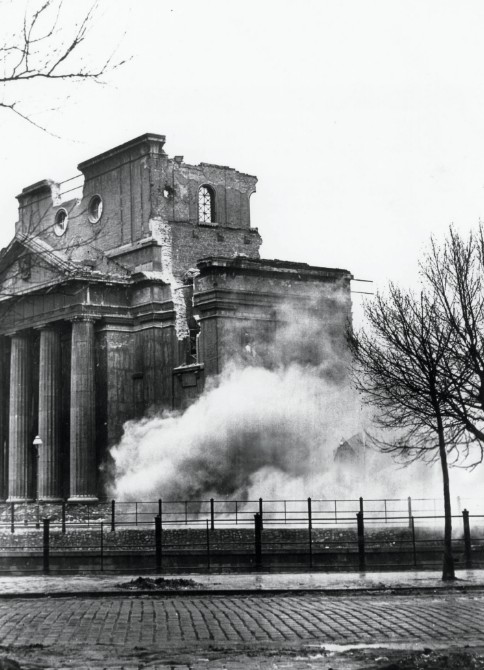
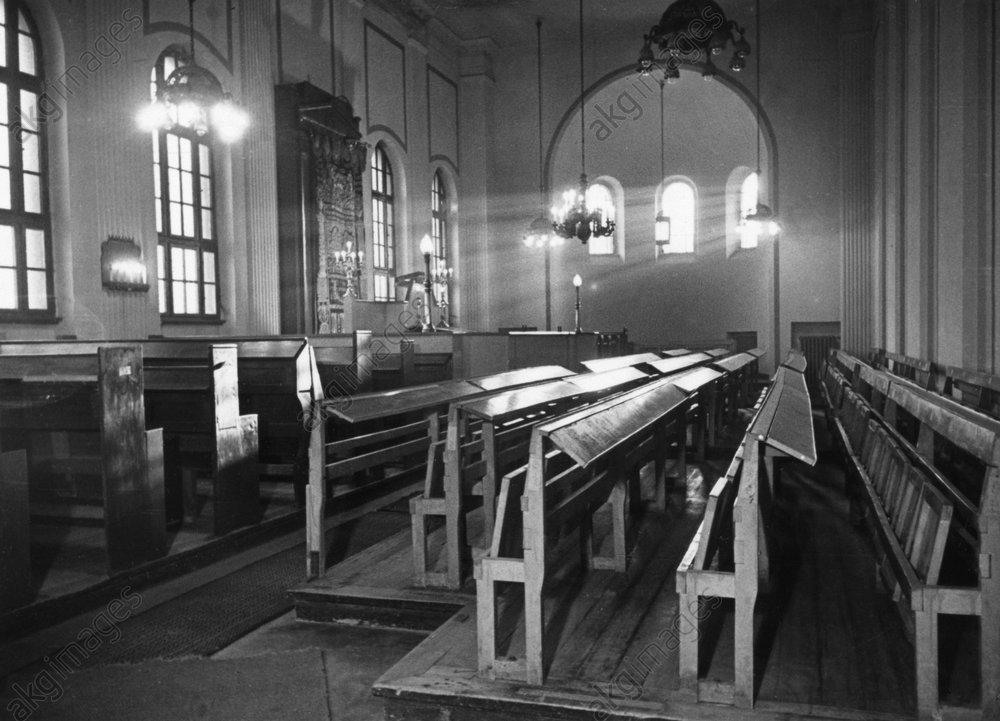
The original building was built between 1913 and 1916 by the architect Alexander Beer Historical photographs show a massive, temple-like building with powerful columns on the front of the street. “The synagogue at that time was built in a classicist style – which was used, among other things, as a reference to the Schinkel time The building, which was built during the First World War, reflected a period in which local patriotic feelings were not uncommon even within the Jewish community – and architecturally fired, as Daniel Yakubovich historically contextualized the construction.
During the November pogrom in 1938, the synagogue was set on fire and the ruins were largely destroyed in the 1950s. Only the side wing with the former youth and weekday Synagogue, which is still used by a growing community as a Bethau, was preserved. The approximately 188 seats are no longer sufficient – the desire for a larger building is real.
Reconstruction as “good news” – and as a problem
The starting point of the radio contribution is the seemingly positive news: “The synagogue is to be rebuilt.” Politically, the idea of a reconstruction of the historic synagogue by the Berlin SPD Group Chairman is strongly promoted. Raed Saleh, which is publicly committed to the reconstruction as true as possible.
Daniel Yakubovich’s criticism is directed against this form of reconstruction. He describes his discomfort as follows: “I was very frustrated and shocked by the fact that there is no reflection in public space on the issues associated with a reconstruction of synagogues, because it inevitably, whether you like it or not, restores the tragic events of the imperial pogrom night and thereby makes the many destructions and the extent of the suffering of the time partially unresolved.
Reconstruction here does not appear as neutral restoration, but as architectural defusing of a history of violence: what was burned, destroyed, removed would return externally in the form of an imperial temple building – and thus aesthetically satisfied.
“We must no longer feel committed to the imperial era in 2022
Yakubovich receives support for this criticism from Kay ZarehZareh recalls that, at the time of the original synagogue, the last constructional decision was literally with the emperor: “A W II” on the plans marked the approval of Emperor Wilhelm II, who had accompanied and built numerous Jewish sacred buildings in Berlin for decades.
Today, according to Zareh, “But that is now over. The Hohenzollerns are no longer and we can quietly resort to something that we ourselves can best or find best or think most useful. We as a Jewish community in 2022 must no longer feel obliged to the Hohenzollerns.”
In this way, he opposes the attempt to Imperially charged image without in-depth discussion, write back to the city – and plead that Jewish communities today take their own forms instead of imitating historical power gestures.
Rubbles, cellar remains and the danger of overbuilding the original
In the course of his research for the master’s thesis, Daniel Yakubovich has documented rubble on the property and earth masses that are supposedly based on the cellars of the original synagogue. Remains of Beer’s construction no longer form visible walls, but as a topographic trace may be present to this day.
According to Yakubovich, the planned reconstruction is less history-sensitive because the site could damage or finally destroy the possible original fragments and “…which leads to the fact that with the reconstruction and superstructure of the historical substance by a copy of the original the original is even more likely to be destroyed — a paradoxical situation which must be prevented. “
The reconstruction project is thus in a double slant: on the one hand, it claims to “save” the destroyed building, on the other hand, it threatens to overform or finally destroy the last material traces of that building.
“Mantle of Silence” – Criticism of Intransparenz
The radio article reports that requests from Deutschlandfunk Kultur to key decision-makers remained unanswered: neither the political mentor of the project, Raed Saleh, nor the chairman of the Jewish Community of Berlin, saw themselves ready for an interview.
This experience of non-response reflects what Yakubovich knows from the planning process: “I would like to say that it is amazing how many deaf ears you sometimes encounter when you try to address such obvious problems and questions, because you sometimes feel that a cover of silence would be laid over the entire planning, construction and procurement process. Much seems intransparent – as if essential decisions were made in the background without public feedback.
The show echoes the fact that not only an architectural question, but also a Procedures, participation and the public But it is not a question of whether this conflict should be further clarified.
Voices from the community – need, but not a clear preference
Many people do not express themselves in front of the microphone, a young mother emphasizes above all the desire for more space and for a living Jewish centre in Kreuzberg; the concrete form – reconstruction or new building – is subordinate to them.
Thus, in the radio contribution a voltage field between functional needs, political symbolism and memory cultural responsibility that is not resolved: the desire for enlargement is clear, the question of “how remains open.”
A stacked house – Yakubovich’s counter-design
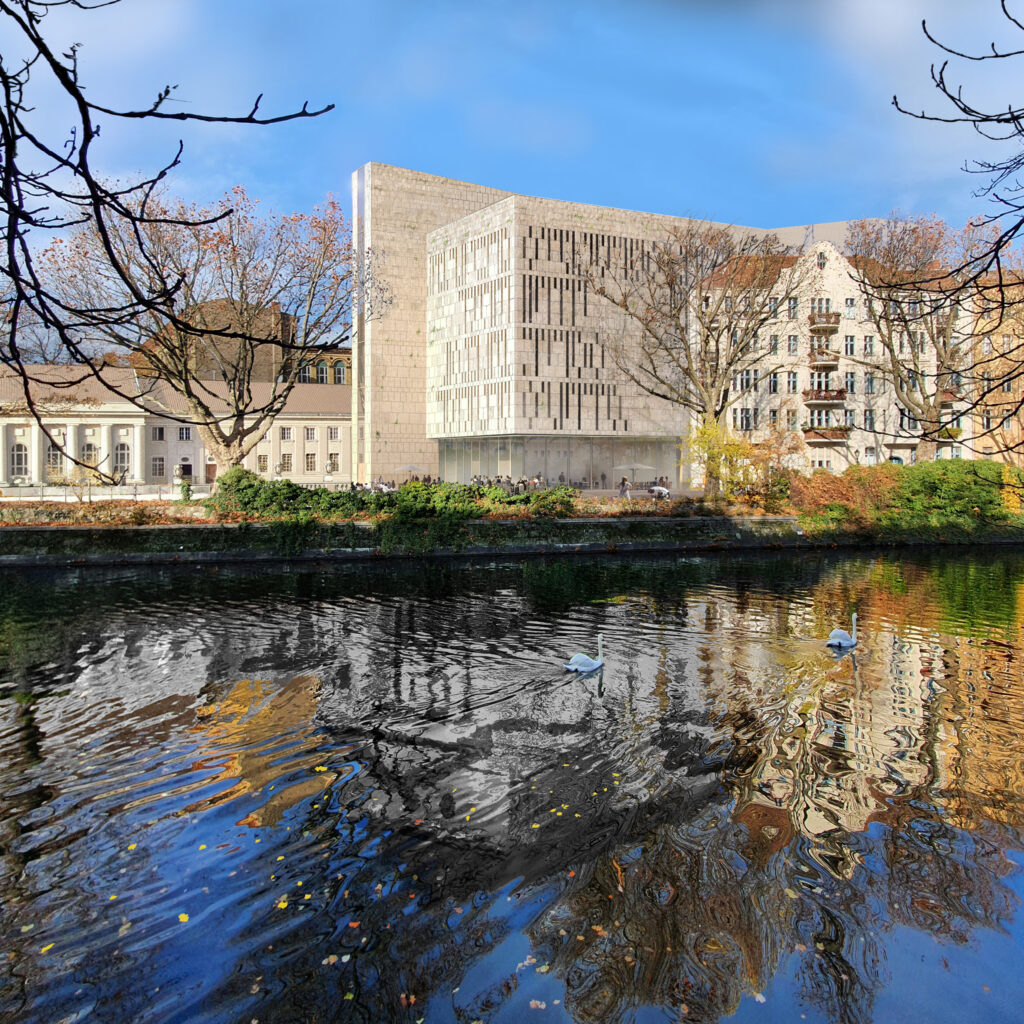
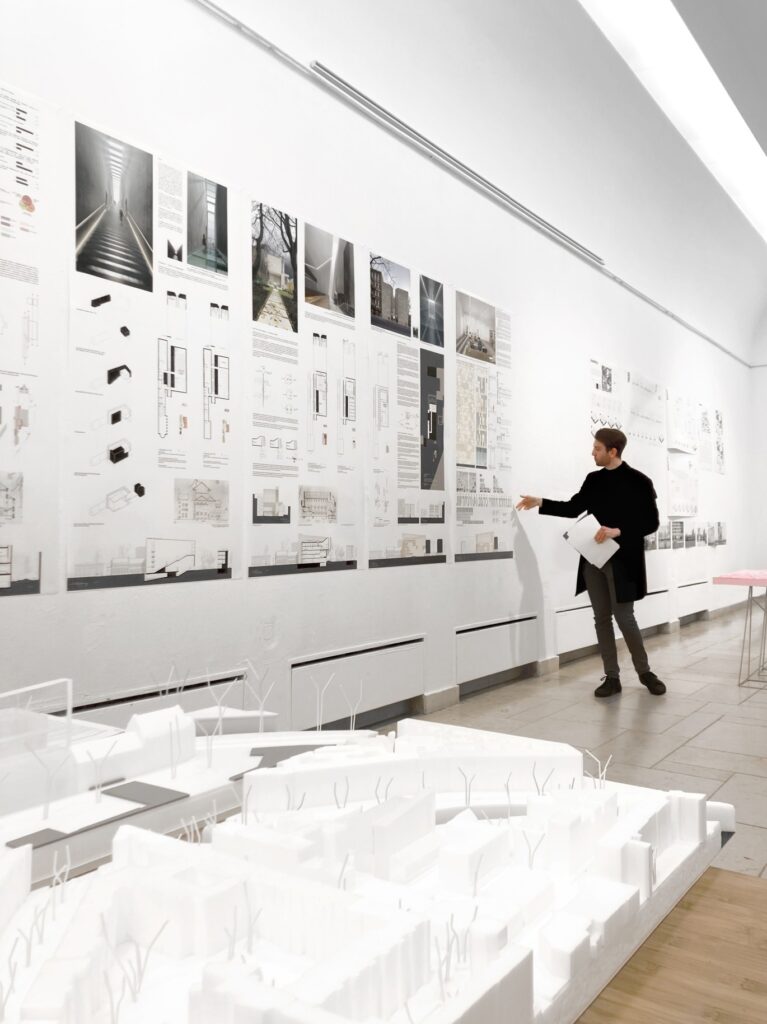
Instead of an imperial temple backdrop, Yakubovich puts a contemporary counter-design In the radio article the basics are outlined; Yakubovich himself describes the structure as follows: “The idea is to shift the building in such a way that we have up to six different levels, which are stacked on top of each other and become increasingly intimate and sacramental from the bottom up. On the ground floor there is, for example, an exhibition level, above which can be rented concert halls, libraries, further exhibition rooms, music rooms, teaching rooms, studios, and finally another day’s Synagogue, which rattles over the rubble pile of the former altar, the former Bima – that is, the Torah shrine and reading console.
The draft is therefore expressly understood as: Urban building block: Synagogue, cultural house, learning place and neighbourhood address in one – with a vertical course from the public ground floor to the liturgically condensed upper area.
Jerusalemstein, Kiez and second temple reference
In particular, the contribution highlights that the design in its facade design is based on the Jerusalem Temple and the Wailing Wall Kay Zareh explains that this connection is important to him in Yakubovich’s proposal: a conscious reference to Jerusalem, which will be translated into Berlin’s urban space instead of replicating a Prussian-Caiser temple façade.
At the same time, Zareh emphasizes the urban context: “The second is that you are here in a neighbourhood that is very lively and where many things take place. And this vitality should be taken up as much as possible, with an urban idea of offering more than just a synagogue, but something similar to a cultural centre, the Kreuzbergers who are here.
Thus the question of the external form is intertwined with that of the internal use: it is not only about a synagogue for a congregation, but also about a place where religious life, culture and public ==References==
Open questions instead of final answers
At the end of the radio program, it remains open which line will prevail: a politically supported reconstruction or a solution that – as Yakubovich and Zareh demand – re-thinks the place, takes the remnants of destruction seriously and places the needs of the present in the center.
The show points out that in a few years’ time it will be possible to see whether an SPD politician “pervades himself according to the nature of the Hohenzollern, as Kay Zareh called it – or whether another more discursive form of building becomes possible. The crucial question of who owns memory and who decides on its architectural shape remains deliberately unspoken – and thus stands even more clearly in the room.
Subsequent remark
The program “From the Jewish World” of 16 December 2022, designed by Stefan May, is dedicated to the planned reconstruction of the synagogue on the banks of Berlin’s Fraenkel and publicly presents a counter-project based on a contemporary solution. The fact that this draft was once again given space within the framework of a nationwide broadcast format is undisputedly a merit of the editorial staff. And yet, as already in related formats, a number of content points that are characteristic for a media discussion about Jewish topics in Germany are shown in this article.
First of all, the frame of the contribution is striking: an introductory, exhilarating, cheerful voice by comedian Katja Garmash, who occasionally appears as Katja Kremlin, asks “Mazel tov – a good news, right?’ and thus oscillates between benevolent solemnity and ironic distance. The contribution is extremely vivid and makes the closer urban environment of the Fraenkelufer through an analytical pattern for compaction or emotional strengthening more plastic and tangible: “Headstone pavements, jokers, curved bridges across the canal, cyclists.”
It should be stressed that Stefan May refrains from an auctorial framing and the history of the synagogue is not explained by the journalistic speaker, but rather the critics are also allowed to speak in contextualization and thematic classification – a difference to earlier contributions in which the moderation creates a framework for interpretation even before arguments come to light.
In terms of content, the paper offers valuable excerpts from the positions of Daniel Yakubovich and Kay Zareh. A deeper research that would investigate the central points of the interview partners takes place only to a degree that allowed a short amount. Among these are the criticisms of the planning, decision-making and awarding practices perceived by many parties at that time as intransparent, of the lack of public debate and of the political framework of a SPD leader whose appearance is read with a view to the reconstruction of some as part of a federal political profile, by setting the project in public terms, while a broader discussion about possible alternatives in public space hardly takes place. All of these topics are unquestionably raised and, compared to the previous public-law contributions, sound out in unusual clarity between the lines.
It is also particularly striking that no voice from the decision-making level of the municipality, from the politically responsible state level, the Senate Chancellery, the Senate Department for Urban Development, Building and Housing or the project managers of the foundation actually speak – although interview requests were made according to the broadcast. Instead of an active research, a resignative tone occurs that there had been no answers and one will see what was created on the Fraenkelufer. This leads the contribution into the attitude that he tries to critically illuminate: Silence, avoidance, political fog. The gaps in contextualizing queries, an occasional lack of necessary source-critical sharpness or simply uncomfortable contributions, which are weakened or not sent at all, can often be observed in public and private editorial offices and does not require any conspiracy thesis. It is enough to look at incentive structures: narrow broadcasting stations, editorial cuts, legal precautions and the need to keep sensitive topics as low as possible. Voices were made audible – and this is to be emphasized – that do not occur elsewhere. The fact that in the final version, however, the next logical step could not or could not be taken seems like a consequence of the production conditions: it is left when documenting where a second, recapitulating format would be required.
Thus, “balance” becomes an aesthetic formula that grinds down edges – especially on issues charged with identity politics. Symbolic political narratives of a mainstream, which is largely left-liberal today, are regarded as “reasonable”, while regulatory criteria – the rule of law of procedures, budgetary discipline, security issues, respect for liturgical requirements – come into the background. In the writing rooms, such a soft morally curated hegemony that smoothes deviating but legitimate positions. Nevertheless, the contribution is a positive step: it makes important positions audible in unusual clarity and at least makes contradictions appear. The question of whom memory belongs is indicated; its clarification requires a separate, carefully curated follow-up discussion.
Looking back at all the contributions – from the first references in the cultural departments to radio broadcasts to national coverage – a recurring pattern emerges: one frames the topic as an aesthetic alternative (reconstruction versus contemporary design), but avoids the actual test pieces – competition and participation, responsibilities, involvement of the living community, Halachian requirements, follow-up costs and operation. The symbolic gain is emphasized, while procedures, legal certainty and budgetary responsibility fade; the external impact often outweighs the intended construction’s function.
It would not be difficult to return to a factual standard: first participation, then form; first procedures, then visualization; first use and security, then gesture. Memory, which is aware of its responsibility, does not need staging, but spaces that carry, and processes that deserve trust. With this scale, the debate can be productively closed – not in the sense of silence, but as a transition into a more mature stage: a planning that serves the community, is good for the city and is just about history.


See also: