Can we reconstruct synagogues if we rebuild castles? Would that strengthen the integrity of Judaism in Germany, or would it forget the destruction, suffering and destruction as if it had never existed? Is the Reconstruction a synagogue a new beginning or the new beginning of the end, when destruction becomes a subplot in the history of these buildings? What can a contemporary, new form of memory culture look like if the recent witnesses go and the painful emptiness instead of the once so proud buildings is increasingly perceived as such? What does it mean to build a modern synagogue in Germany? What does it mean to reconstruct an old one? Can both go together? And if so, how?
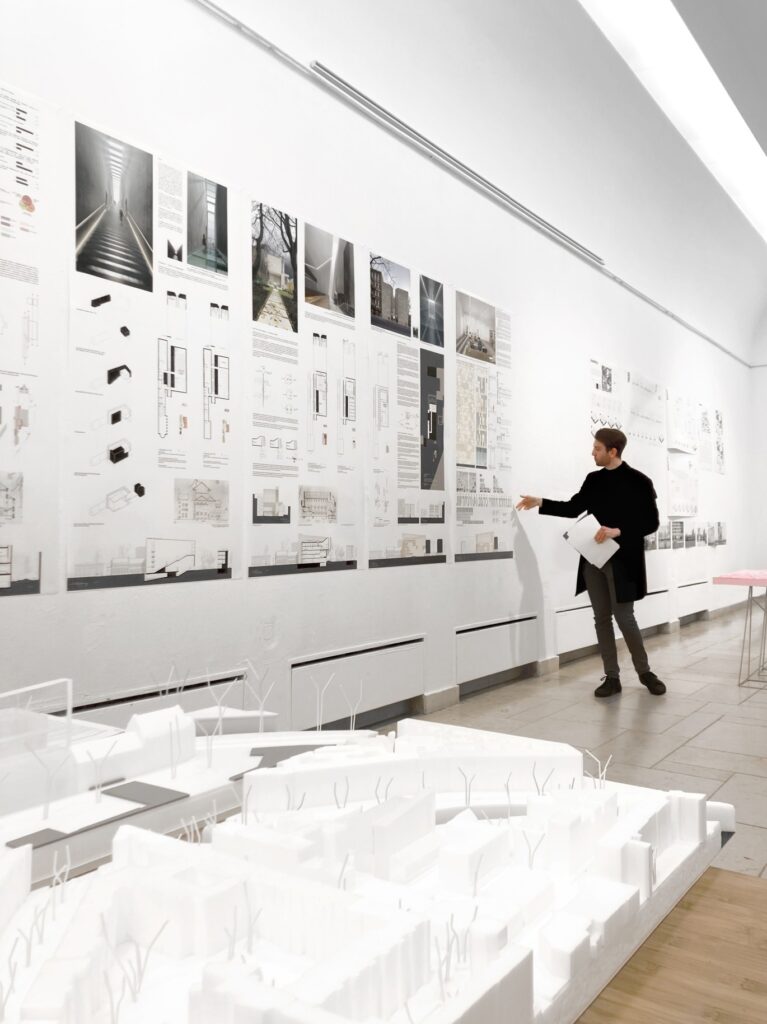
The present work, developed as part of the Master’s degree at the University of the Arts Berlin under the supervision ofKay Zareh (1943–2025), one of Berlin’s defining synagogue architects, examines these questions and develops a poetic and realistic counterproposal to the originally planned Reconstruction: not a backdrop, not a copy, but a precise answer to a difficult place, which should be at the same time a shelter and an open house, memorial site and workshop of the present. This work indirectly meets the desire for reconstruction without having to recover what is irretrievably lost. At the same time, insights were gained that could significantly influence the construction project after they were publicly discussed.
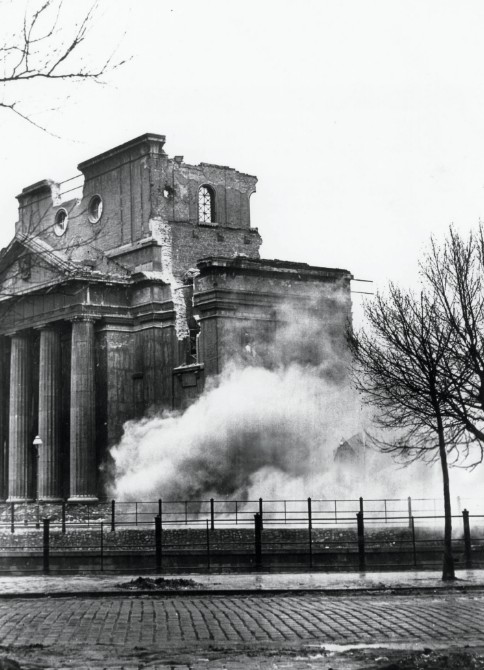
This resulted in a monograph of architectural theoretical essays, design studies and a technical as well as very personal examination of the question of what it means to build a synagogue today. The starting point for thinking and planning was the Synagogue of the municipal architect. Alexander Beer (1873–1944) on the former Kottbusser Ufer (now Fraenkelufer) in Berlin-Kreuzberg, once the largest orthodox community synagogue of the Jewish Community of Berlin with about 2,000 seats, devastated in 1938, blown up in 1958, today reduced to a much too small outbuilding that tries to accommodate a growing, younger, often migrant-influenced community under chaotic lack of space.
Several introductory chapters on reconstruction theoretic, memory-cultural and identity-political approaches form the basis on which the planned building unfolds in the course of the further book pages and illustrates how theoretical considerations are translated conceptually:
The first part of the book traces the history of the synagogues in Berlin and describes these “Dialectics between freedom and oppression“, in which Jewish cult buildings have always stood: between visibility in the city space and discretion, between stylistic proximity to Christian churches and alhambresque mosque quotations. At the same time, the current political situation is dissected: from an architectural historical point of view unreflected slogans of politics culminating in the much quoted formula: “A city that builds castles should also build synagogues, the reconstruction gesture in “best Germany we have ever had” – and the question whether the reconstruction of historical shells is really an answer to pogroms, shoah and present-day antisemitism or just a well-wrapped form of oblivion.
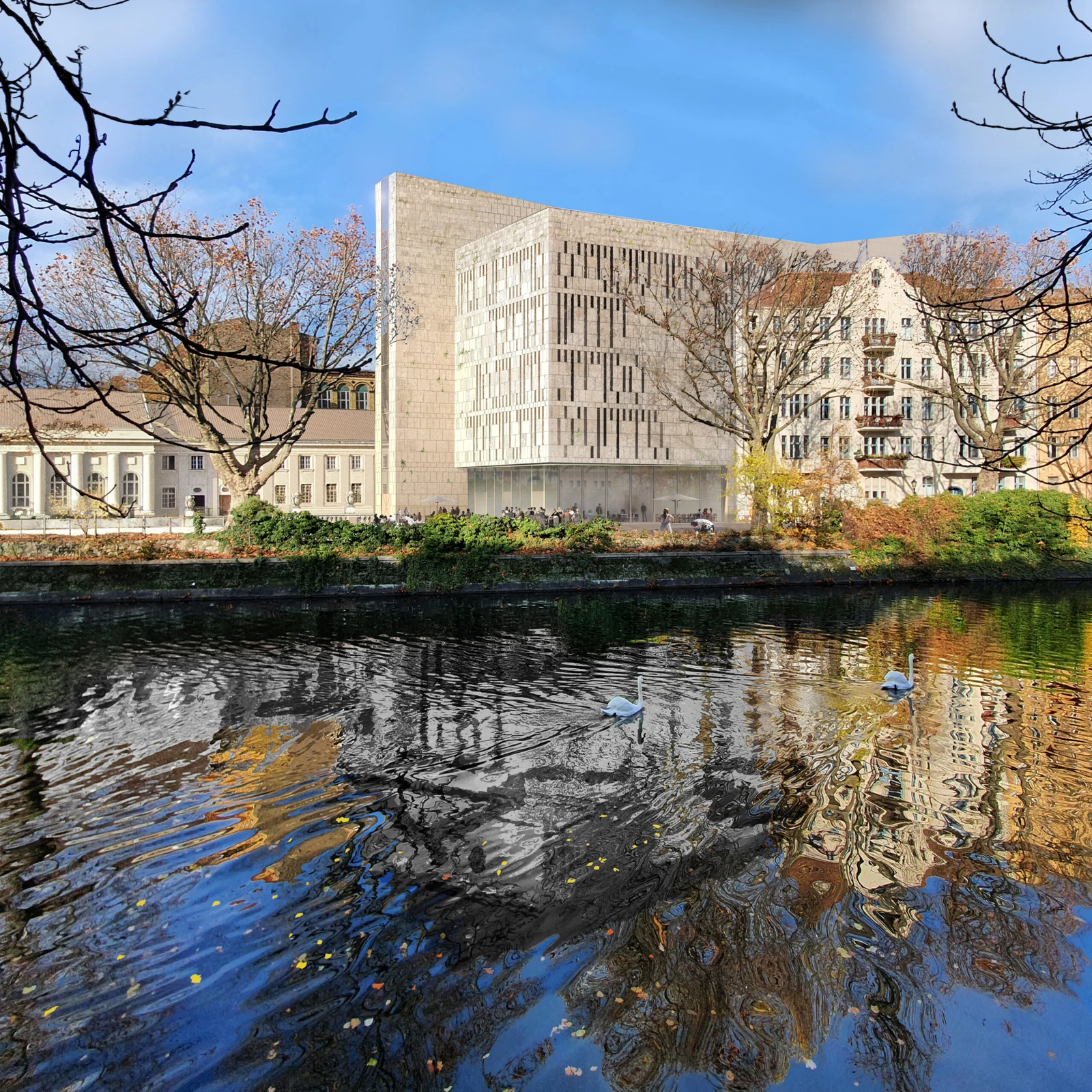
In several chapters, a counter-project to the originally planned historiography is unfolded. Reconstruction: a community and cultural centre that takes history seriously, without it MusealizeThe book leads to a kind of bullet for bullets through this imagined house: from the Ground floor as exhibition level on a Stairwellthe biblical light metaphors spatially interpreted, up to the concert hall, to the library, to the Festival Synagogue high above the Landwehrkanal, further to the administrative level and finally into an attic which as hortus conclusus – a closed garden – gives an almost contemplative answer to the debris landscape below.
The final part is a reviewing part, which combines the reporting on the design, followed by a scientifically sound glossary. The bilingual book gathers historical and current photographs, plans, cuts, axonometry, model photographs from the work process, diagrams of the Berlin synagogue stock before and after 1938, technical data sheets as well as numerous drawings and collages that make the design more tangible.
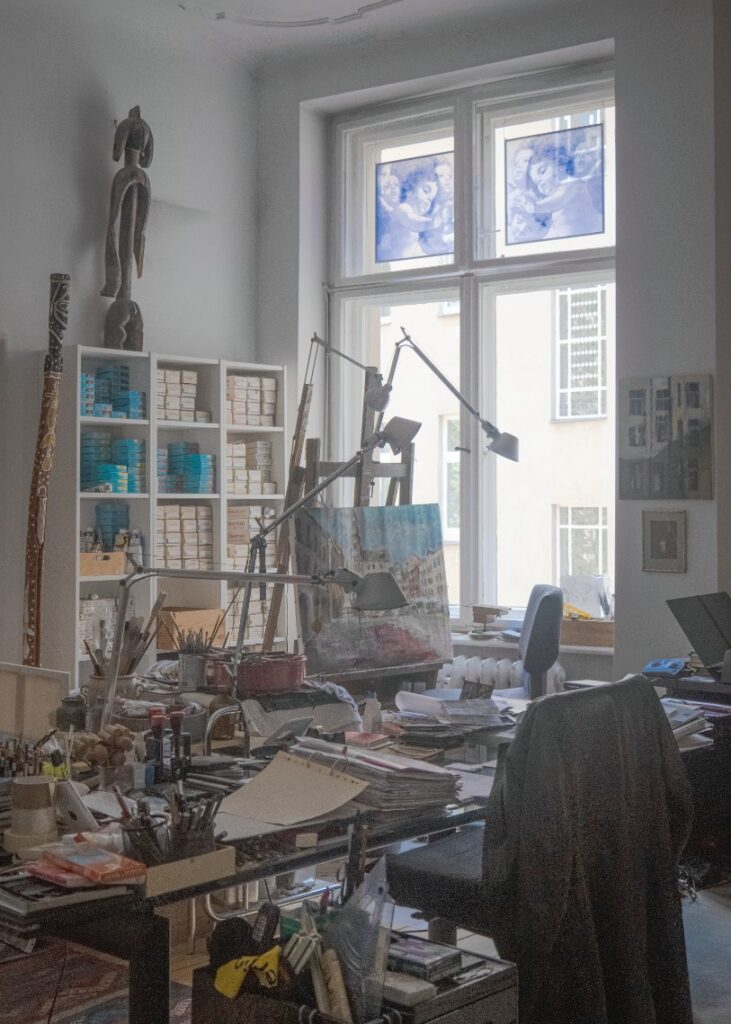
Methodically, the book is based on a rather untypical entanglement: own migration history as a Jewish contingent refugee, twelve years of Jewish schooling in Berlin, then seven years of architectural studies, years of study with the Reconstruction of the Berliner Schlosses / Humboldt Forumes as a major national memorial building project – and the close collaboration with Kay Zareh, who, together with his wife, as “house and court architects” of the Jewish community, have realized numerous construction projects for Jewish life in Berlin, including the renovation, restoration and restoration of Germany’s largest synagogue on Rykestraße in Berlin. This creates a Jewish-Berlinian architectural perspective that has so far been conspicuously lacking in public discourse on the banks of the Fraenkel and which has been deliberately opposed to the well-balanced reconstruction enthusiasm of political operations.
The topics, questions, insights, reviews, interviews and conclusions collected in this monograph complement an existing discourse that so far lacked such a perspective. Reconstruction for the sake of photogenicity, no progress without origin: The design on the banks of the Fraenkel understands the ruin as a quiet foundation, evades the reflex of the historical mask and develops a synagogal synthesis from the program, topography and neighbourhood that makes visible the dialectic of past and future – as a living memory that passes to the next generation and is not merely remembered but used there.
Order requests
If you want to buy this book and are interested in finding a position between Berlin’s castle fetishism, reconstruction romanticism and very real Jewish everyday life, you are welcome to write a message – most easily by e-mail to daniel@yakubovich.berlin with a brief note that it is about ordering the synagogue book. I will then personally report back with information on availability, price and shipping modalities.
@danielyakubovich