
About the moral self-paralysis of the communities, the ban on uttering one’s blind spots, and why inner Jewish criticism today is more radical than any external one.

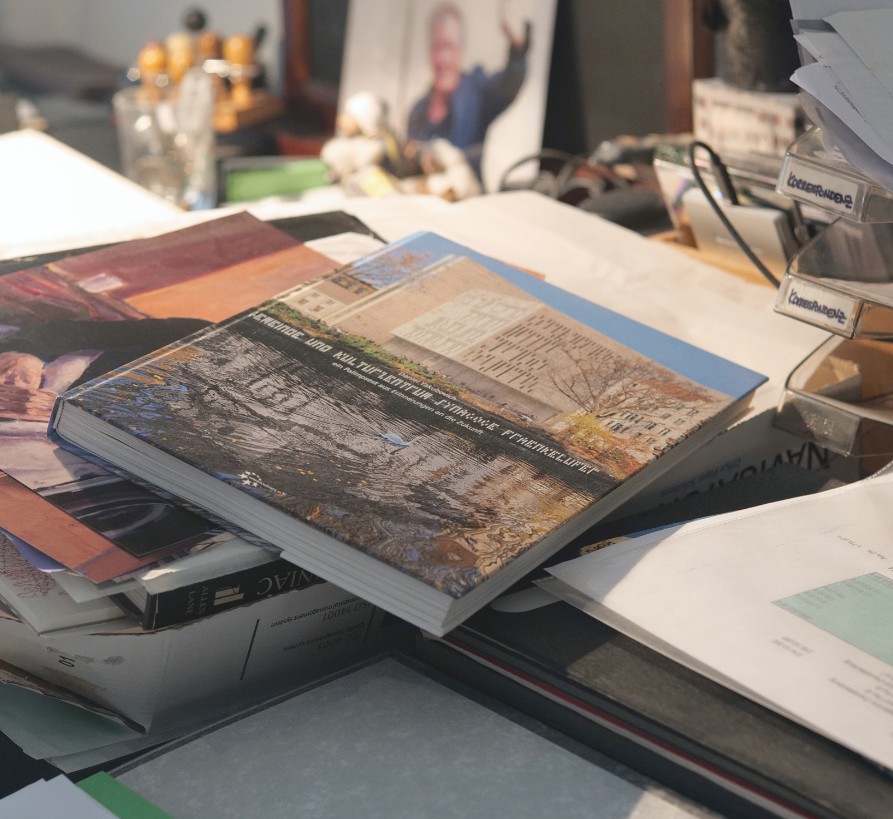
After the completion of the conceptual work, the discourse was not ended, but rather deliberately directed into further directions. In addition to the publication of the work in expanded book form and the targeted address of potential discourse partners, an attempt was made to initiate a broad debate on the reconstruction efforts that existed in 2022, which was also institutionally supported. In doing so, it became clear that the difficulty of opening up institutional spaces of reflection when it came to critical monitoring of projects charged with memory policy.
Paradox of memory culture
In the current discourse, a remarkable paradox is revealed: while many voices in public space sincerely seek to acknowledge Jewish presence, there seems to be a deep-seated discomfort at the same time when this presence is critical of the gesture of its own architectural in-scene setting and when Jewish voices question these forms. The reconstruction of historical synagogues is often understood as a reconciliation gesture – a symbolic “act of reparation” in a country that seeks to reorient itself as a civilization break after World War II.
Reconstruction as a calming platform
There is a danger in this particular case: Reconstruction The impression arises that many representatives of the community affected by the construction of a new synagogue are moving towards power and the powerful, while at the same time those voices, which demand a substantial, also aesthetic confrontation with today from the Jewish side, are falling apart. Even more tragic is the observation that, for fear of misinterpretation or structural exclusion, Jewish representatives are sometimes prepared to contribute to a consensus that answers the deeper question prematurely instead of asking it – how Jewish presence in urban space should become visible. One praises the dress – but no one realizes that the king is naked.
Co-responsibility of Jewish communities
This creates a peculiar double contract: one arranges with a political order that, on the one hand, formulates confessions about “Israel’s state, regardless of its sensuality or legitimacy, and at the same time seems to support organizations through direct and indirect financial flows that can hardly begin with that Raison. While synagogue facades are reconstructed, memorial plaques polished and the teachings from the past are stressed pathetically, there is an astonishing indifference towards the very concrete threats to which Jews are exposed in the present day. The much-conjured “culture of memory” thus gets close to a political photograph, which preserves the image of the dead Jew in high resolution, while the living Jew, security, protection and sometimes uncomfortable political consequences demands disappears in the blurred background. Against this background, the willingness of many official representatives of Jewish communities to adhere closely to those political classes who have been pursuing a generous immigration policy towards states with deeply rooted anti-Semitism for years has had an effect, such as a peculiar form of Self-hazard by loyalty. At the latest at the moment of the publicly celebrated Merz tears under the kippa1 At least with a view to the security of the Jews, the question of a re-thinking of migration policy would have to arise: If not for the benefit of the German population as a whole, but because of concern about rising Muslim and political left and right anti-Semitism, this would be sufficient reason for a change in immigration and identity policy. It is known that anti-Semitism is increasingly also migrant and left, while the largest nationalist group is the Turkish Grey Wolves.2
If all this is transferred back to the present subject of discourse in the reconstruction of synagogues, the paradox described at the outset gains an additional sharpness. The eroding security situation — an expression of a greater economic, demographic and cultural decline — naturally applies to the entire population, but the contradictions manifest themselves in dealing with Jews in a particularly caricative way: Jews who, at least in public perception – for fear, from institutional dependence or opportune harmony – seem to be attached to precisely those power centres which, through an uncritical immigration and identity policy, increase the anti-Semitic threats in everyday life, unintentionally contribute to the fact that the staged backdrops of Jewish presence can be read as proof of a successful “normalization”. One is devotedly discussing domes, portals and series of ornaments, but the real question whether the political and social environment enables these spaces to liveable today is politely avoided. Stage design of a calming aesthetic to be carefully planned, expensively built, well illuminated and yet dangerously naked.
Change of mind on the way from mere speech to concrete action
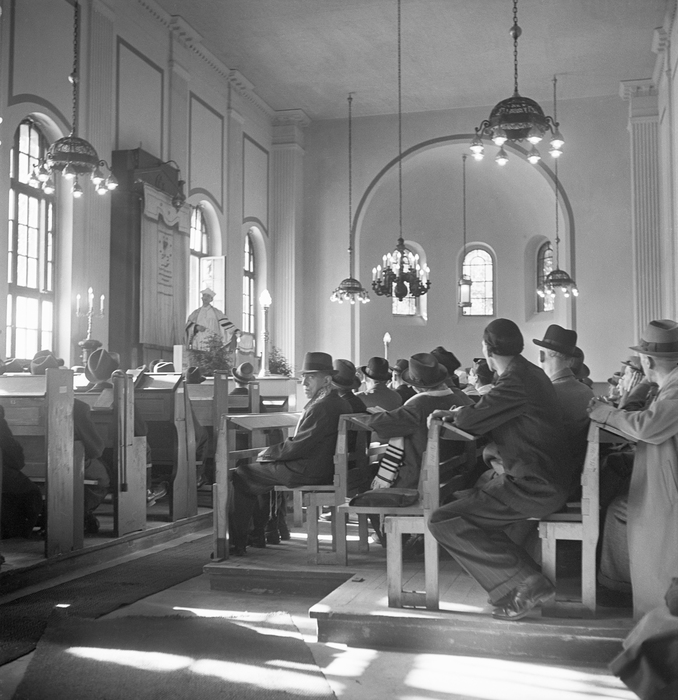
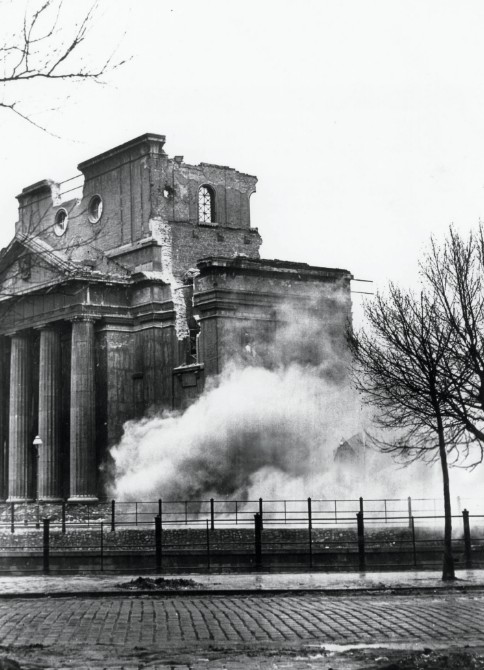
In retrospect, the erratic path of the project can be roughly sketched out. Starting from the initially loudly proclaimed idea of a “reconstruction of the synagogue” – embedded in the German reconstruction desire between Frauenkirche, Dom-Roman and Stadtschloss – the focus gradually shifted from the shell to the program. Reconstruction as such would by no means be disavowed: it can, properly understood, a to be a radically serious commitment to irretrievability and the survival of Jewish life, as Saleh puts itAgainst this background, it seems peculiar when a politician like Raed Saleh appears to be one of the loudest supporters of reconstruction, while his “loud silence” to the Attacks of 7 October 2023 in the relevant public appearances and debates But in the case of Fraenkelufer, it became more and more apparent during the course of the debate that the reconstruction here was less an expression of a thought-out theological, commemorational, urban or liturgical necessity, but above all a populist, intellectually unfinished, symbolical gesture of calming. At this point, the reconstruction begins to become dangerously harmless.
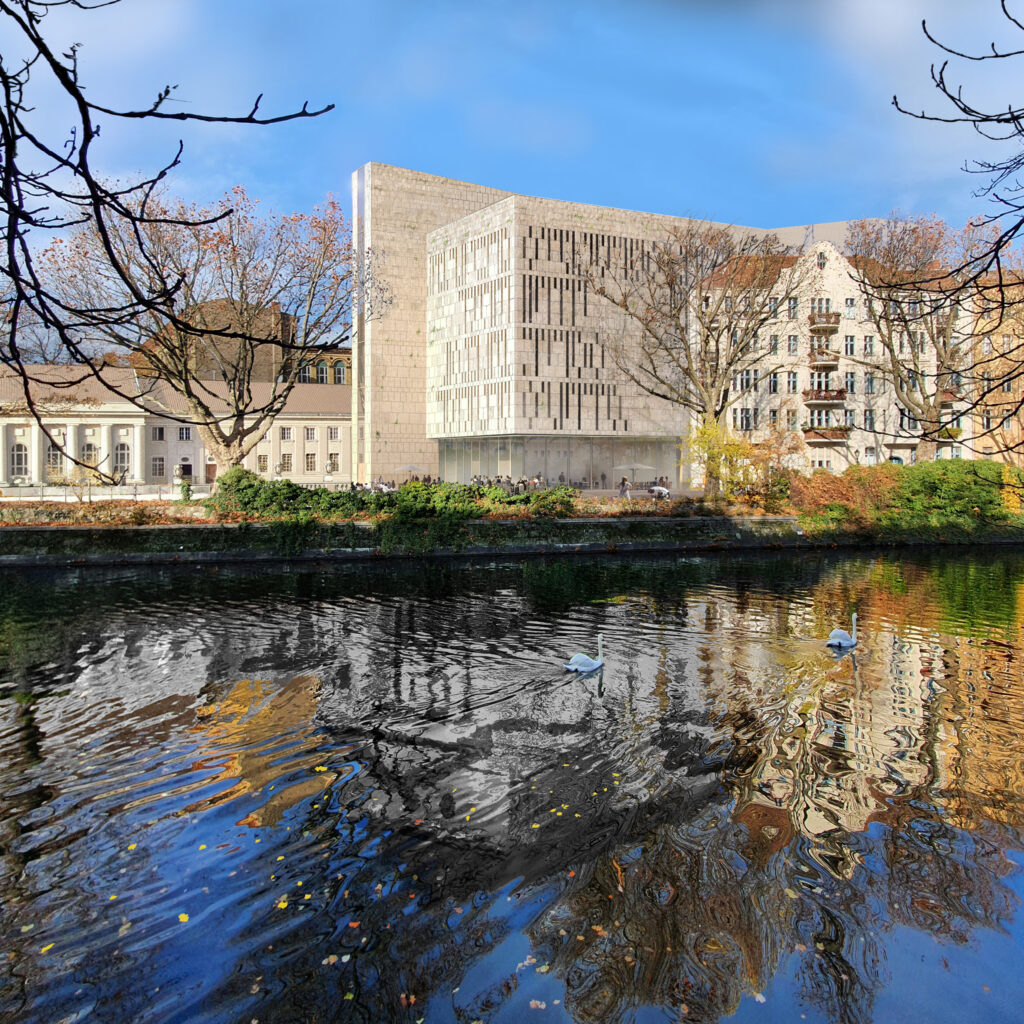
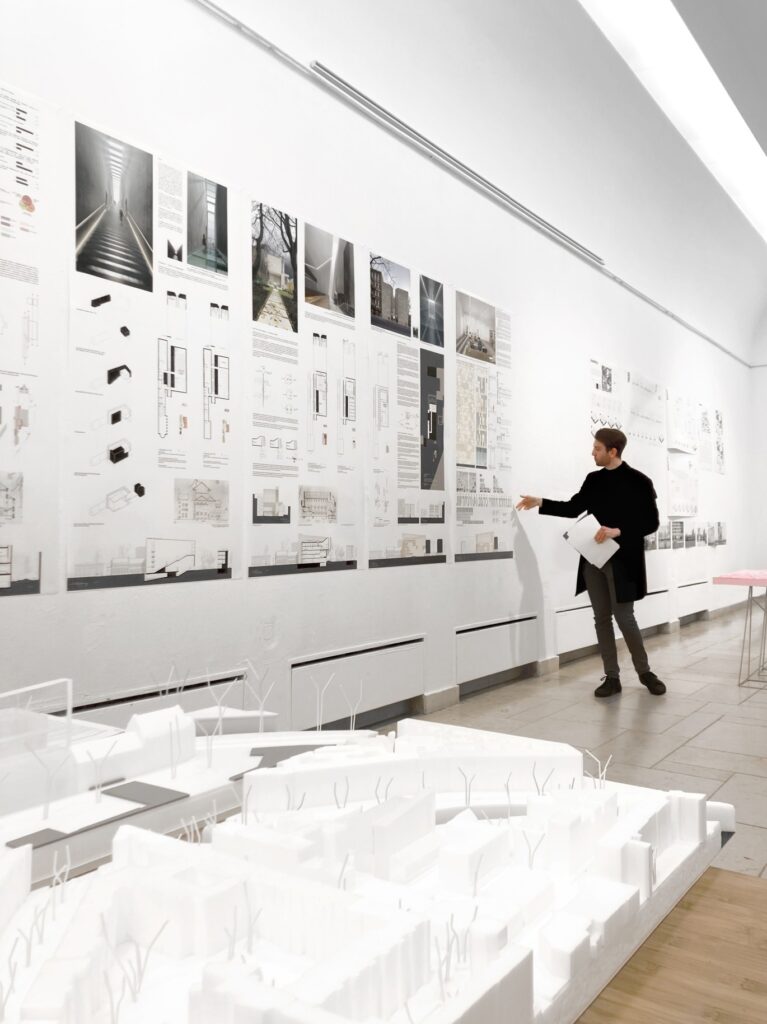
Consequently, the process eventually resulted in a non-open competition, the result of which – the future community and cultural centre – the historical synagogue was no longer to be copied as a building but rather as a contemporary resonance figure Whether this change of mind would have come about without the interviews and criticisms available can not be proven; it is only certain that a change of mind is emerging in the transition from the loud reconstruction slogan to silent awarding. One has understood – or began to understand – that it is not enough to build a dead backdrop if one does not want to ask the question, which intellectual-historical ideas and socio-political constellations are reconstructed together with architecturethat the uncomfortable sides of the History not destroyed and how Jewish presence in urban space today should be visible, vulnerable and at the same time protectable. In this sense reconstruction remains a possible, but only one of several forms; decisive is what history it tells – and for whom.
On the following radio broadcasts
The following articles are based on broadcast contributions to my work. These oscillate between an explanation of the draft, the criticism of the then intended reconstruction of the synagogue (cf. Visualizations by Dipl.-Ing. Kilian Endres) and the participation policy I criticized towards experts and people of Jewish origin or faith. Just as the construction project was set up and initiated, the impression that the public sector was building – with all its fine rhetoric and involvement of the communities – at a symbolic-metaphysical level on dead Jews instead for liveThe impression also remains that the Jewish communities support this culture of memory due to financial-institutional dependence.
The following contributions shall be made: No literal transcript The author’s own content is a journalistic contribution, but rather an independent reproduction of the author’s content. If the archive policy of the public service broadcasters permits, the still available contributions are linked accordingly. paraphrased and in indirect speech sequence, selection and formulations follow the content structure of the conversation, not the technical version of the original broadcast.

See also:
- This is the appearance of Chancellor Friedrich Merz at the solemn reopening of the Reichenbachstraße Synagogue in Munich in September 2025. After years of renovation, the synagogue was rebuilt in 1931 by Gustav Meyerstein in the style of the Bauhaus and the Neue Sachlichkeit (New Objectivity), which was heavily devastated in November 1938 as a Bauhaus jewel. Merz appeared with Kippa and gave an emotionally charged speech on the crimes of National Socialism, the resurgence of anti-Semitism and Germany’s special responsibility for the security of Jewish life; numerous reports pointed out that during his speech he was standing with tears. The appearance sparked a broad journalistic echo that oscillates between the interpretation as authentic sentimental expression and the criticism of a symbolic political gesture that can only be brought into limited harmony with the actual migration and Middle East policy of the Federal Government.
– Federal Government: “Kanzler Merz in Synagogue Reichenbachstraße – Place of Remembrance and Confidence”, 15.09.2025, online at: https://www.bundesregierung.de/ (last access: 10.12.2025).
– Jewish General: Cordula Dieckmann, “Merz fights in synagogue with tears”, 17.09.2025, online at: https://www.juedische-allgemeine.de/ (last access: 10.12.2025).
– Deutschlandfunk Kultur: “Synagogue reopened in Munich – Merz fights with tears”, news from 16.09.2025, online at: https://www.deutschlandfunkkultur.de/ (last access: 10.12.2025). ↩︎ - See
– Independent expert group on anti-Semitism: Anti-Semitism in Germany – current developments, Report to the German Bundestag, Berlin 2017, online at:
https://stk.sachsen-anhalt.de/ (last access: 10.12.2025);
– Federal Office for Constitutional Protection: Situation picture anti-Semitism 2022/23, Berlin 2024, online:
https://www.verfassungsschutz.de/ (last access: 10.12.2025);
– Bundeszentrale für politische Bildung: “Grey wolves in Germany: A Turkish problem?”, Podcast, o. J., online at: https://www.bpb.de/ (last access: 10.12.2025);
– Federal Office for Constitutional Protection: Turkish right-wing extremism – The “Grey Wolves” in Germany, brochure, August 2023, online at: https://www.verfassungsschutz.de/ (last access: 10.12.2025). ↩︎