
after Kohelet 3.1–8 (Luther 1984/2017)
How the art historian and architectural critic died in 2015 Dieter Bartetzko in a FAZ-feuilleton about the longing desire for the resurrection of the destroyed in the context of the controversial Dom Römer district in Frankfurt am Main, lives the memory of the lost, once intact old town as a longing figure of “Security, belonging and continuity” in the collective consciousness of the cityrs and can not be forgotten by the speediness in the “data vortex of the information age”, because despite all superstructures and superscriptions by modern post-war buildings with technoid constructions that are often perceived as foreign objects, the past can still be read through and a Reconstruction less the object itself, but rather an identity believed to be lost behind it.1
The loss of architectural heritage appears here above all to be seen as a loss of quality of life, and individual buildings are attributed an ideal meaning that goes beyond the mere substance, such as that which flows between the lines of the plea for the reconstruction of the synagogue. Certain lost buildings are perceived as defining and indispensable for the identity of a place, although in the same place new buildings can emerge with corresponding consequences for new address and identity formations as a mirror and a reflection of a new era, since any change caused by the course of history continuously produces new identities that cannot exist without their predecessors. Consequently, an ideal state is assumed here, which can be rebuilt. True, it is true that the Frauenkirche cannot be thought away from the cityscape of Dresden, but the newly established context of its ruins can create new identities similar to the Berlin Memorial Church.
In this respect, the Authenticity concept the feeling of being connected to the home and thus the decisions in favour of Reconstructions This is because contemporary interventions are often perceived as an aesthetic reduction, even a loss of an identity-creating moment, while historicizing architecture is considered more appealing – whose questionability, however, is linked to the demand for a clear separation between old and new, usually reserved for the discourse of narrow professional circles.
All the more urgent is the question why a “culture architecture” is perceived as more familiar – although the current urban development can also be an expression of social identity, which is no less evolving. Susanne Hauser, expressed in a panel discussion with Christoph Mäckler in that it is precisely the abundance of documentary materials that often makes lost objects appear present: “So what happens today seems to me not only critical, but also contemplative – because it is also about simply wiping aside and no longer discussing very many positive things that have once connected with modernity.2
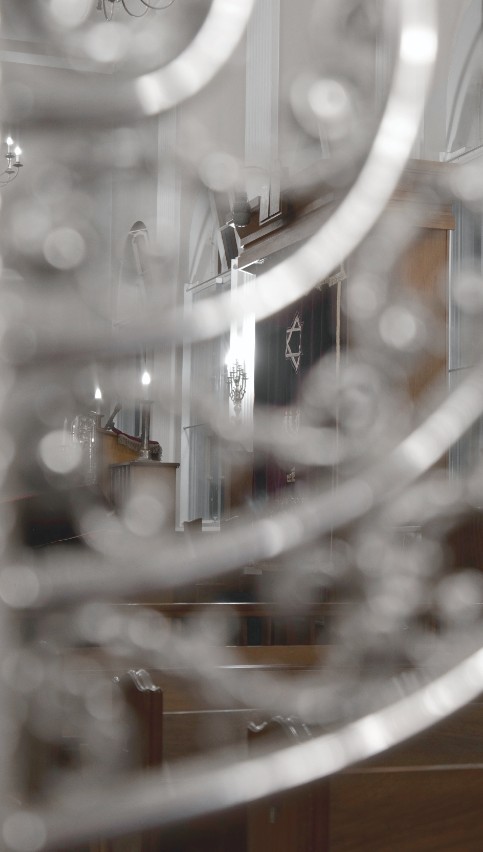
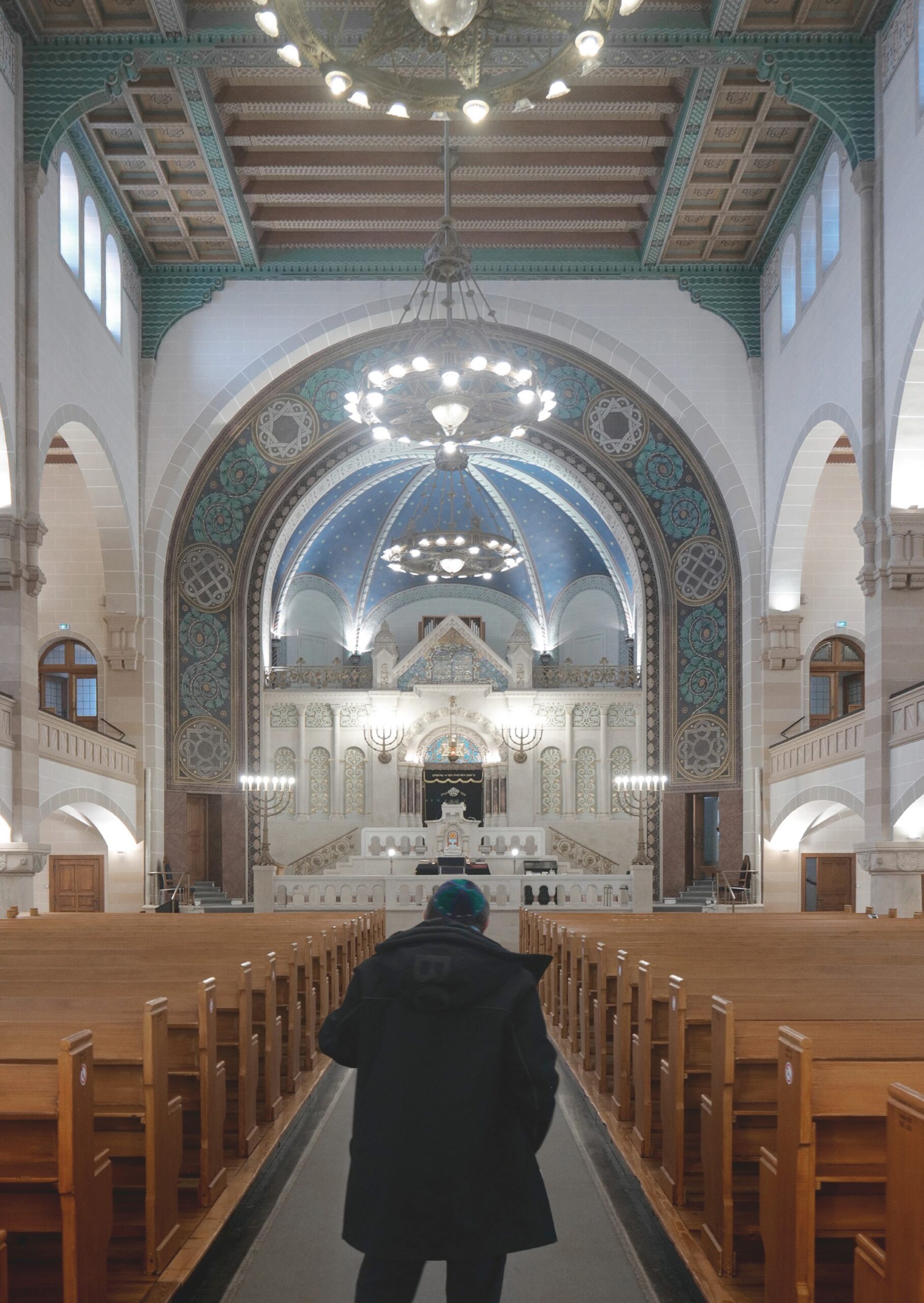
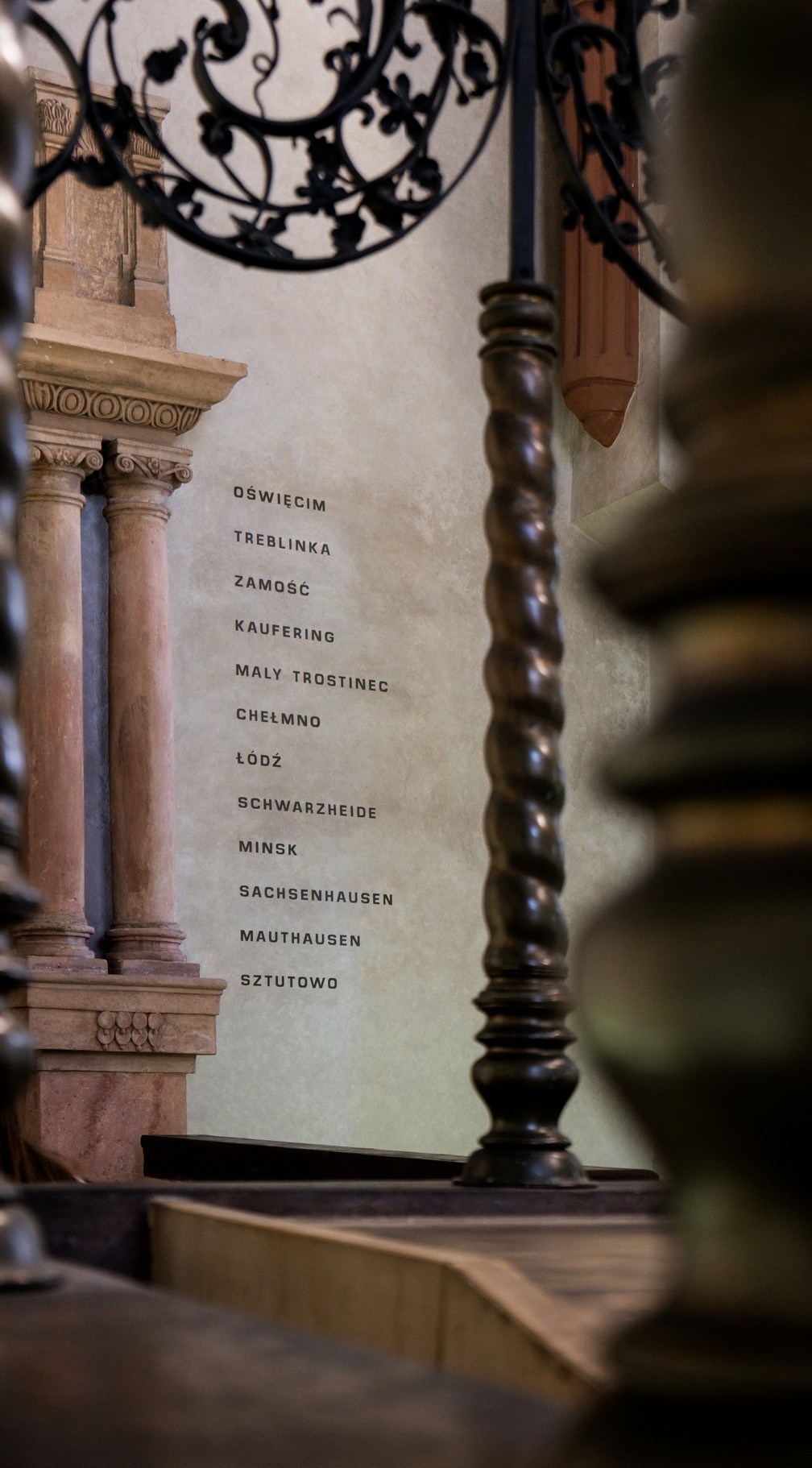
What seems like Astwerk is silver-plated consolation. Interior of the former youth synagogue on the banks of the Fraenkel, recorded during the Hanukkah service in December 2021.
© Daniel Yakubovich.
Hope and Homeland Security — for the Political Functionalization of History
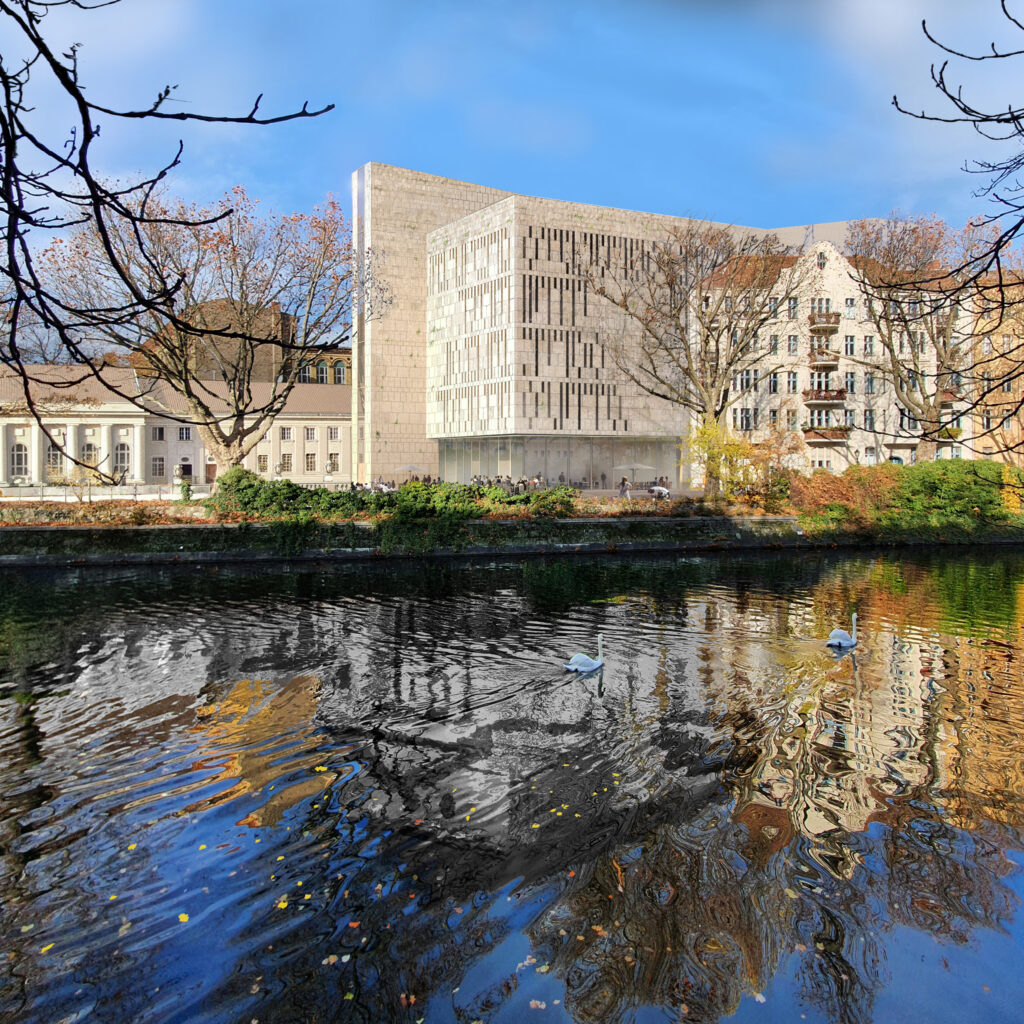
Reconstructions Thus, it seems to respond to the needs, to enroll in a chain of human genders, which is often burdened with older objects. A break in historical continuity – that break that seeks to link the departure of the Jewish population from the status of a once declassified minority with today’s media-present struggle against racism and discrimination – should be sealed. However, the fact that a contemporary building immediately after its completion can create identity and thus fulfil the same stated goals demonstrates not only the façade of the present project – which evokes a significantly older symbol by quoting the thousands of years old lamentation wall and thus consciously fits into a long tradition – but also shows the Elbphilharmonie in Hamburg in an exemplary way: a structure that can no longer be thought away from the cityscape.
The visualisation of the identity-creating moment in the architecture of an object – that moment that can legitimize or promote its reconstruction – was always a question of Tirage, i.e. the circulation and distribution of visual information carriers: first stamps and postcards that prefer certain buildings to others by targeted repetition, they hold them in the minds of people with meaning and meaning and – as in the case of the Brandenburg Gate, one among many city gates – bundle a collective identification around such a symbolically charged object.3
The search for points of contact with a founding myth and those places that, due to their historical complexity, have been able to pool historical events of supra-regional importance, often serves to deepen one’s own historical consciousness – and is all too often misunderstood as a springboard into a promised, glorious future. This is precisely why the return to the imperial era – as a supposedly successful example of a tolerant and progressive immigration society – seems particularly appealing to a social democrat, although historically extremely contentious. If one looks more closely, the German Empire can only be described as tolerant and progressive in the sense of today’s integration and immigration policy: economically receptive, certainly – the industry so-called Ruhrpolen, Italian or Dutch in large numbers, and the early social legislation created a first security line of participation; legally, however, the way to belonging remained narrow, the naturalization restrained, and with the Reich and nationality law of 1913 the principle of descent was anchored, which made it difficult for Poles and East Jews in particular to naturalize; culturally, the state expected extensive assimilation, visible in language and school politics as in the expulsions of 1885, while the civil equality of the Jews did not lead to the disappearance of social resentments; finally, politically, the early general (male) Reichstag election law combined with an authoritarian superstructure, which framed participation and limited minority areas, and in the colonies anyway there was a separate, hierarchical order without prospect of integration. In short: modern in the work and in parts inclusive in everyday life, but in the national self-image primarily aimed at descent, language and loyalty.
In the Euro-Atlantic comparison, France has shown that since the reform of 1889, with a strong jus solo The United States, regardless of racial barriers, was characterised by an extraordinary capacity for reception; Great Britain, with the Aliens Act of 1905, set first restrictions, but remained in its self-image less ethnonationally fixed than the Reich, although the main goal was to control Jewish immigration from Eastern Europe and above all from the Russian Empire. In an international comparison, the German Empire followed a more descendant belonging model on the continent: it combined the modernization of industrial society with a time-typical, cultural and descent-related view of the state, which classified affiliation substantially over descent, language and loyalty. This was mentally prepared by the idea of cultural nation shaped in Romanticism (Herder, Fichte). After 1848, the republican demos thought resigned behind constitutional monarchy and federal order. The Reich was founded in 1871 as part of a constitutional monarchy with distinct administrative and military culture. Integration was primarily understood as cultural coherence. In 1913, the Reichs- und Nationalitätsgesetz established a legal fixation of the jus sanguinis;The acquisition of citizenship was thus – by no means atypical in European comparison – more linked to descent and set higher hurdles for foreigners.
Against this background, it is less about transfiguration than about a sober classification of the heritage of the German Empire: the great enterprises of those years – from infrastructure to representation building – were generally joint works of crown, state, city and citizenry and testify to a remarkable organizational and technical modernization will. The partially reconstructed Berlin Castle, which is used as a reference for the synagogue on the banks of the Fraenkel, can be read – depending on the point of view – on the one hand as a memorial to Wilhelminian representation, on the other hand as an expression of an urban building tradition that shaped the capital. The national union of 1871 under Prussian leadership created stable legal and administrative structures; at the same time, areas of social organization, such as the labor movement, remained more regulated – according to the Zeitgeist. Raed Saleh the imperial era as a model of a tolerant and progressive immigration society: Social democracy was, as is well known, on a tense footing with the monarchic state, as shown by the socialist law and the police supervision of the workers’ movement, and the Berlin castle was regarded in left-hand memory as a cipher of Wilhelminian representation – up to its removal and detonation in the GDR, because it reads into it the symbol of militarism and imperialism. Whoever, from a social democratic perspective, raises the Berlin castle and the German Empire today to a model for building culture and integration policy, is sitting – in a friendly way – at his own branch; however, it remains legitimate to appreciate the courtly building and urban culture as part of a larger, bourgeois-based building tradition. Therefore, a sober, ambivalence-sensitive reading of the sources – without sharp tone and with serenity towards the capriols of day politics. Raed Saleh the history of his party and social democracy, or he has long since arrived in the right-wing conservative camp in terms of content; then, of course, the question arises why he still belongs to the SPD – more honest would be the shift into that conservative spectrum in which the virtues of the constitutional monarchy, the Hohenzollern heritage and respect for historical continuity are not regarded as an impetus, but as a civilisative self-evident.
Nevertheless, reconstruction of destroyed, partially or completely lost buildings or complexes often aims to create an environment of memory of the lost ensemble and to mitigate the absence of the original ensemble.4 However, the fact of the reconstruction of peu à peu is forgotten and with time, which is known to heal everything, and the patina on the replenishment, the reconstructively sealed wound grows together as an organic part with the preserved environment, whereby an irreversible annihilation, i.e. the irretrievable loss of substance with subsequent reconstruction, becomes a mere marginal note in the history of objects. It could even be said that precisely the reconstruction of the synagogue with its pre-war façade of integration of Judaism in Germany and the synagogues as an integral component of German architectural history as a whole, such as the construction of a synagogue Alexander Beer It is praised that a disservice could be performed because it illustrates how easy the wounds of the past are to close, rather than constantly admonishing, because it would not be a big problem to destroy a synagogue where it simply needs to be reconstructed – a reminder that so easily runs into the bagatelle.
But this threatens to undermine a fundamental pillar of the ever-injured singularity of the tragic and painful events of that time. Not least, the initiators of the planned Jewish Cultural Centre on the banks of the Fraenkel thus contradict themselves in parts even when they postulate the darkest chapters of the past “always remind us that we are always fighting against inhumanity, discrimination and persecution everywhere. It is not an individual guilt of today’s generations of Germans. Rather, German society bears a responsibility for the crimes of the past – not backward-looking but looking forward.5 This is precisely why a contemporary new building would have to be discussed with all the greater emphasis.
The replica as a form of memory — a confusion between stone and sense
The multiplicity and range of observations made suggests that the decision in favour of Reconstruction In addition, modern building materials and technologies are often used in the reconstruction work, because – regardless of the intended construction intention – the objects are considered new buildings and thus subject to certain conditions, which reduces costs and shortens construction time, however by definition reduces the architectural historical and scientific-restauratorial value of the result – if such an object can be asserted at all. Therefore, restored objects often function merely as a case, a surrogate or symbol for the lost object actually meant behind it. In doing so, reconstructions often increase a supposedly lost homogeneity of the city structure, although by their loss new historical identities, spatial qualities and urban spaces can arise.
One of the crucial issues in today’s monument protection therefore concerns the so-called Original substance. This does not only mean the stone, but also the complexity of usage biographies, which lie physically and metaphorically above the stone as visible traces of age and valuable evidence of time. The official-institutional conservation practice goes in places even so far, value-free no condition as Original(state) to consider,6 to which an object can be traced, because otherwise one prefers a “specially valued style picture before other later revisions” among the innumerable designated and dateable layers of monuments7 and precisely the historical stratification of different building materials and phases, behind plaster and velvet curtains removed from view, represent a scientific-pedagogical-documentative, museum-historical-conservatory value which would not be satisfied with the reconstructive, purely external form reproduction even using the same construction technique.
But if the act of building is not attributed to an almost cultic-performative character, then the object identical to the last stone can never be re-created at the same time and under the same circumstances and production methods. Reconstructions Does this not address the core question of to what extent architecture is either art or a functional building subject to change, whether the building should be preserved as a work of art from the time of its completion or a thermal and constructive protective cover, a “hard skin” that decays and can be constantly revised and developed with technical progress in the sense of the respective time and user requirements? Authenticity of the building material analogous to the Originalductus a painter who can never be replaced by a (photo) copy of a painter’s work, i.e. by a reconstruction? Or is the decisive factor in the social component – acceptance – which is left behind by the question of authenticity? In such an argument as Bartetzko’s, why do we restore Frankfurt’s Old Town, Berlin Castle or Fraenkelufer Synagogue as representative of so many important objects, lost art treasures, such as the faculty paintings by Gustav Klimt8 and many other works that died of the flames, on the other hand, are not? Does the desire for reconstruction not rather reflect the replicability of an object – as in the case of the destroyed synagogue – which is not thought to be unique but can be repeated in principle? Is it also possible to replicate the memory of the historical context of the Hohenzollern Monarchy? And if the then synagogue, built during World War I, was a product of its time, it would not be a logical step to rebuild the synagogue as at that time — as a product of its time, namely today?
The impossibility of an exact restoration makes every reconstruction resemble the pitiful attempt to resurrect a dead person – which, in fact, is based on concern for one’s own identity and for the continued existence of that cultural heritage with which one identifies oneself, because one can no longer pretend to oppose anything genuine new. It is a deeply pessimistic view – and this despite all positive rhetoric. A contemporary memory, on the other hand, is a living memory: one that is carried on in coming generations – and thus increases the chance that something will not be forgotten. Therefore, the need for a new building is not the question of “ob” but of “how” or “how”.
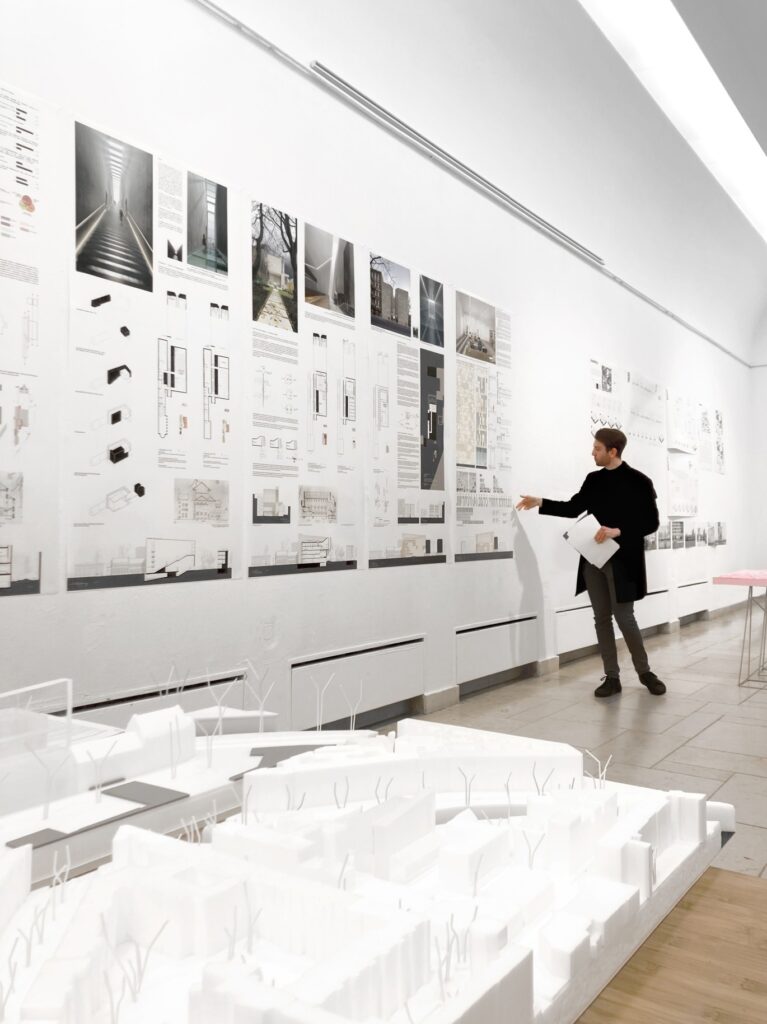
That is precisely why it seems questionable to me to reconstruct a synagogue from the outside.9 If the attempt is to succeed, its interior needs to be contemporary – and will inevitably be more than a mere house of prayer. However, if the interior is modern, it cannot simply be overlaid with a historical façade, but must unfold from inside to outside – in the consciousness of history. This was the aim of this project.
As the French socialist Jean Jaurès said, it is not a question of “preserving the ashes, but of carrying on the flame” – and thus linking the memory of destruction with a hope for the future, because the recent witnesses are mute. Soon no one will live who has ever seen the old synagogue with his own eyes.10 And thus the conditions of commemoration are also changing – because the vacancy in the city landscape is increasingly less and less often perceived as a void at all.
Between admonition and possibility – reflections on a will to create memories
So if the architectural Reconstruction In the final analysis, the question arises as to what a desire for design that is responsible for memory politics can look like at all – not as a mere reflection on supposed gaps in the cityscape, but as a conscious decision for a specific narrative form in public space. This is expressly not about culturally militant renaming rituals or the politicization of every stone, but rather about the simple realization that architecture – previously widely read as a political medium – often fails today because of lack of architectural and aesthetic education; therefore, too non-chalantly obvious proposals are created, which, in truth, treat reconstruction as an apparently unsuccessful all-healing remedy.
First of all, it would be necessary to demand that any form of restoration – whether historically inspired, formally citing or explicitly counter-thinking – openly acknowledge its intentions: What exactly should be remembered? By whom? And by what means? Reconstruction cannot be rejected in principle; it can have very good reasons for urban development, craftsmanship, liturgical or monument preservation – provided that the means are named, the goals established and the limits of the process are recognized. The claim that “only a facade is reconstructed remains a form of relief rhetoric, which ignores the political content of the architectonic and derives its legitimacy from an alleged innocence of building. Building is never innocent – but it also does not require moral overload, but clear justifications and visible responsibility.
The Frauenkirche in Dresden, for example, was supported by an unprecedented civic foundation and based on an exceptionally dense source situation – plans, photographs and material finds – and not only constituted the silhouette of the city, but also a functional offer of worship and music. The Neumarkt squares show how historically exact guiding buildings can be mixed with historicising new buildings without denying the city’s floor plan. In Frankfurt, the Dom Römer project succeeded in recovering small-scale parcels, artisanal detail and an everyday ground floor civicity. In Potsdam, the Stadtschloss, today Landtag, Palais Barberini and the reconstructed Alte Markt for ensemble healing, which restores urban edges, squares and visual relationships. Even large-scale reconstructions such as the Warsaw Old Town after 1945 or – in a different pitch – the Berlin Castle – facade reconstruction at a contemporary core – show that reconstruction can function as consciously told memory if program, use and claim to authenticity are clearly declared.
Such examples would allow for a more sober Catalogue of criteria win:
(1) a adequate documentation density (plans, photographs, colour and material certificates) for a scientifically acceptable approach;
(2) a Sustainable use and operation modelwhich does not degrade the reconstructed body to the backdrop;
(3) a Urban logic – intact parcels, Loadable axles, meaningful edges;
(4) a Publicly shared will to rememberbeyond tourism;
(5) and, where sacral spaces are affected, a liturgical and safety-related fit to the present.
According to these standards, almost everything on the banks of the Fraenkel is against the demand for Reconstruction: The documentation situation allows only an approximate spatial impression in the interior, but no conventional basis for a reconstruction according to scientific standards; the usage requirements of a living community (security zones, access rotations, Mikveh, Visual and spatial axesIn this particular case, reconstruction would not only be unwise, but – to put it plainly – materially failed to materialize, in contrast to a historical shell that rather hinders these programs than carries them; in terms of memory, the overbuilding of the invisible – the rupture would be aestheticized, the wound would be plastered up, the destruction to the backdrop; urban planning had shifted parcels, neighborhoods and technical boundary conditions to such an extent that a historical façade line would no longer be meaningful.
In the field of urban development, especially public buildings, greater emphasis would have to be placed on transparent negotiation of narratives of memory politics. It is not enough to restore a facade historically correctly if its interior is overburdened with symbolic significance – or even remains empty. Rather, a process should be established in places such as the banks of the Fraenkel, which not only brings together expert bodies but also civil society, the Jewish community, memory initiatives, research and art – not to create a smooth consensus, but to make the tensions visible, which call for memory.
Last but not least, architecture itself would have to be taken seriously as a cultural language again – as a medium that does not merely formulate answers but asks questions. A synagogue that is reflexive of its own history cannot simply “be as it used to be,” but must negotiate in the draft itself the breach, endure the irretrievable, make the ambiguity visible. Perhaps this is precisely where its dignity lies.
If memory is to succeed today, it must take the risk of being uncomfortable. It must not lose itself in the splendor of past forms, but must find forms that do not merely reflect the past, but question it. The reconstruction of a synagogue would then be no reconstruction in the narrow sense, but a multi-voiced continuation – an attempt not only to fill the space, but to open it up for what is missing. For what wants to be remembered. For what is not yet said.


See also:

- Bartetzko, Dieter: Resurrection from RuinsIn: Frankfurter Allgemeine Zeitung, 20.05.2014 ↩︎
- Controversy 1 — Accounts with Modernism? Dr. Paul Sigel, Prof. Dr. Susanne Hauser, Prof. Christoph Mäckler; in: BMVBS [ed.], Identity through reconstruction? — Documentation of the Baukulturwerkstatt of 16 October 2008 in the Bärensaal of the Old Town House in Berlin. Berlin, 2009, p. 35 ↩︎
- See Andreas Huyssen: Present Pasts. Urban Palimpsests and the Politics of MemoryStanford: Stanford University Press, 2003. ↩︎
- See Pierre Nora: Between History and MemoryFrankfurt am Main: Fischer Taschenbuch Verlag, 1990. ↩︎
- Friends of the Fraenkelufer Synagogue (eds.): 100 Years of Synagogue at the Fraenkelufer: A Century of Jewish Life in Kreuzberg 1916–2016. Exhibition catalogue, Berlin 2016. ↩︎
- See Alois Riegl: The modern monument cult – its essence and its originVienna: Verlag der Österreichischen Staatsdruckerei, 1903. Newly published, among others, in: Riegl, Alois: Collected essays, Volume 1. Vienna: Böhlau, 1995. ↩︎
- Prof. Dr. Georg Mörsch (20 June 1998), May monuments age?, ETH Zurich, Institute for Monument Conservation, p. 6 ↩︎
- Between 1900 and 1907, paintings were made for the University of Vienna, which were destroyed in 1945 during a fire at Immendorf Castle. ↩︎
- Hans Rudolf Meier: Reconstruction – a misguided path? In: Bundesstiftung Baukultur (Hg.): The Reconstruction of the Old Town. Desire and Reality. Berlin: Jovis, 2010, pp. 29–34. ↩︎
- See Harald Welzer: Communicative Memory – A Theory. In: Harald Welzer, Sabine Moller and Katharina Tschuggnall (eds.), “Opa war kein Nazi.” Nationalsozialismus und Holocaust im Familiengedächtnis. Frankfurt am Main: Fischer, 2002, pp. 23–34. ↩︎