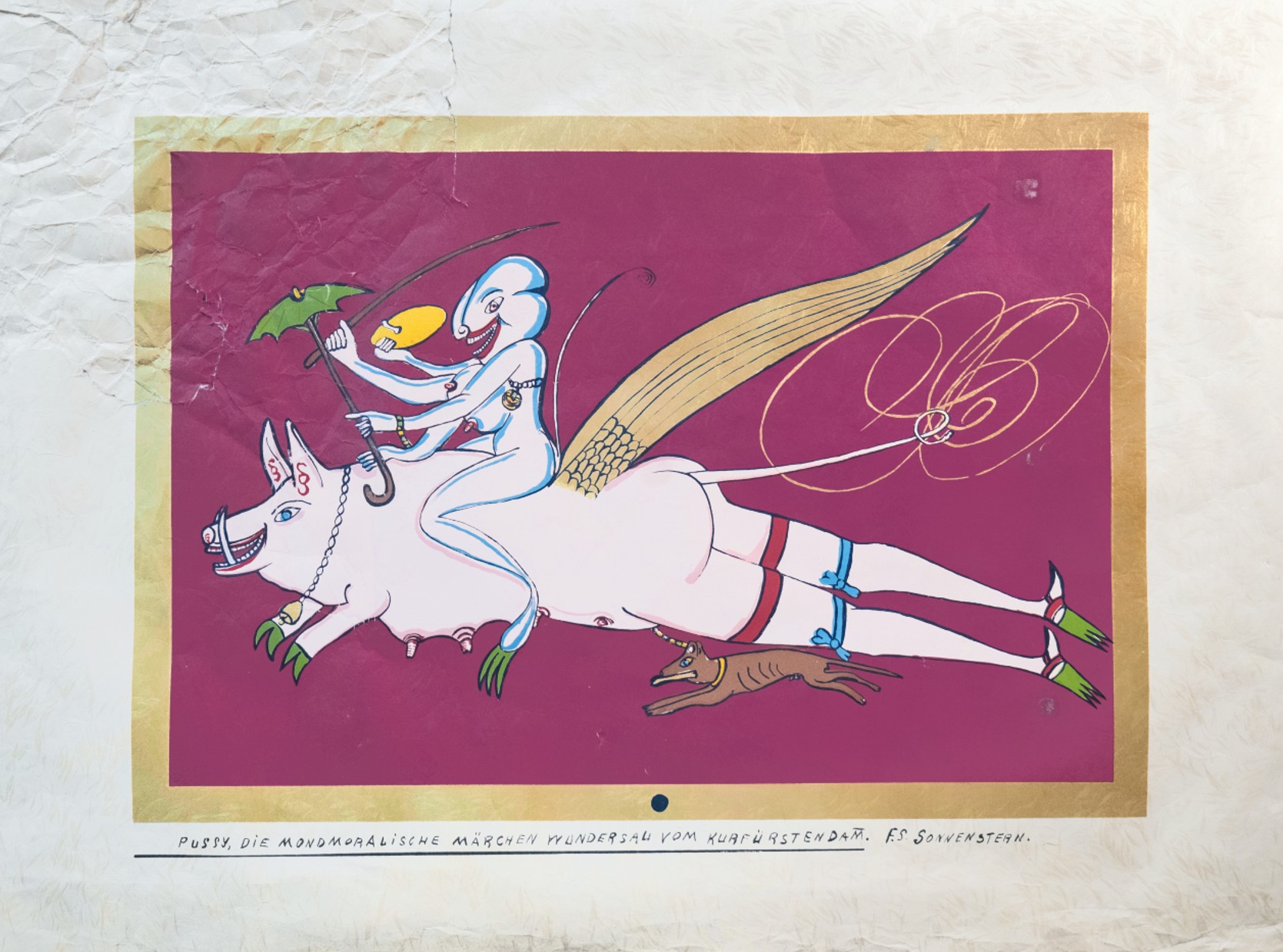
“I practise the most beautiful, most disgusting pictures in the world.”
Friedrich Schröder-Sonnenstern, quoted from a collection of his statements compiled by Jes Petersen, Berlin, from handwritten notes and tape recordings.

In Die Pferdearschbetrachtung (The Horse’s Arse Contemplation), a collection of Schröder-Sonnenstern’s writings compiled and published by Jes Petersen in 1972, states: “Sonnenstern’s philosophy and work can only be understood if all the pictures were hung close together on an enormous wall. All the pictures are merely sections of the great Sonnenstern philosophy.” The collection’s principal works do indeed hang together as the self-proclaimed “triple world champion” suggested. “He would be very pleased with the wall,” says the collector.
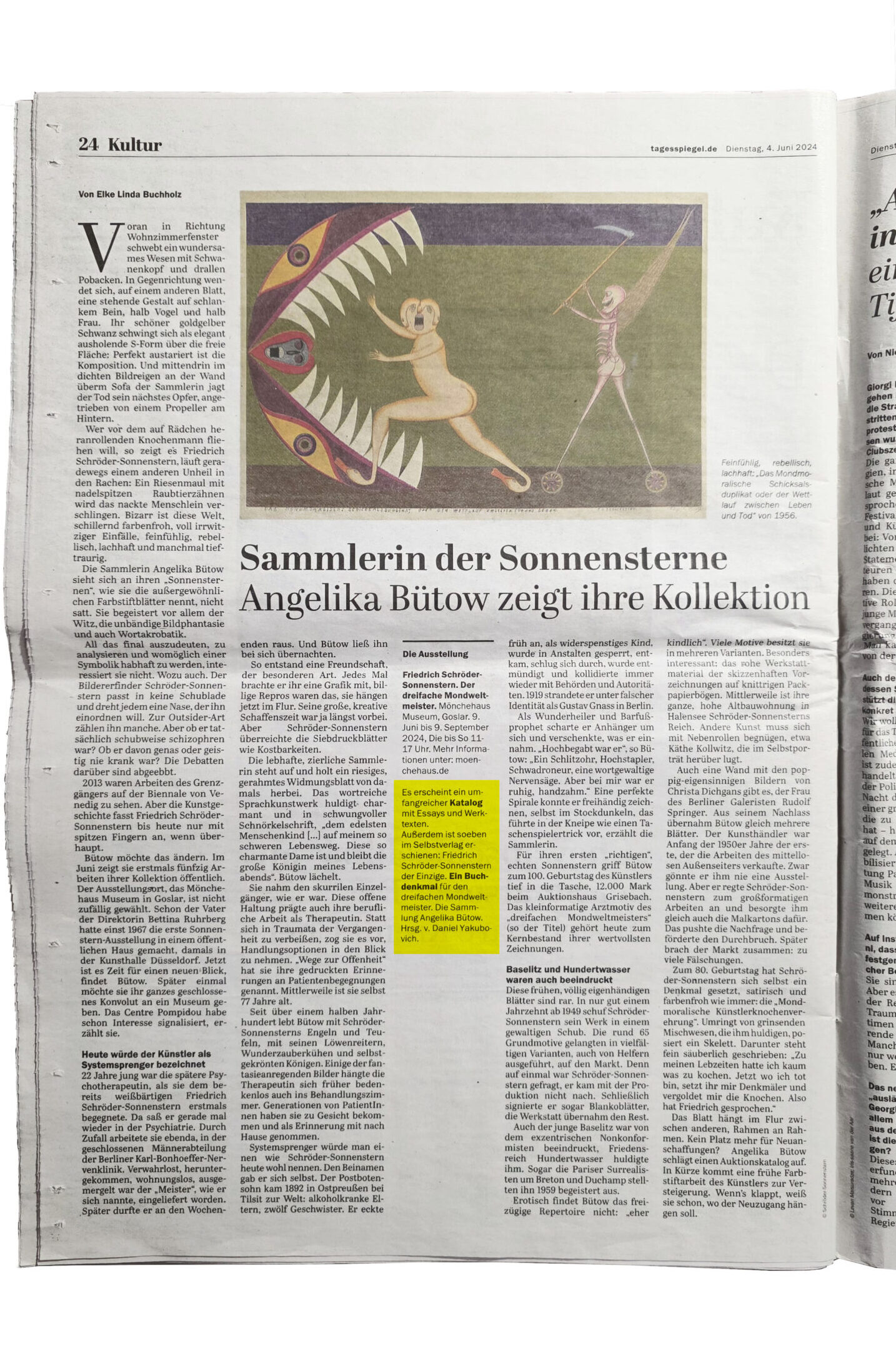
With no false modesty and a healthy dose of self-irony, this publication consciously calls itself a “book-monument” in its title. For the first time, it brings together in a coherent form what accumulated over more than five decades in a Berlin flat, first in Wilmersdorf and later Charlottenburg, into what is probably one of the most important private collections of Friedrich Schröder-Sonnenstern’s work: the multilayered relationship—marked simultaneously by intimacy, irritation and professional distance—between the psychotherapist Angelika Bütow and the artist Friedrich Schröder-Sonnenstern. Long labelled “mentally ill” by psychiatry, the self-taught artist is now regarded as one of the most important representatives of Art brut. Their correspondence, numerous dedications by Schröder-Sonnenstern and the recollections of the young therapist, then still in training, form the core of a private collection shown publicly in its full breadth for the first time at the Mönchehaus Museum in Goslar in 2024. Edited by Daniel Yakubovich, the book conceives itself as a double portrait. It illuminates the artist through the prism of a collection that developed over time, and the collector as both eyewitness and co-author of this narrative. The deliberate interweaving of these perspectives reveals how closely work and author condition one another, while insisting on separating them analytically to enable as unprejudiced a view as possible of both Schröder-Sonnenstern the person and his pictorial world.
In the first part, the collector gives an autobiographical account of meeting Schröder-Sonnenstern in the late 1960s, her years in everyday clinical work, the “master’s” visits to her Wilmersdorf flat and a West Berlin milieu in which psychiatry, the art world and subculture intersected. She describes him not as a “case”, but as a wilful, intensely alive person with an archaic will to survive, unfolding his “tragicomic operas” in image and word. The book thus corrects the long-dominant view in psychiatric literature and shifts the focus from diagnosis back to the work. Here pictures are not symptoms, but moral pictorial narratives, grotesque parables and idiosyncratic comments on post-war society.
The subjective strand of historical recollection is set against a source-critical catalogue of the works in the Angelika Bütow collection. Each sheet is documented through technical information—date, medium, dimensions and signature—provenance, exhibition history and bibliography, alongside brief descriptions and iconographic commentary. Existing research and commissioned expert opinions also identify questions of attribution and authenticity, while making visible the transitions arising from copying, workshop practice and later attributions. This overview clarifies the complex problems of transmission and authenticity in Schröder-Sonnenstern’s oeuvre without altering or replacing the character of the expert opinions.
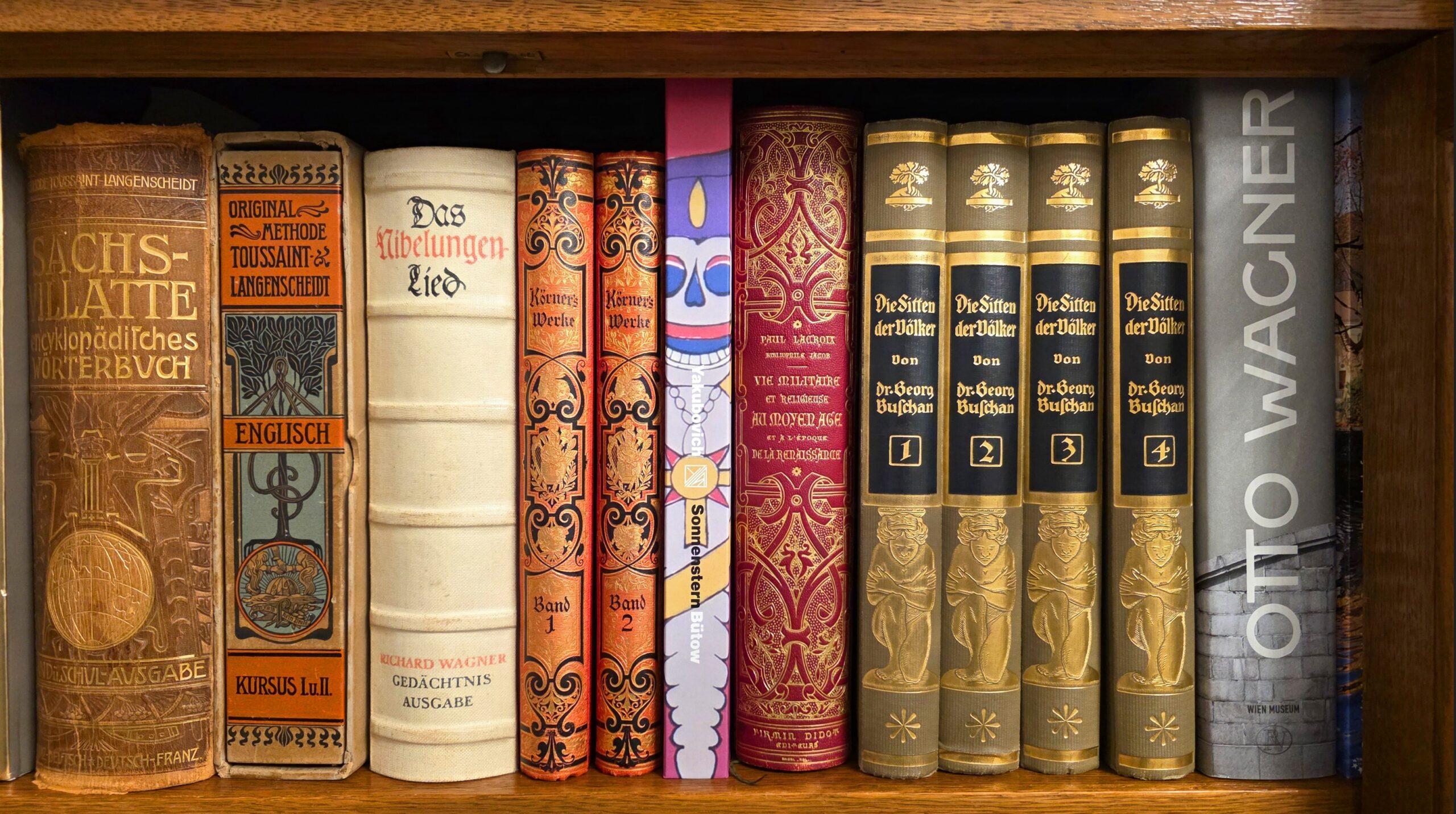
Methodologically, the catalogue follows a distinctive organising principle. Works are presented in the order in which they entered the Bütow collection, supported by purchase receipts, delivery notes, transfer confirmations and correspondence with dealers such as Rudolf Springer and Jes Petersen, and with other sellers. Instead of hierarchies based on stylistic criticism or the history of motifs, a sober chronology of auctions and acquisitions makes visible the burning trace of a collector’s life. From this perspective emerges something like a “proto-catalogue raisonné” of Sonnenstern works within a single collection: open to later additions, but internally coherent and as precise as possible in its treatment of sources.
The making of the book is itself part of its narrative. For decades, Angelika Bütow preserved photographs, newspaper cuttings, letters, dedications, invoices and digital copies in the knowledge that they must one day become a book. The editor takes up this material, orders, systematises and digitises it, renews old contacts and brings previously unpublished works by Schröder-Sonnenstern to light. The publication deliberately positions itself within existing research, including Ferentschik, Gorsen, Schmied and Werner/Kort, extending it through the perspective of a concentrated Berlin private collection that speaks from within the relationship between artistic practice, collector and market. Selected passages are also available in English translation, making central sections accessible to an international audience.
The result is a hybrid volume between memoir, collection catalogue and research contribution: a historical document of the West Berlin art scene, a carefully compiled catalogue of privately owned works by Schröder-Sonnenstern, and a reflection on how perceptions of this artist have changed through forgery scandals, scholarship and collectors’ perspectives. Its conception addresses readers interested in art history, collecting and West Berlin’s recent history, while retaining the character of a private documentation reproduced in a small number of copies.