
Raed Saleh himself says that he cannot be a good Muslim if he does not stand up for the diversity of religions and protect members of all faiths from hostility – which is why he suggested: “A city that builds castles should also build synagogues.“1
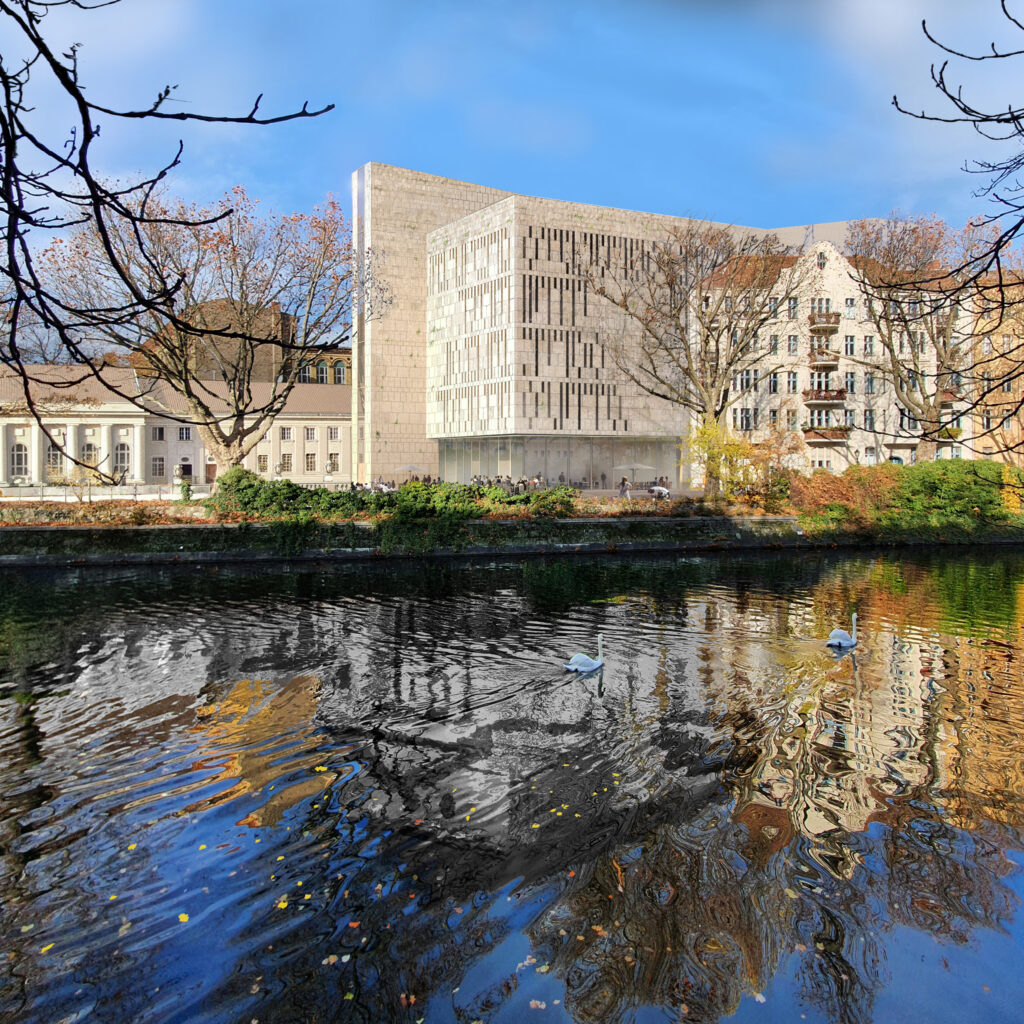
However, the public response to this proposal has so far lacked a well-founded examination of the question whether the reconstruction of the castle was at all a correct step, that the school should take – or whether it is not legitimised only retroactively by its implementation. Reconstructions – regardless of its historical comparability – is it allowed to repeat similar things elsewhere? Is the gesture of the external reconstruction of a synagogue according to historical plans still contemporary today – would it strengthen the integrity of Judaism in Germany, or rather does it lead to the fact that the suffering and destruction of the Nazi era seem forgotten as if it had never existed? Is the reconstruction a new beginning – or already the new beginning from the end, because the destruction by its external repetition only appears as a subplot of history and no longer seems so bad when everything can be rebuilt so easily? Should not the breaks of history remain visible, so that we can learn from it? How can destruction be remembered when it is no longer visible in the city space? Isn’t it an inner contradiction under these circumstances, in the space program, to formulate a memorial for the memory of destruction? Is the reconstruction a memory – or is it already forgotten? What can a contemporary culture of memory look like if the disappearance of recent witnesses also diminishes the painful emptiness of those places where once proud buildings stood – and this emptiness is increasingly perceived as such? What does it mean to build a modern synagogue in Germany? And what does it mean to reconstruct an old synagogue – one whose history has not only been built but also destroyed? Can both be thought together at all – or is there already an insoluble contradiction in simultaneity? If so – how? And above all, with what narrative in its luggage?
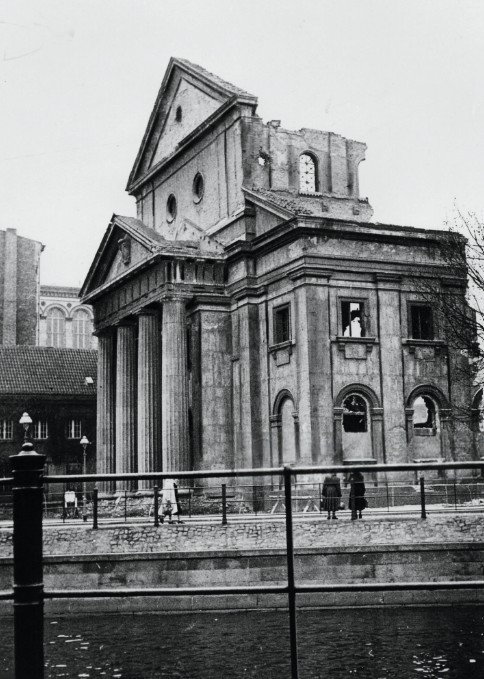
Synagogue Fraenkelufer, around 1959. Remains of gravity – an Orthodox church that still preserves attitude while the official extermination is already prepared…
Synagogue Fraenkelufer around 1959. © ullstein bild
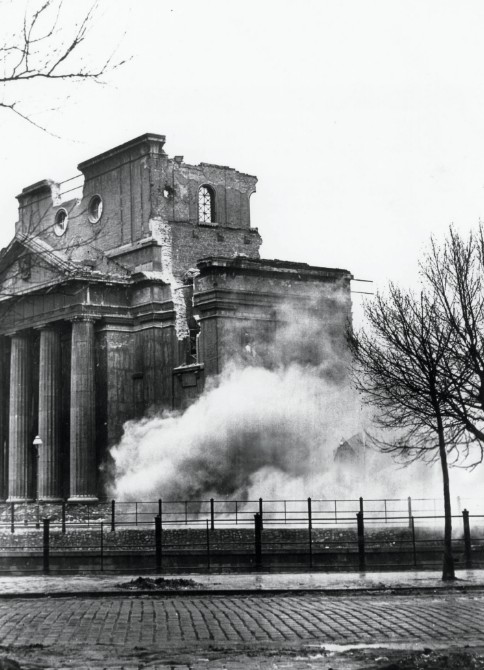
…the authorities call it clearance, the photograph shows a negative liturgy: a short smoke rise as a final “amen” out of stone; the body disappears, the commitment of the place remains.
Architecture as an argument — Between National Narrative and Remembrance Policy Responsibility
From the reflection on the long history of Judaism in Germany to the longing for “good old times” – “before the great German guilt”, such as the Dutch cultural historian Merlijn Schoonenboom2 With regard to the Berlin Castle, from the (conspicuous) normalization of the synagogue as a natural component of German building history to the subtle devaluation by excluding the historical singularity of the industrially executed genocide, from the hope that one can build on the former heydays of German Judaism, to the resignation in the face of an uncertain future without present equivalents – and finally from the desire to remember the dead, to the no less legitimate desire to be able to live again, the mere proposal of reconstruction of a synagogue in that very place reveals the social fractures which would be overly easily obscured in the smooth robe of reconstruction.
It is precisely because our memory not only weakens, but transforms – and therefore we are in a state of permanent self-questioning in which it would always be necessary to clarify who we are and what constitutes us – that place opens up the possibility to ask this question. And perhaps also to answer it. As an exemplary case for the field of tension between memory and the future, the synagogue on the banks of the Fraenkel – in its historical and future form – can be read as a test stone for the memory-political seriousness of our time. The present work sees itself as an attempt to give an answer to this – and as an invitation to think further about it.
The question of Reconstruction can only be viewed appropriately in the light of different perspectives – for example, that according to its objective: what is to be achieved with it, what is to be brought back, what is to be remembered at all? Is it a question of symbolically resurrecting the empire in the form of the old synagogue – or should the present, colorful Germany be read into the imperial cubature as it were, and indeed written into it? And if the latter: how?
This question immediately leads to the next one – namely, why we care so much about reconstructions at all. Authenticity the material and thus with one of the central points of contention of preservation of monuments and reconstruction theory. From this can be derived the examining conclusion, whether – and to what extent – the declared goal of a reminiscising spatial shape can be redeemed by a reconstruction at all.
In his contribution “Rebuild the synagogues!” – published on 9 November, the date of historical importance chosen with caution for the FAZ 2017 edition – writes Raed Saleh“Before the National Socialists took power, the former church had stood for proud, self-confident and home-linked German Judaism.” And the darkest chapters of the past would remind us “at all times […].” According to Saleh, this was not an individual fault of today’s generations of Germans; rather, German society bears a responsibility for the crimes of the past – “not backward-looking, but forward-looking”. This formulation initially suggests a vision that aims less at the reproduction of a past than rather at the new production of history, the future – and as a result of space.
The SPD politician continues to argue that today’s Germany is one of the “most tolerant, cosmopolitan, liberal, most modern and advanced countries in the world” – and then draws a surprising parallel to the Empire: the current social openness, according to Saleh, is also the result of a society “always founded on immigration and characterized by the mixing of different cultures.”
As a reminder, around 1890, the German Empire – directly after the United States – had the second highest rate of immigration in the world. Only today this was largely forgotten. According to Saleh, the current construction activities do not take account of this historical reality.
At the end of his contribution Raed Saleh criticizes that all previous reconstruction attempts in the best Germany we have ever had3 In the end, “half-heartedly” – only “foundaments have been excavated and rebuilt”, but not the building as such has been rebuilt. That is precisely why, according to Saleh, “a strong sign must now be set by restoring the old synagogue as a “deep German place”. As he writes, “one should take courage and affirm this part of our national narrative just as confidently as the Germany of castles and churches.” Finally, Saleh affirms: “He will definitely support the reconstruction of a synagogue like that on the banks of the Fraenkel.”
Raed Saleh’s speaking with Pathos may seem to him as an act of political prudence – a rhetorical gesture that seeks to reconcile memory-cultural commitment with national narrative. However, it is precisely in the stylistically charged, yet structurally unconceivable argumentation that a dilemma emerges, which is exemplary for the misunderstanding with which political representatives too often venture into architectural debates: with their hearts at the right spot – and with their theory far away.
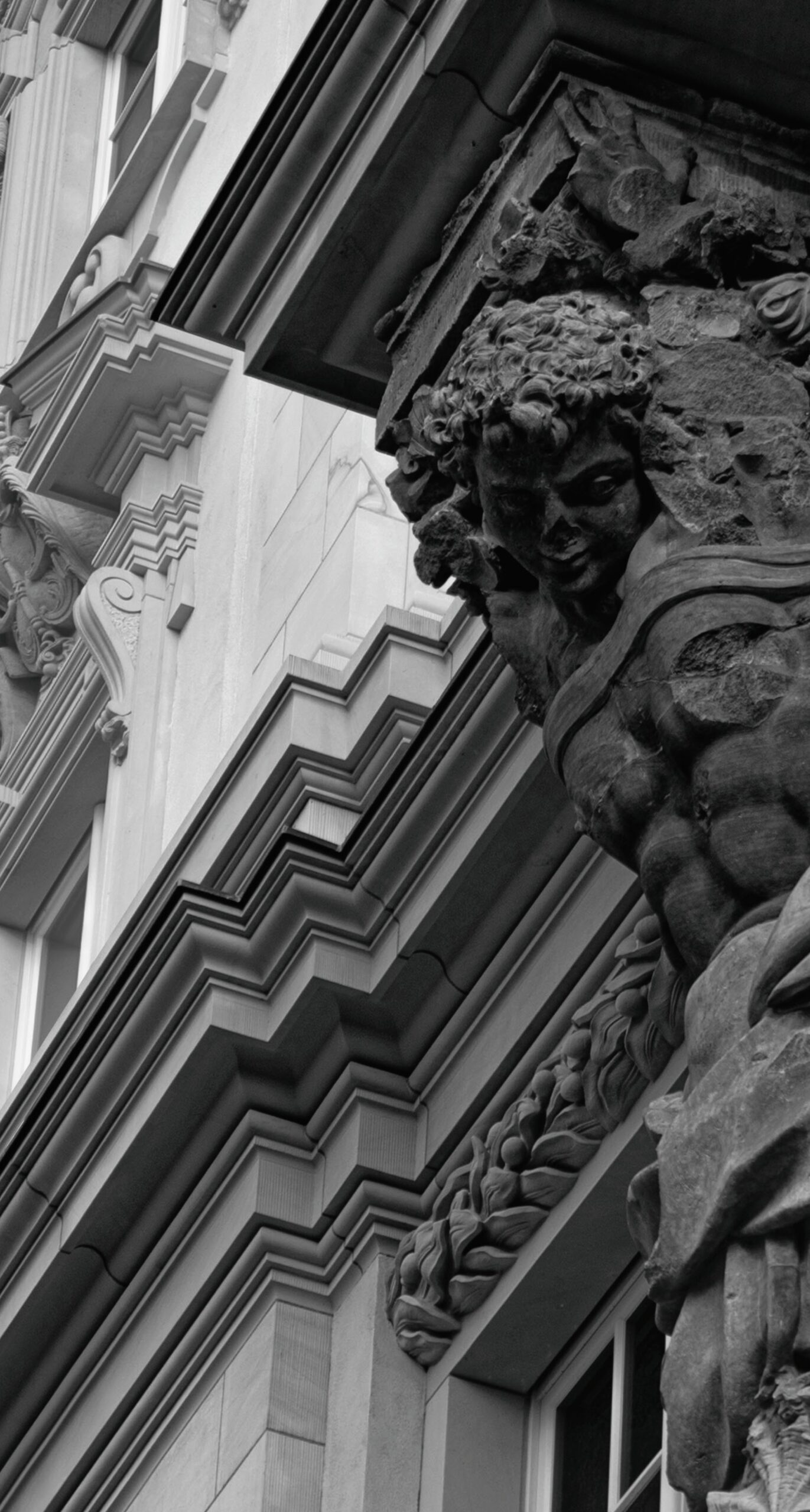
The recovered sculpture originates from the original Berlin castle – everything else is a retelling in stone. What seems like wholeness is in fact the artistically applied assertion of an original that only exists in fragments.
© Daniel Yakubovich.
Scenery or culture? About the danger of self-empowerment
Saleh But the well-meaning here results in a series of promises, whose semantic surplus is in flagrant disproportion to the substance of architectural history and memory theory. The equation of synagogue and castle, of historical wound and monarchic representational rage, reveals more about the need for unity of discourse than about its complexity. The assumption that with reconstruction a “national narrative” can be completed or even healed, ignores the actual imposition of every serious memory culture – namely, that it does not aim at redemption, but rather at irritation, inconclusiveness, at making visible the crack in the continuum of history.
In addition, the almost touching, albeit disturbing naivety, with which Saleh translates architectural theoretical questions into a set of political confessions: as if the question of Authenticity and materiality, in form and context, by recuring to historical immigration rates or by quoting from the law on building regulations. One of the particularly striking blind places in his speech is that he reduces the synagogue space – its origin, its destruction, its memory-political gravity – to a national backdrop which he wants to refine through semantic elevation. However, the pathos of the backdrop do not replace their content.
If now the call for Reconstruction In the political vocabulary of a man who, according to his own evidence, feels obliged to tolerance and cosmopolitanism, there is a suspicion that here there is a symbolic-political reflex at work, which has less to do with the specific history of Judaism in Germany than with the desire to stabilize a social narrative by architectural gesture, which has long since become out of its way. However, where political longing meets memory-cultural ambivalence, there is no viable construction plan – but rather a monumental error.
What is overlooked – perhaps because it is harder to grasp than numbers or quotations – is the fragility of what is really at stake: not stone, not facade, not national narrative, but space in between. About what is missing. About the gap that cannot be closed. But precisely there architecture begins as a memory. Whoever overlooks this – or wants to pass over – runs the risk of building a monument of self-deception instead of a memorial of memory.
It is precisely in this constellation that it becomes clear that the danger of an overly willing reconstruction does not lie in itself, but in the attitude with which it is carried out: whoever understands what is rebuilt above all as proof of national greatness and civilizational resilience, overlooks that architecture – especially in places of historical violence – is not merely a body in space, but a bearer of narrative. The return to the visible alone heals nothing if the invisible is not remembered at the same time. A synagogue re-established by political declamation without the fragility of its history continuing in its design is no longer a built appeasement. And a memory that is poured only in stone but not in form comes to illustration. Raed Saleh In the midst of this debate, terms such as “strong sign”, “courageous confession” and “national narrative” inflationaryly strung together without reflecting on their architectural historical, historical and semantic ballast are not evidenced by visionary power, but rather by a naively overformed will to create, which confuses the irretrievable with the recoverable – and the rebuilt with the re-established.
The fact that politicians have to stage themselves in all this – as advocates of progress, as born conciliators, as eloquent guardians of the interreligious dialogue with a biographically charged bonus of origin – is probably due to the nature of a political enterprise which has long since become more a stage than a burden. It is not possible to completely blame them for this reflex of being surrounded by the aura of good and at the same time acting up as architects of a morally charged future. Self-marketing is part of the profession, and those who today do not circulate a narrative of themselves have little chance of resonating in the political discourse. However, one should not fall into the error of confusing this narrative domination with epistemic authority. Because where personal mission consciousness radiates the complex lines of tradition, not only the memory in the shadow threatens to disappear – but also the seriousness of the debate itself.
It would be naive to expect politicians to know everything. But it is dangerous if they don’t want to know – and the less determined they appear, the less they reflect. The history of architecture doesn’t know a friendly word for this attitude, and also the culture of memory does well not to let themselves be drawn to the stage of randomness, on which every quotation, every ruin, every historical line is only more decorative instrument of political self-telling. That education alone is no guarantee of attitude is beyond question – but where the cultural memory of a nation is translated into built space, where memory is poured into stone, history is displayed, loss is symbolized and future is thought, there would be a minimum degree of depth of mind, historical sensitivity and architectural differentiation not an elitist presence, but simply a prerequisite for the dignity of the undertaking. A place of the future should arise, not a backdrop of a past that one cling together again because one cannot tolerate its rupture.
What remains? Perhaps the quiet consolation that every form of exaggeration will eventually expose itself – and that if the space is thought wisely, it can say more than a whole legislature period. However, everything else – would be material for another chapter. And perhaps also for another genre.


See also:

- Raed Saleh (November 9, 2017), Rebuild the synagogues! FAZ ↩︎
- Merlijn Schoonenboom (17 November 2020), A Palace for the Republic. A Small History of the Great German Search for Identity, Argobooks, Berlin ↩︎
- Federal President Steinermeier at a ceremony and ecumenical service in Potsdam on the 30th anniversary of the reunification ↩︎