Thomas Klatt from RBB Kultur on representation, participation and the role of architecture in memory
Source: RBB Kultur, broadcast “Schalom”, November 22, 2022. Edited by Almut Engelien. Contribution: Thomas Glatt on “The Synagogue Project” and a conversation with Daniel Yakubovich.
Note on the text shape
The following article is based on a conversation broadcast on the radio. No literal transcript of the broadcast, but an independent account of its content by the author. This text is not a publication of RBB Kultur; editorial responsibility rests with this website.
For copyright reasons, the statements of the parties are mainly paraphrased and in indirect speech sequence, selection and formulations follow the content structure of the conversation, not the technical editing of the original broadcast.
An exhibition project on destroyed synagogues
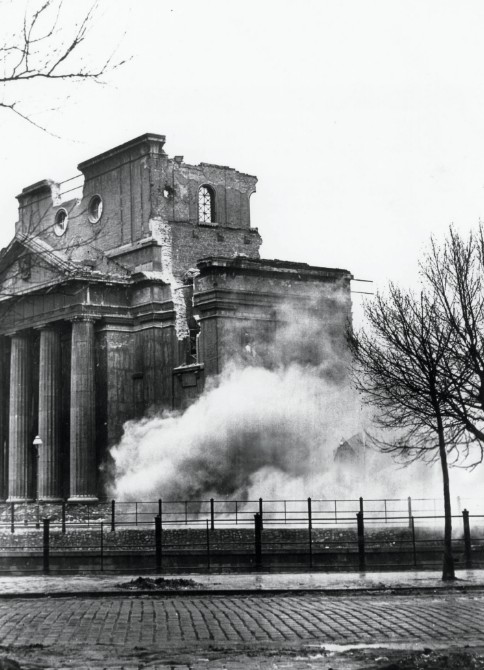
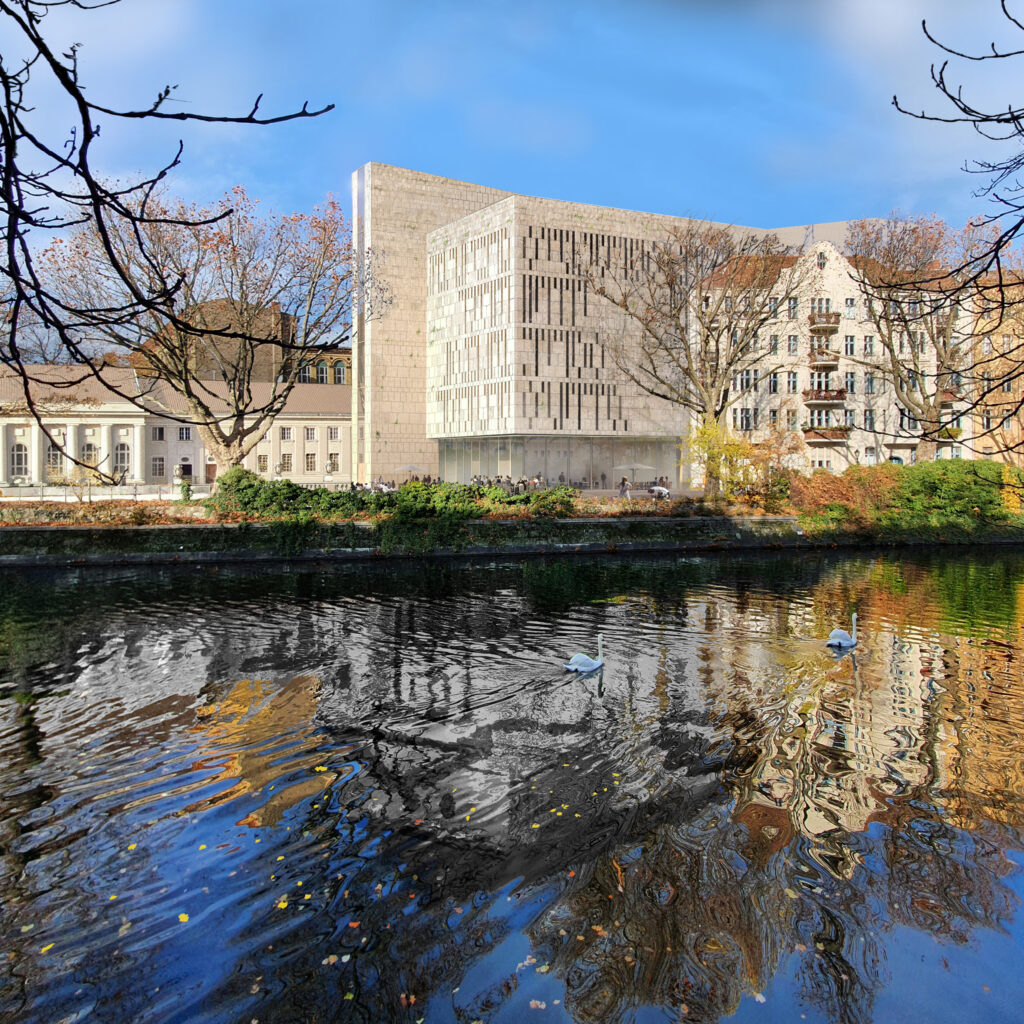
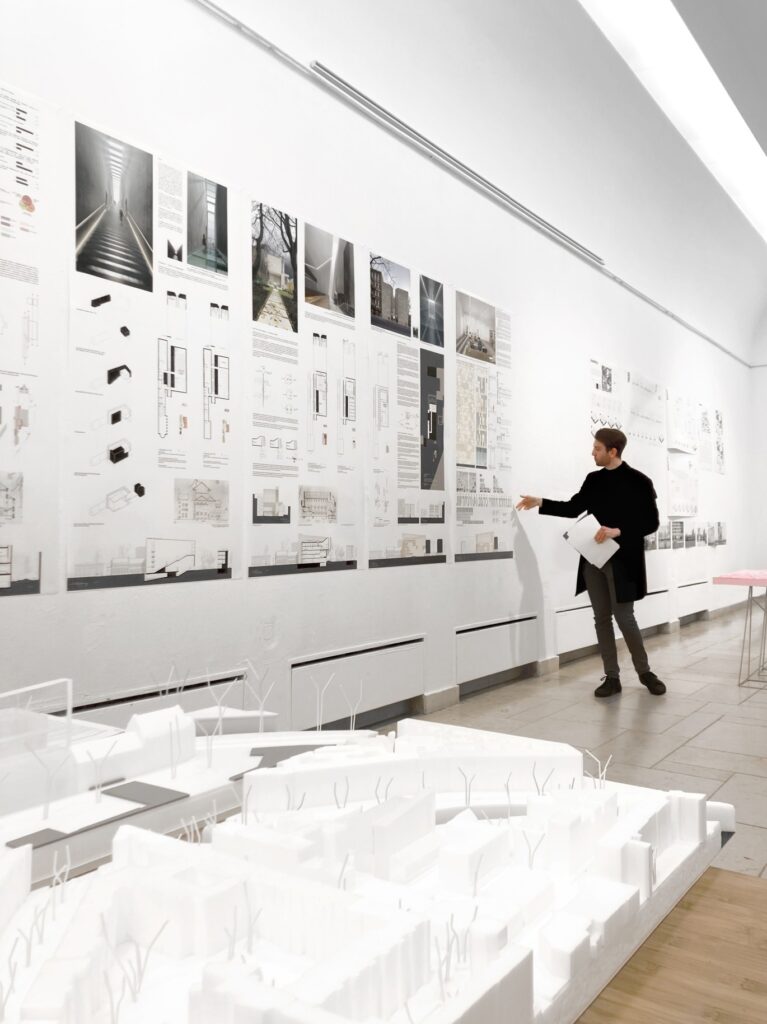
The programme’s starting point is an exhibition entitled “The Synagogue Project”, shown in the Berlin House of Representatives and parallel on the Internet. Students’ designs for reconstruction or new construction of three synagogues destroyed in November 1938 – including the large synagogue on the banks of the Fraenkel River in Berlin. Introductory political voices are reminiscent of the fire attacks of 1938, the subsequent demolition of the ruins and the present situation: a growing community that reaches its limits spatially. The radio article describes student designs as a range between restrained and self-confident: it is a competition for ideas, not concrete building planning, predominantly modern in appearance and spitted with historical quotations.
A participating architecture professor points out in the discussion that many teachers and students both Jewish life and the liturgical dimension largely alien At the same time, he stressed the difficulty of dealing with the “significant effect” of architectural images – a level that had become unfamiliar in contemporary architecture.
This self-description marks a starting point: designs for Jewish sacred spaces are largely developed by non-Jewish actors who explicitly name their own distance – without this being critically deepened in the contribution.
“No single Jewish or Israeli student
At this point, Daniel Yakubovich’s voice is used, which is presented in his contribution as a Jewish architectural graduate from Berlin. He has presented a master thesis on the planned reconstruction of the synagogue on the banks of Fraenkel, which formulates an independent counter-project to the idea of reconstruction. That his work is not part of the synagogue project is named in the radio article as the starting point of his criticism.
Yakubovich himself puts it this way: “No single Jewish or Israeli student from Berlin is represented among the exhibited designs – but it would have been her perspective that would have been indispensable in the question of how synagogues can be thought architecturally in a democratic society today.
The paper points out that the visible result area – the designs shown – lacks an original Jewish-Berlin perspective. “It is striking that none of the four Berlin architecture faculties – neither the UdK nor the TU Berlin, nor the former Beuth University or the University of Applied Sciences – was included in the exhibition. This raises questions, especially with regard to integrating local perspectives from Kiez, city society and Jewish community.
This means that in a project that explicitly deals with Jewish building culture, neither local colleges nor Jewish or Israeli students have been structurally integrated from Berlin – a blank space that the radio article names but does not comment on.
Design synagogues – with whom and for whom?
Between the political classifications, the presentation of student designs and the O-tones from the architectural scene, the program draws a picture in which Jewish places are primarily spoken from outside.
Yakubovich’s intervention is less directed against the students themselves than against the institutional frameworkIn which they work: against a constellation, in which synagogues as symbolically high charged tasks without Jewish speaking positions being structurally involved – neither on the part of the teachers nor the designers. Transferred to the synagogue project means: If design and interpretation authority over Jewish memory spaces lie largely in non-Jewish hands, a Architecture without religious grammar and a building of memory that tells more about the institutions he is responsible for than about the community whose history he touches.
“Until the start of construction, there seems to be a need for discussion
Towards the end of the radio contribution, it is stated in summary that there is still “need for conversation” until the construction begins on the banks of the Fraenkel. The formulation indicates a tension without further spelling it out: between well-meaning visibility, political symbolism, academic ideas sketches and the actual participation of those for whom synagogues are concrete religious and social spaces. The RBB broadcast makes this conflict visible without completely carrying it out. The article documented here tries to trace the lines laid down in the radio contribution and at the same time strengthen those voices which occur in the synagogue project itself only on the margins: the perspectives of Jewish architects, researchers and communities whose participation in the design and interpretation of Jewish architecture should not be an exception but a prerequisite.
Source: RBB Kultur, broadcast “Schalom”, 22 November 2022. Edited by Almut Engelien. Contribution: Thomas Glatt on the synagogue project and a conversation with Daniel Yakubovich.
Subsequent remark
The following criticism reflects the perspective of the author and sees itself as a contribution to the media-critical classification of the broadcast:
The RBB broadcast “Schalom” of November 22, 2022, entitled “The Synagogue Project” was dedicated to an exhibition of student designs for the reconstruction of historical synagogues in Berlin and Hamburg with a focus on the synagogue on the Fraenkelufer. What was intended as a contribution to a differentiated discourse of remembrance reveals central blind spots in its structure and selection: a structural omission of Jewish speaking positions in a debate that explicitly revolves around Jewish places, Jewish commemoration and Jewish community life.
The editorial team chooses a narrative framework that is limited to a series of well-meaning voices: political representation (Dennis Buchner), architectural outside perspective (Jörg Springer), journalistic framing (Thomas Klatt, Almut Engelien). What is missing is a deeper discussion with the question of who speaks, for whom and on what basis. Although reference is made to the growing community life on the banks of the Fraenkel – but the perspectives of the affected community itself, as well as Jewish voices within the architectural discourse, appear only marginalized or commenting later in the contribution. The fact that neither Berlin architecture colleges nor Jewish or Israeli students were involved in the project is named in the contribution, but remains largely uncommented by journalists.
From the author’s point of view, it would have been up to the editors not only to name this space, but also to contextualize it: Why does Jewish participation become an exception in a synagogue project? What mechanisms of speaking about, rather than with Jewish actors are effective here? And to what extent does the reporting also reproduce these structures? This asymmetry is particularly evident in the quoted statements by Jörg Springer. The statement that “one is little familiar with Jewish life or even the liturgy and has trouble with the “signal effect of architectural images” is left uncommented – and acts more like a relief in the ductus of the contributionThe fact that the project management is left to a highly symbolic building task such as a synagogue, without reflecting on liturgical, historical or community-specific questions, however, would have been an occasion for journalistic research.
There are no shortages of experts in the field of synagogue construction and Jewish sacred architecture in Germany, who have been involved in the debate or even in a university design project with sufficient expertise. The architect Kay Zareh (Berlin), for example, who has renovated historical synagogue buildings over many years; the Judaist and architectural historian Dr. Rachel Heuberger (Frankfurt), who deals with spatial concepts of Jewish meeting places in German-speaking countries; or the historian Prof. Dr. Julius H. Schoeps, who published on the political symbolism of Jewish building forms. Prof. Johannes Modrescu (Cologne University of Technology), co-author of a standard work on the relationship between space and ritual in modern synagogue construction, could have been used as an advisory head or critical voice. They are all well-known connoisseurs of Jewish building culture – and, unlike the students, have a much more profound architectural and liturgical expertise.
Instead, in several student drafts – for example in the context of the Weimar contributions – obvious references to Japanese shrines are waved through, without a single critical intervention being documented by the teachers. The fact that an architecture professor such as Jörg Springer publicly admits that he is not sufficiently knowledgeable in the field he teaches and is not relativized by collegial addition, external expertise or editorial classification points to a deeper problem. It is less about ignorance than the void that arises when no one objects. The result is an architecture without religious grammar, a reconstruction without historical differentiation – and a building of memory without memory.
Thus the mission remains ultimately undecided in its quest for reconciliation: between well-intentioned visibility and an unconscious reproduction of that structural exclusion which it actually wants to overcome.



See also: