Sarah Durrer from the Jewish weekly tachles about the synagogue on the banks of the Fraenkel and a counter-project by Daniel Yakubovich
Source: tachles – Jewish weekly newspaper, issue 47 of November 25, 2022 (22nd year). Article by Sarah Leonie Durrer on the planned reconstruction of the synagogue at the Fraenkelufer in Berlin-Kreuzberg and the counter draft by Daniel Yakubovich. Online version on tachles.ch (Paywall).
to the contribution on the website of Deutschlandfunk Kultur following link:

Note on the text shape
The following article is based on an article in the weekly newspaper tachles published articles. It is not a literal transcript and not an authorized second publication, but an independent content reproduction and commenting of the author. The text is not a publication of tachles and is the editorial responsibility of this website. For copyright reasons, the statements of the parties are primarily paraphrased, reproduced in indirect speech, partly summarized and contextualized. Orders, selections and formulations follow the content structure of the article, not its exact text shape.
Reconstruction plans on the banks of the Fraenkel
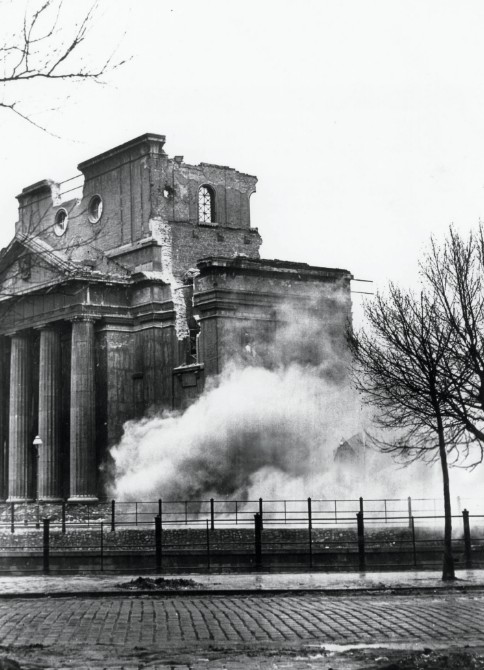
tachles The large synagogue on the banks of the Fraenkel was inaugurated in 1916, heavily damaged during the imperial pogrom night, further destroyed in the war years and demolished at the end of the 1950s. The side wing with the former youth Synagogue, which had already been restored to Rosh ha-Schana in 1945, has been continuously used as a Bethau since then.
The idea of a reconstruction for several years is supported by the association “Jewish Centre Synagogue Fraenkelufer” (JZSF), whose foundation in 2018 on a proposal of the Berlin SPD politician Raed Saleh The association plans a Jewish cultural and community centre that “is designed to orient itself in size and form according to the original, with rooms for prayer, community life, cultural events, day care and café. Visualisation of the architect Kilian Enders strongly leans on the historical building, but in bright white.
At the request of the newspaper, the JZSF chairman stressed that there was not yet a final draft; at the end of a feasibility study, a competition or selection procedure were planned in the next step. A new building should be clearly based on the original out of respect for history.
Hamburg as a contrast: The Bornplatz Synagogue
As a comparative case tachles the Bornplatz Synagogue in Hamburg, whose reconstruction is politically supported after a positive feasibility study. An architectural competition has already been announced there; the new building will take on the historical form but be developed as a contemporary building. The well-known ground mosaic, which marks the layout of the destroyed synagogue, will be integrated into the new building. At the same time, it is recalled that historians and artists spoke out in a declaration against the reconstruction and for the preservation of the mosaic – an indication that there is public debate in Hamburg.
For Berlin, the article, on the other hand, notes a striking silence.
“Let’s pretend nothing happened
For Berlin, the article states the opposite: A conspicuous silent debate. tachles quotes Daniel Yakubovich with his diagnosis, and the Berlin reconstruction proposal conveys a message that he feels to be unbearable: “For me, the design unintentionally transports the message: Let’s pretend Crystal Night, National Socialism and Holocaust never happened.For him it is more than just a style debate. It would also be about the Message that sends a building from past days into the present. “He who reconstructs a destroyed synagogue, thereby reconstructs the horizon of the imperial era. In Berlin 2020ff. this seems as if the historical breaks did not exist.”
A counter-draft: Protection area and Wailing Wall
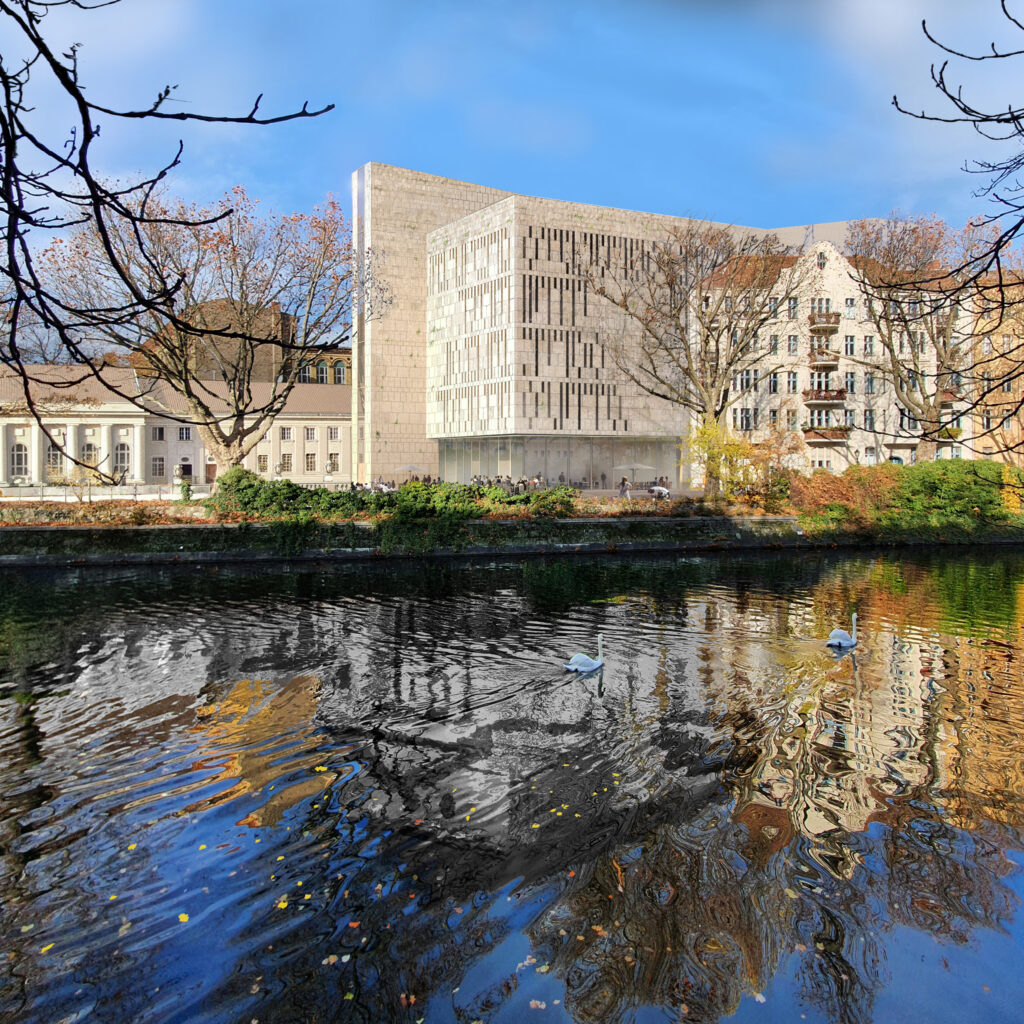
tachles presents Yakubovich’s master thesis as alternative proposal His design integrates the existing youth Synagogue into a multi-storey, sand-coloured body; the synagogue is protected in it and at the same time reframed.
Yakubovich describes the guiding idea as follows: “The house should look outwards like a symbolic shelter – and there is a large wall reminiscent of the Wailing WallThe construction thus deliberately refers to the Temple Mount in JerusalemThe grand form sees Yakubovich as a contemporary answer: a space for prayer, community life and culture that is conscious of not the facade of the destroyed original is repeated.
Remains in the ground – and the question of building
Special attention will be given to: tachles-Article of Topography Yakubovich points out the hilly terrain and suspects that the embankments have arisen after the destruction of the high cellar and high ground of the synagogue. It is conceivable that there remains of the synagogue still exist. Bima From this he derives a clear position: “If beneath the hills there are still parts of the high cellar and the Bima, these areas would have to remain undeveloped for ethical and religious reasons.” The question of reconstruction is thus — as in Hamburg — the question of how to deal with possible relics in the ground.
Subsequent remark
The article by Sarah Durrer in the tachles of November 25, 2022, deals primarily with the reconstruction project of the synagogue on the banks of the Fraenkel, but confuses the journalistic gesture of information transfer with an interest in knowledge that goes beyond mere reproduction of association statements. tachles-Contributions to the Fraenkelufer and misses the opportunity to work out spiritual breakpoints – between the desire of a mostly non-Jewish project public for healing symbol architecture and the real absence of Jewish participation in this production.
The fact that the article does not mention any of these fault lines that the questions about awards, project communication relevant to the public sphere and the access to memory policy are not raised is not only a failure, but an indication of a form of professional indifference that reproduces structural exclusions by not marking them.
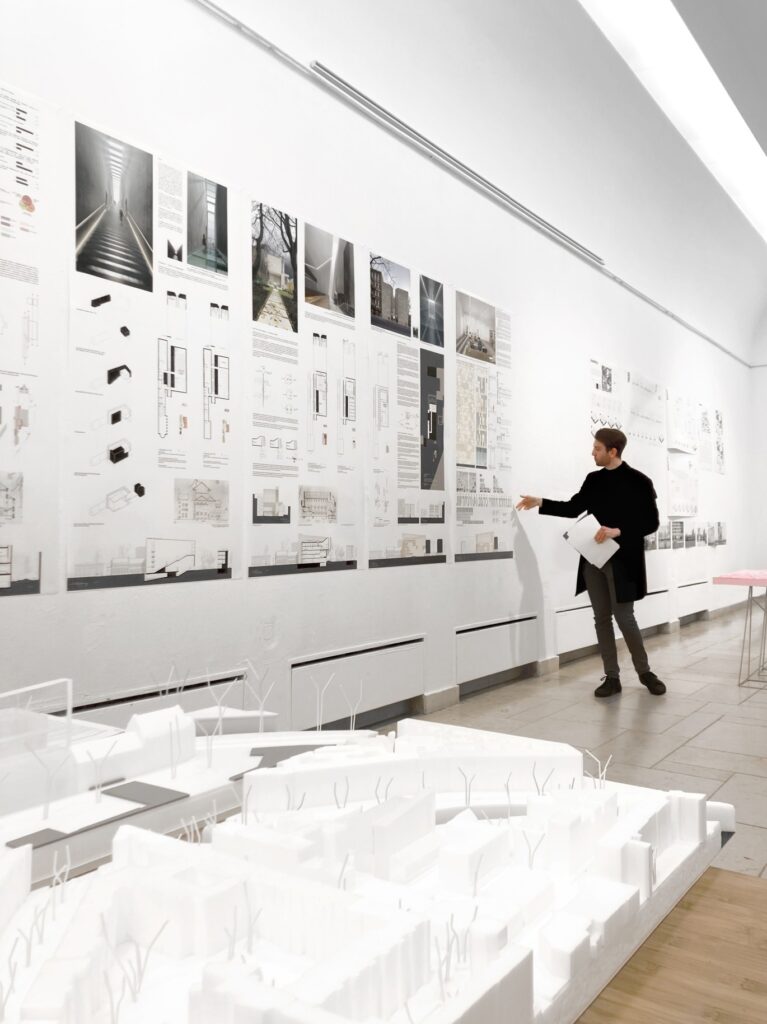
The article refers to a nationwide project by four renowned German universities for the design of synagogues and the exhibition “Das Synagoguenprojekt” (Deputy House Berlin, Nov.–Dec. 2022); however, it remains unreflected that there designs with far eastern temple references, Torii-like portals and pagoda-like roof silhouettes have the same rank as works that are seriously derived from liturgy, topography and community practice. Both – decorative historization and arbitrary style syncretism – misses the measure and center of a Jewish church. At the same time, the few Jewish voices are mentioned, but not developed in their arguments.
Durrer writes about dead buildings, but hardly talks to today’s users of the place, but mainly talks about voices from association and building responsibility, as if their interpretations were unaltered. What is missing is a sober classification, which needs to be negotiated publicly about a sacral building: objectives, program and lines of design in a transparently communicated, professionally accompanied procedure – instead of telling them in the mode of symbol-political self-assurance.
The external dramaturgy of the article suggests a juxtaposition – perhaps even an assessment – between a planned reconstruction according to historical model with a picture of Kilian Endres and Yakubovich’s contemporary design. But the text itself does not solve this tension. Yakubovich’s position is given in few, almost casual sentences, without argumentative development, without contextualization, without discernible editorial debate. Neither is his methodical approach – for example, the study of liturgical levels, topography, or material symbolism – nor is the design related to what the project structurally hides: the open dialogue about Jewish presence, structural responsibility, and memory policy in the city space. Rather, Yakubovich’s work is embedded in the flow of an otherwise affirmative project report – as remarkable Marginalie. The subjectivity of his draft is indicated (“what Yakubovich also employs”), but not taken seriously as criticism. Reconstruction as progress.
Anyone who takes memory seriously avoids symbolic politics. Whoever takes community seriously sets the primacy of the living community before external self-representation. It is not about building on dead Jews, but about getting into conversation with the living. Therefore, an open procedure with proven Halachian expertise, clear economic assumptions and a draft that puts use, security and dignity before any declamatory gesture of political zeitgeist is required.



See also: