
on the origins of the surname “Yakubovich”
Every time I sign my name, I put my mark beneath a story of deception and defiance thousands of years old. While Yakubovich today simply signals Eastern European ancestry, its linguistic root leads directly into a moral grey area: grasping a heel and stealing a birthright.
Between sacred protection and the profane motif of holding a heel, the name spans a spectrum of meanings that has travelled around the world in countless linguistic variants.
My surname is patronymic because it derives from the given name of a male ancestor.1 Its core is “Jakub” — a West Slavic, Polish form of the biblical name Ja’akow. The Slavic ending “-ovich” expresses affiliation and literally means “son of …”. A surname that can be translated as “son of Jacob” is therefore often compared with “Jacobson” in English-language contexts.2,3
The form Jakub also exists in the Muslim world — the Arabic-Ottoman name Yaʿqūb (Arabic يعقوب), for example, corresponds to this basic form.4 The basic form of the surname Yakubovich thus has a seemingly intercultural anthroponymic core, with parallels across different linguistic regions.
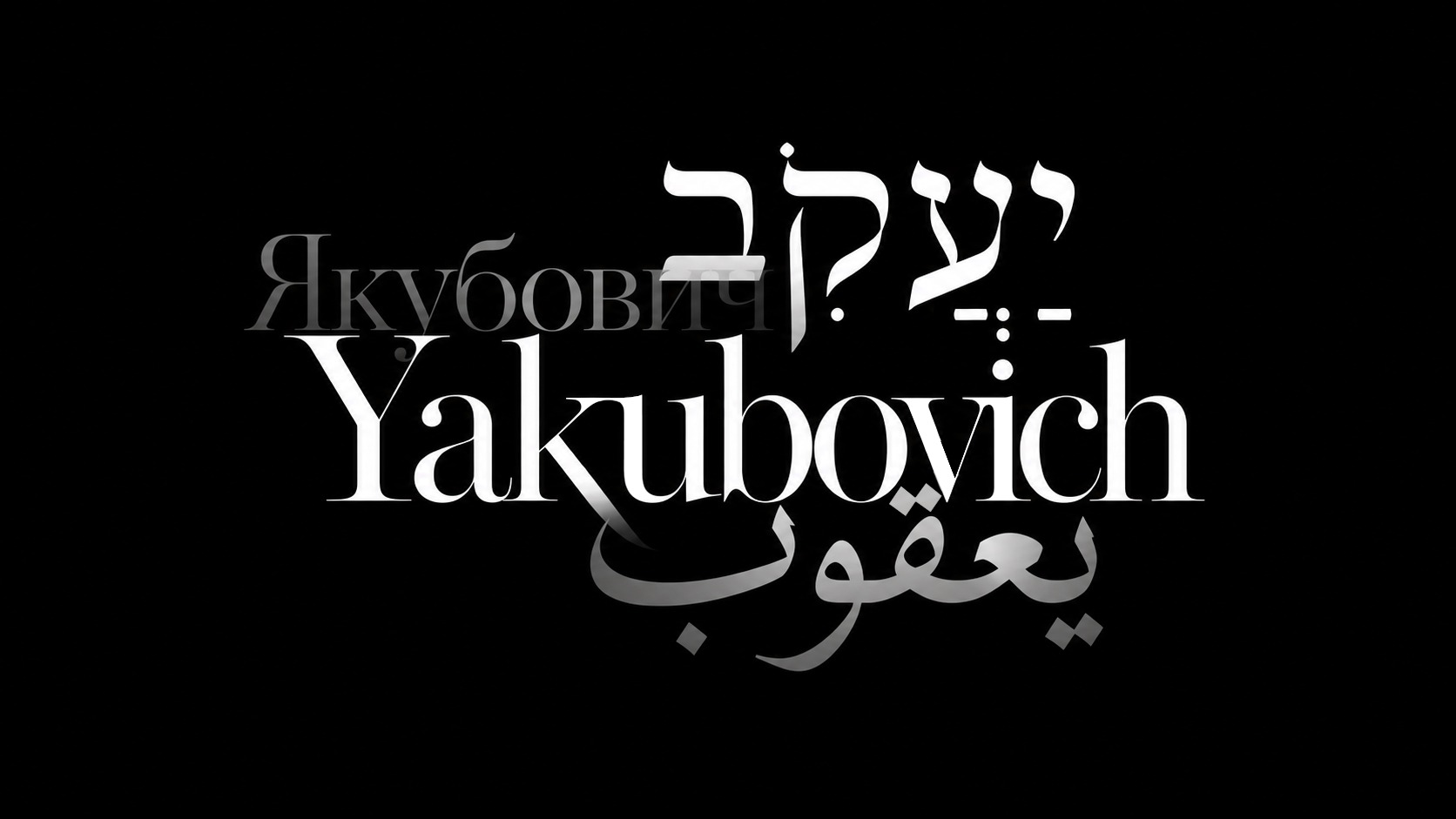
I. Deception, Bible and Bloodline — Semitic Linguistic Roots
The male given name Jacob (Hebrew יַעֲקֹב, Yaʿaqōv) is deeply rooted in the Semitic languages and inseparably linked to one of the formative narratives of Genesis. The Book of Genesis already presents Jacob’s birth as an omen: he is born second, his hand firmly grasping the heel of his twin brother Esau.5 Biblical tradition therefore derives the name as “heel-holder” from the Hebrew word עָקֵב (ʿāqev) for “heel”.
The story does not remain purely anatomical, however, but acquires a moral-philosophical charge: when Jacob deprives his brother first of his birthright and then of their father’s blessing, the deceived Esau cries out: “Was he not rightly named Jacob? For he has deceived me twice now!” (Gen. 27:36).6
Ever since, the Hebrew root ʿ-q-b (עק״ב) has bridged the physical and the psychological: the noun ʿāqev (עָקֵב) denotes the heel, footprint or rear7, while derivatives of the same consonantal framework can mean “deceive” and “outwit” (yaʿqĕvēni, יַעְקְבֵנִי). The root describes literally “following on someone’s heels”.8
The related adjective ʿāqōv (עָקֹב) — a cipher for the inscrutable and unpredictable — shows how deeply this semantics reaches into the abyss. When Martin Luther translates ‘āqōḇ hal-lêḇ (עָקֹ֥ב הַלֵּ֛ב) in Jeremiah 17:9, he chooses forceful words: “The heart is a defiant and despondent thing.”9
In linguistic history, however, the narrative of deception falls short. The name Yaʿaqōv was probably originally a shortened form of an older sentence-name: Yaʿaqov-’El — “May God protect”.10 In this reconstruction, Yaʿaqov is an abbreviated verbal form — comparable to Russian Spasibo (спасибо), in which the original phrase Spasi Bog (“God save [you]”) merged into a single word over time.
Evidence supporting this thesis appears in Old Ethiopic and in the Aramaic papyri from Elephantine near Aswan, where names such as ʿqbjh (Yaʿaqov-Yahu): “Yahweh has protected” are still attested. The popular interpretation as “heel-holder” and “deceiver” would accordingly be a secondary, folk-etymological reinterpretation that gave the name moral and narrative weight through sound association.11
A look at the Semitic languages shows how flexible the root ʿ-Q-B is in detail12:
| Word Form | Language | Meaning |
|---|---|---|
| עָקֵב (ʿāqēv) | Hebrew, noun | heel; footprint; rear13 |
| עָקַב (ʿaqav) | Hebrew, verb | follow on someone’s heels; (fig.) outwit, deceive14 |
| יַעֲקֹב (Yaʿaqōv) | Hebrew, proper name | Jacob (patriarch; folk-etymologically “heel-holder” or “deceiver”)15 |
| עָקֹב (ʿāqov) | Hebrew, adjective | treacherous, deceitful (literally “inscrutable”, cf. Jer. 17:9) |
| ʿqb (written form) | Old Ethiopic (Geʿez), verb | protect, preserve (in personal names, e.g. ʿAQABE–ILL “Ill has protected”)16 |
| ܝܥܩܘܒ (Yaʿqūḇ) | Aramaic (Syriac), proper name | Jacob (Aramaic form, e.g. in the Peshitta Bible) |
| يعقوب (Yaʿqūb) | Arabic, proper name | Yaʿqūb — Arabic form of Jacob (biblical patriarch, mentioned in the Quran as a prophet) |
| عَقِب (ʿaqib) / عَقْب (ʿaqb) | Arabic, noun | heel (literal); end, consequence, offspring (figurative)17 |
| عَقِبَ (ʿaqiba) | Arabic, preposition/dialect | immediately after (in the sense of “on the heels of”, regionally meaning “directly following”)18 |
| اِسْتَعْقَبَ (istaʿqaba) and others | Arabic, derived verbs | cause to follow, follow; result in (e.g. مُسْتَعْقِب mustaʿqib “following, subsequent”) — illustrates the root’s “sequence/consequence” meaning |
| πτερνίζω (pternízō) | Ancient Greek, verb | “grasp by the heel” → “outwit”. (Calque of the Hebrew root in the Septuagint for Gen. 27:36 and Hos. 12:4)19, 20 |
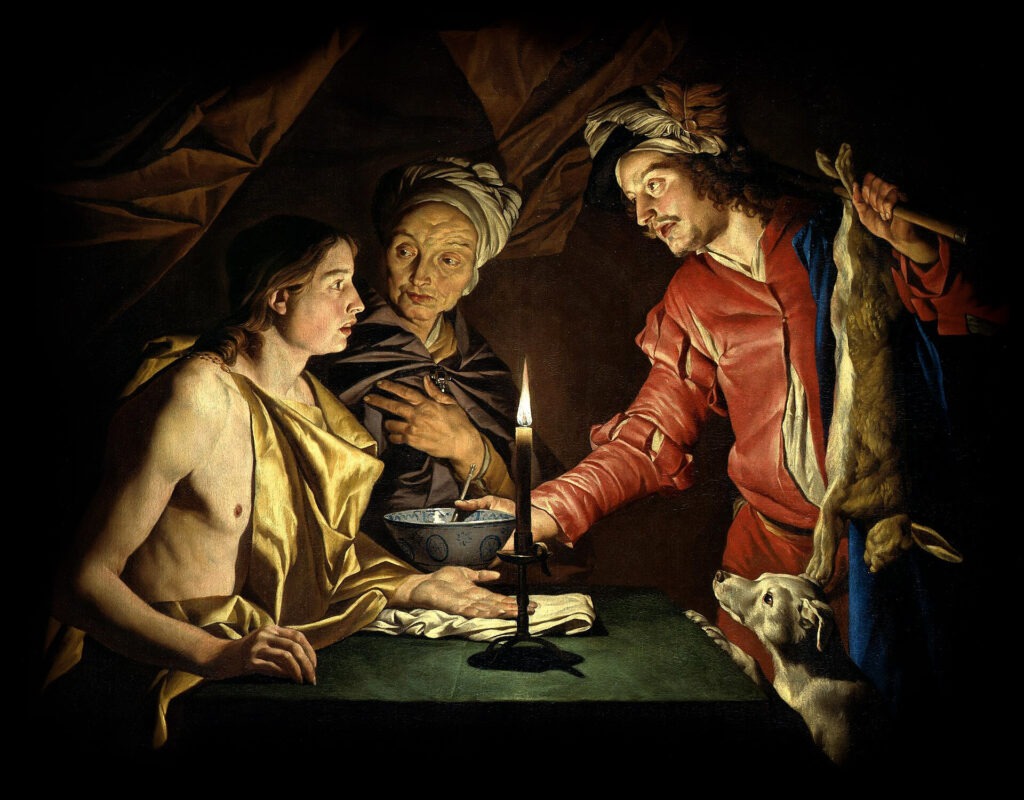
Matthias Stom, Esau Selling His Birthright, 1642–1645, Gemäldegalerie, Staatliche Museen zu Berlin, inv. no. 434. Image: Staatliche Museen zu Berlin / Wikimedia Commons, public domain.
II. Santiago, James and Diego — Adoption into Greek and Latin
The name Jacob crossed the boundaries of its original linguistic region even in pre-Christian times. When scholars translated the Hebrew Bible into the Greek of the Septuagint in the third century BC, they rendered the name as Ἰακώβ (Iakṓb). In the New Testament texts it developed into the Hellenised form Ἰάκωβος (Iákōbos), which eventually entered the late-antique Vulgate. Popular Late and Vulgar Latin ultimately produced the variant Iacomus — a bridge over which the name would pass into the Romance and European languages of the modern era.
Thus the biblical name spread through Europe via ecclesiastical Latin as early as the Early Middle Ages. While Hebrew, through Yiddish, developed variants such as Yakov or Yankev over the centuries, European written languages often retained the characteristic -b-.
At the Slavic linguistic boundary, the name becomes a mirror of Europe’s confessional history: while Polish and Czech Jakub followed Latin-Catholic influence and preserved the hard -b-, East Slavic took a different path. The Greek beta (Β) in Iákōbos was pronounced [v] in the Orthodox Church Slavonic tradition. A single letter at the end of a name thus still marks the dividing line between Rome and Byzantium.
Late Latin Iacomus developed extraordinary momentum: through the Romance languages — and, following the Norman Conquest, in English as well — it branched into an astonishing variety of forms. In Italy it produced Giacomo21; in Old French, Iacomus changed through intermediate forms such as Jaimes into the elegant Jacques.
English in particular displays an unusual polarity: while Jacob remained reserved for the Old Testament patriarch, James became established for New Testament figures. Although both names spring from the same root, today they are regarded as two entirely separate identities — a phenomenon unfamiliar to most European languages, where a single name unites both worlds.
Spanish, however, underwent the most radical transformation. Here the invocation of the saint — Sant Iacob — fused in popular speech into Santiago. Further contractions eventually produced the notorious given name Diego.22
III. Expansion, Aristocracy and Assimilation — Polish Szlachta and Little Russian Nobility
The fact that the name Jakub is at home in both West Slavic and Eastern Muslim regions shows that it was never the monopoly of a single ethnicity. In Eastern Europe it was borne by both the Polish and the Little Russian23 szlachta. The old noble Yakubovich family can be traced without a break to the seventeenth century.24 When Hetman Bohdan Khmelnytsky granted the progenitor Fyodor Yakubovich the rank of colonel and extensive lands in 1654, the name was already hereditary.25 In the Kingdom of Poland, meanwhile, the name was recorded as Jakubowicz in the official registers of the nobility. These include dynasties of Armenian-Polish origin such as Jakubowicz-Paschalis26, who rose to the nobility through industrial pioneering.
For the broad mass of the Ashkenazi population in the shtetls of present-day Poland, Lithuania, Belarus and Ukraine, the moment of naming arrived only between the late eighteenth and nineteenth centuries. When tsarist authorities decreed the registration of hereditary surnames to make taxation and recruitment more efficient, many families chose the name of their forefather Jaakov. In a Slavic-speaking environment, morphological and phonetic assimilation reshaped the Hebrew patronymic into the present-day Jakubowicz.
Exceptions, as is well known, prove the rule. Although the emergence of hereditary surnames remains a late achievement of bureaucracy, one case stands out: the case of Israel Jakubowicz. In the middle of the sixteenth century, long before the later tsarist decrees, the name appeared in the records of Lviv as a legally valid civil personal name. When the printer Ivan Fyodorov faced an acute financial crisis in 1579, he pledged his entire printing house, including its printed stock, to the Lviv Jew Israel Jakubowicz for 411 gold florins.27 Depending on the method of calculation, this sum corresponds to the purchase price of a present-day three- to six-room apartment in affluent West Berlin. The case demonstrates that the personal name was established in the Jewish context of the Polish-Lithuanian Commonwealth centuries before the general requirement to adopt surnames.
At the beginning of the twentieth century, Jewish bearers of the name were concentrated above all in the Russian Empire’s Pale of Settlement — in the regions of Minsk, Grodno, Brest and Gomel, and neighbouring Bryansk. This geography corresponds directly to my own genealogical roots in the region around Mogilev.
When the German Wehrmacht occupied the area in the summer of 1941, Mogilev’s Jewish population was systematically murdered, before the region was captured by the Red Army in 1944 and developed into a transport hub in the post-war period.
Taken as a whole, the name Yakubovich proves to be a linguistic palimpsest of Eastern European history. While empires collapsed, dynasties fell and borders were violently redrawn, this linguistic trace endured. It spans sacred protection and human deception — and builds a bridge from biblical beginnings to my own family history.


- „The Bryansk Surnames YAKUBOV, YAKUBOVICH, YAKUPOV“, Journey through Bryansk, https://www.puteshestvie32.ru/ (accessed 5 October 2026). The page explains Jakub as the Polish form of Yakov and the surnames as patronymic derivatives. ↩︎
- „What Does the Surname Yakubovich Mean?“, Toldot.ru, https://toldot.com/ (accessed 5 October 2026). ↩︎
- „Meaning of the name Jacobson“, Wisdom Library, last updated 18 July 2026, https://www.wisdomlib.org/ (accessed 5 October 2026). ↩︎
- Campbell, Mike, „Yakub“, Behind the Name, https://www.behindthename.com/ (accessed 5 October 2026). ↩︎
- Einheitsübersetzung 2016, Gen 27,36, in: ERF Bibleserver, Bible text of the Katholisches Bibelwerk, https://www.bibleserver.com/ (accessed 5 October 2026). ↩︎
- „Genesis 27:36 Lexicon“, Bible Hub, https://biblehub.com/ (accessed 5 October 2026). ↩︎
- as in 7 ↩︎
- Hensel, Benedikt, “Deception”, WiBiLex – The Scholarly Bible Encyclopaedia Online, Deutsche Bibelgesellschaft, https://www.die-bibel.de/ (accessed 5 October 2026). The sections “Jacob, the ‘Deceiver’” and “Heel-Grasper” are particularly relevant. ↩︎
- „Jeremiah 17:9 Hebrew Text Analysis“, Bible Hub, https://biblehub.com/ (accessed 5 October 2026). ↩︎
- Rechenmacher, Hans, Althebräische Personennamen, Münster 2012, pp. 30, 143. ↩︎
- Campbell, Mike, „Jacob“, Behind the Name, https://www.behindthename.com/ (accessed 5 October 2026). The page discusses both the traditional interpretation as “heel-holder/supplanter” and the alternative etymological explanation through a hypothetical Yaʿaqovʾel. ↩︎
- „The Meaning of the Biblical Name Yeshurun“, Jewish Link, https://jewishlink.news/ (accessed 5 October 2026). ↩︎
- Hensel, Benedikt, “Deception”, WiBiLex – The Scholarly Bible Encyclopaedia Online, Deutsche Bibelgesellschaft, https://www.die-bibel.de/ (accessed 5 October 2026). ↩︎
- as in 13 ↩︎
- as in 5 ↩︎
- Hans Rechenmacher: Althebräische Personennamen, Münster 2012, pp. 30, 143. ↩︎
- Wiktionary, the Free Dictionary, https://en.wiktionary.org/ (accessed 5 October 2026) ↩︎
- „What does عقب mean?“, HiNative, https://hinative.com/ (accessed 5 October 2026). ↩︎
- as in 13 ↩︎
- „πτερνίζω“, LSJ – The Online Liddell-Scott-Jones Greek-English Lexicon, https://lsj.gr/ (accessed 5 October 2026). ↩︎
- the Gi- corresponds to the soft [dʒ] for Lat. ↩︎
- properly Diago < Iago < Jacob ↩︎
- Little Russian (малороссийское): in historical texts, this term denotes the territory of present-day Ukraine within the Russian Empire or the Hetmanate ↩︎
- Gajl, Tadeusz, „Jakubowicz“, in: Polish Armorial, http://gajl.wielcy.pl/ (accessed 5 October 2026). The database assigns the surname Jakubowicz to several heraldic clans. ↩︎
- Brockhaus and Efron Encyclopaedic Dictionary: 86 vols. (82 vols. and 4 supplements). — St Petersburg, 1890–1907. ↩︎
- Program indeksacji aktów stanu cywilnego i metryk kościelnych, „Warszawa, jednostka 122 UMZ-1817, 1817, plik 104–107.jpg“, Metryki – Skanoteka. Baza skanów akt metrykalnych, Polskie Towarzystwo Genealogiczne, https://metryki.genealodzy.pl/ (accessed 5 October 2026). ↩︎
- Dmitrievskij, Aleksej Afanas’evič, „Deacon Ivan Fyodorov — the First Russian Printer. On the 300th Anniversary of His Death“, ABC of Faith, https://azbyka.ru/ (accessed 5 October 2026). ↩︎