on the origins of the surname “Kreynin”
This is an immortality entrusted not to stone, but enduring in language. The trail of this surname leads into a labyrinth far beyond the former expanses of the tsarist empire — down into an etymological palimpsest in which Latin and Yiddish overlap. Behind the name Kreynin stands the influential ancestress of a Yiddish shtetl, whose special position within the family was commemorated in language and administration. The surname owes its present form to the transition from everyday provincial shtetl life to systematic registration by the tsarist bureaucracy of the late eighteenth and early nineteenth centuries, when fluid identities were fixed as hereditary names for taxation and recruitment. Before hereditary surnames were introduced, the Jewish population used a flexible arrangement of given names, patronymics, nicknames and place names. Within the shtetl, this was entirely sufficient: people identified one another not by a passport name in the modern sense, but through trade and origin, father or mother.
The name is by no means evidence of a single historical ancestress of all Kreynins, still less of a biological unit. Rather, the surname could arise independently in different places from the given name of a Kreyna — after a mother, widow, head of a household or a woman of outstanding standing in family and community. Conversely, even close relatives could receive different surnames if they lived in separate households or were registered under different administrative circumstances. A surname should therefore be understood as a geographical and cultural fingerprint. Archival documents remain the only reliable source for reconstructing an actual family tree: civil registers and lineages, land registers and catalogues, and traces in military and emigration records.
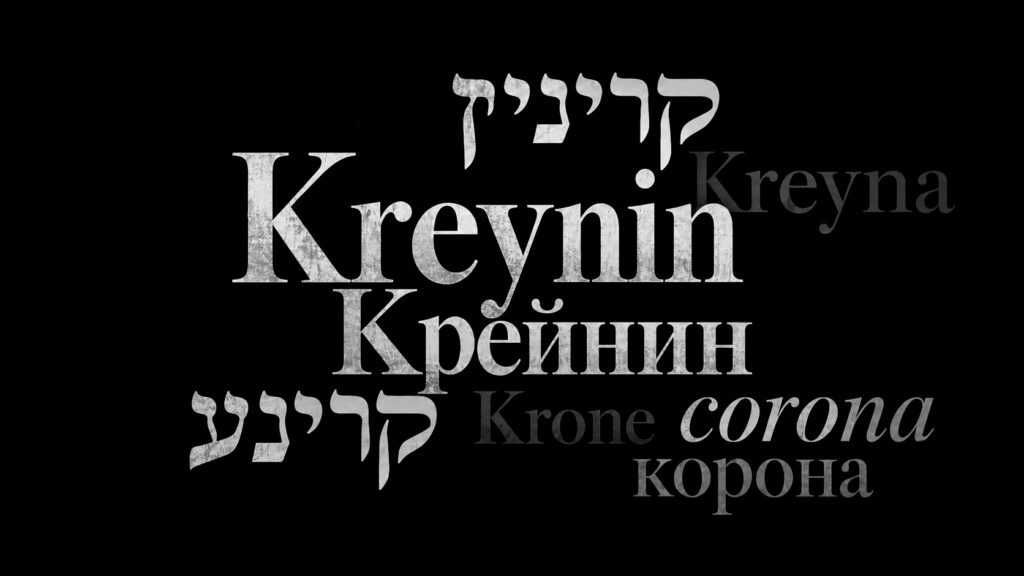
Etymologically, the Yiddish female given name Kreyna means “the crowned one”. It probably came through Middle High German kroune and Latin corona from Greek, where it originally denoted a “wreath” or “ring”. The surname thus belongs to the Indo-European rather than the Semitic word family, like German Krone or Russian корона. The Slavic suffix -in marks affiliation “with the house of Kreyne” — or, more directly, the “son of Kreyne”.
Geographically, the surname fits seamlessly into the territory of the former Pale of Settlement. In the few genealogical sources that survived the war, we encountered it above all in the Belarusian governorates and districts — precisely where the world of the Jewish shtetl, the control exercised by tsarist bureaucracy and the catastrophes of the twentieth century were closely intertwined. Transcription variants recur in the archives because spelling shifted between Yiddish, Russian, Polish and German, as well as between Hebrew, Cyrillic and Latin characters.
In this sense, the name Kreynin echoes the story of a woman who became the matriarch of an entire household, a story that, despite every storm, leads through languages and empires, migrations and the silence of the archives into the present.