A Genealogical Interview

Those who hunger carry water.
Editorial Note
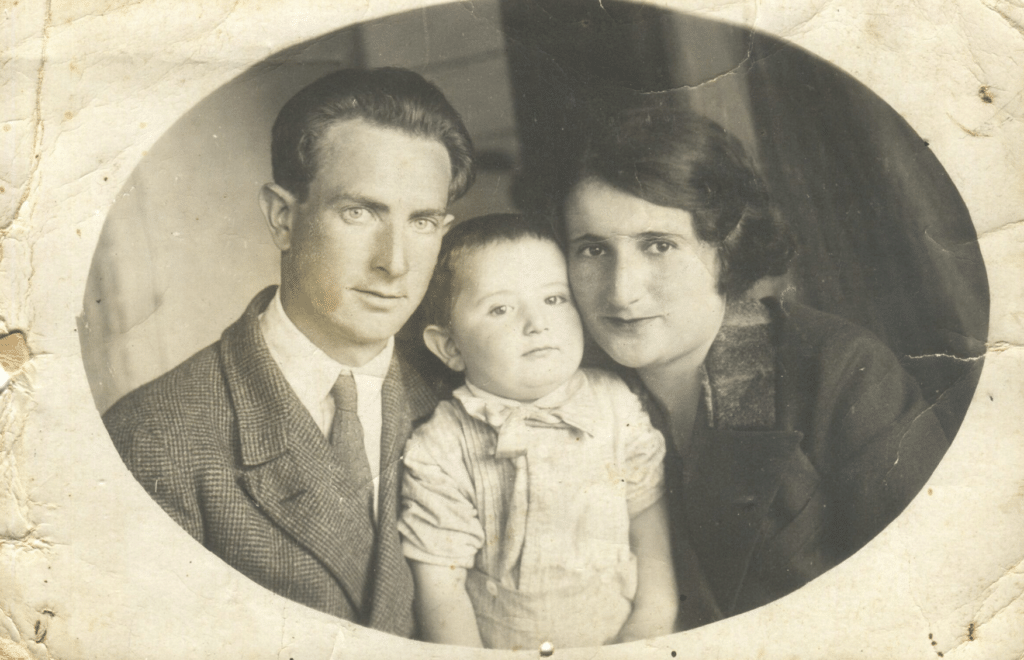
The following text is a literary reconstruction based on genealogical documents, family traditions and historical contextualization. The German version is not a historical audio recording, but a narrative attempt to approach a possible voice of this person.
I. ליכט — /lɪxt/ — Light
The kitchen air tastes of cold fat and the sourness of soup that cooled long ago. Beneath the lampshade, the light bulb trembles anemically, an almost sickly yellow, as though the current were seeping reluctantly, drop by drop, like an intravenous drip, into the brittle wires. Schifra remains beneath it. The lampshade holds her face back in shadow; only her hands lie in the dull circle of light.
Beyond the cone of light, her outlines bleed into a shimmering twilight. In this shadow realm of nervous tangles, order loses its hold; the corners of the room surrender their geometry to the grainy noise of the retina. Amid this instability, the sticky kitchen table remains the last certainty—a dirty island of tangibility before oblivion swallows everything. Everything hangs by a fraying wire.
On the stained oilcloth, her hands lie like stranded skeletons. Blue veins run through a landscape of arthritic knots and deep fissures, her parchment skin stretched between them.
They are hands that no longer open fully, shaped by decades of gripping icy bucket handles. Each breath sends a faint whistle through the silence. It is the sediment of lungs that never relinquished the dust of the offices.
She does not wait for questions. She simply lets them happen.
II. הונגער — /ˈhʊŋɡər/ — Hunger
Interviewer: Schifra, the subject of this interview is the reconstruction of your life history. We shall begin by verifying the family data. According to your sons’ Party personnel records, the death of your husband, Girsch Yakubovich, occurred in 1913. At the time in question, you were approximately in your third decade of life and remained with two minor sons, aged six and two, at the location of Chotimsk in the Mogilew Governorate of the Russian Empire. There were reportedly no capital reserves. Please state the precise point at which taking up salaried employment in private households became a strategy for securing your subsistence.
Schifra: There was no point in time. There was only hunger. Those who hunger carry water. That is the whole explanation.
Interviewer: How did you spend the first day after the funeral?
Schifra: (she scratches her hands; her voice is dry) What is there to ask? The place at the table was empty, but so were the children’s stomachs. Girsch was dead. He worked in the shul, a poor soul, may Adonai grant him rest. He left us nothing at all—only his name. Does a mother ask at a moment like that, “How am I feeling?” No. The only question is, “Where is the work?” I went to the people in the shtetl, to those who still had a few kopecks. Anyone who wants a roof overhead has to bend down. So I bent down.
Interviewer: To which “shul” was his employment assigned at the time in question?
Schifra: (her hands hold the cloth as though she were reading the answer there) The wooden one in Chotimsk, the big one. What difference does it make to know the name today? Everything has burned down and been torn down. For the congregation, it was a house for God, but for Girsch it was only a room full of shadows and drafts. Night after night he kept watch there so the Eternal Light would not go out, while his own light grew smaller and smaller. A watchman in the shul is like an old broom—you need him to keep things clean, but nobody cries when he breaks. When Girsch died, the congregation prayed, yes. But prayers do not fill a belly. The shul remained, God remained; only we—we fell out of the world.
III. אַרבעט — /ˈarbɛt/ — Work
Interviewer: The decline in status from the wife of a melamed1 and synagogue employee to an unskilled domestic worker for affluent citizens constitutes a rapid descent. Describe the physical privations of the first winter period of 1913 following this event.
Schifra: (a short, dry snort that sounds almost like a cough) Descent? When your stomach growls, descent has no sound left. Everyone in the shtetl knows everything, but pity gives no bread.
In winter the water is like a liquid knife. You haul the buckets from the well, and the ice grows up your skirt until you are heavy as a stone. First your fingers turn red, then blue, then you cannot feel them at all. That was my good fortune—if you feel nothing, you can work longer. I scrubbed away other people’s dirt so my sons would not starve in the dirt.
I did everything the gentlefolk did not want to do themselves. Fetching water from the well—and in winter the path was like glass. Chopping wood, heating the stoves. Rinsing the laundry in the river until your fingers were blue and you could no longer feel them. And the baths. I hauled the water for the bathhouse. Bucket after bucket. You only learn how heavy water is when you carry it on your shoulders all day.
Interviewer: The autobiographical records of your firstborn, Schalom, date his entry into employment as a shoemaker’s apprentice to his eleventh year. Chronologically, we are in the year after the October Revolution of 1917. Was this early deployment in economic service your deliberate decision?
Schifra: What do you mean?
Interviewer: Was it your decision that your son should begin working at eleven?
Schifra: (a brief, joyless laugh) A decision? Mine? Life did not ask us; it simply decided. There was war, there was upheaval, and in the Kooperazija there was nothing at all. A little boy of eleven needs more in his stomach than a dry scrap of bread. He had to learn a trade; it was good for him. A man without a trade, you know, is like a house without foundations. It may stand for a while, but it will not hold. We did not complain—who had time for that? He went to work, I went to work. And in the evening there was soup, if HaShem willed it. We functioned. That is all.
Interviewer: In 1918 you then joined the trade union and obtained a position as a cook in the cooperative’s canteen. That sounds like social advancement, away from private homes. Did it change your life?
Schifra: (her fingers scratch almost imperceptibly at a patch of oilcloth where the pattern has long since worn away) You mean the Profsojus? Yes, it was a shield. A little piece of paper so the Buschwah2 would not simply chase you from the doorstep like a mangy dog. Advancement, you say? Perhaps it is advancement on paper. But work, you know, work is always work. Whether you scrub for the gentlefolk or for the Kooperazija—your back does not ask about politics.
In the canteen the heat was enough to soften your brain. And the kettles—as big as barrels. People come with their hunger, their bad moods and cruel words; they devour your peace. All I breathed there was steam and fat. Later came the offices. Cleaning. You think it is finer work, but dirt is dirt. It creeps into your chest and settles there like kalch or veys. What is the word again…?
Interviewer: Lime.
Schifra: Yes! It had to be clean for the gentlemen officials. When they come in the morning in their collars, they want to see shining floors beneath their boots. I scraped the ashes out of the stoves, I scrubbed until my knees had no strength left. To them I was a broom that happened to breathe.
IV. רוקן — /ˈrʊkn/ — Back
Interviewer: In 1929 you were pensioned off under the classification of “disabled worker,” before you turned fifty. Define the psychophysical effect of the abrupt termination of your productive phase of life.
Schifra: (silence)
Interviewer: How did you feel physically when you were pensioned off?
Schifra: (she unconsciously rubs her knees) Your body tells you long beforehand; you simply do not listen. Eventually I could do no more. My legs would no longer take me up the office stairs; my back stayed bent like a question mark. The Strachkassa gave me the pension. What can I say? I was old at forty. A very old woman. But the sons, baruch haShem, they were past the worst of it. Schalom was already in Tschernigow, and Simcha had his own path. So I went to Schalom. A woman like me, when her hands can no longer grip the heavy iron and the buckets, she simply sits down in the corner. You sit and watch the world run. That is the order of things; that is how HaShem made it.
Interviewer: In the 1930s you made the transition into the household of your son Schalom in Tschernigow. After the preceding years of excessive workloads, does this phase mark your first stable state of rest?
Schifra: (she sighs) Rest? What does rest mean? Rest is a word for people who have nothing at all to do in life. A mother never has rest. Even when the legs stopped wanting to work long ago, the head keeps working. So I stayed with Schalom. He already had a family of his own. I sat in the kitchen, cleaned the few vegetables, darned the socks, watched over the children.
I was no longer the strength holding the house together on my shoulders, only a shadow making sure the corners stayed clean. An old broom, you know, knows every corner better than the young people. Do you understand?
Interviewer: Yes.
Schifra: But it was good. There was bread on the table, the mishpokhe was there. In Tschernigow my Schalom was a great man, a whole man, a Predsedatel3 of the Kooperazija. He cared for his old mame. May God grant him light for what he did.
V. מלחמה — /mɪlˈxɔmə/ — War
Interviewer: The year 1941 marks the beginning of the war. Your son Simcha, later Simon, was killed in the Kostjukowitschi area in October 1941. How did you receive this news?
Schifra: (her voice grows still quieter, almost toneless) Black birds—that is what news is in wartime. They always come precisely when you have called for them least. “He is not coming back,” they said. And what am I to do then? Scream? When you scream, you use up your strength, and strength is what you need to survive.
He was my youngest. My Simchele. Wherever the need was greatest, there he was. First the tate in 1913, then the son in 1941. This land is hungry for men; it simply eats them up. I prayed for him, in my own way to HaShem, but what can praying do against iron? I had to keep breathing for the others. The eynikel, my kinderlach, were still there… you cannot lie down and die when the little ones are hungry. We had to leave. Just leave, into the cold, so life would not stop altogether.
Interviewer: Let us consider the evacuation process: a woman in poor health and a daughter-in-law with small children. How did you experience the flight?
Schifra: (she rocks her upper body very slightly back and forth) Dirt. Cold. The rattling of the railway cars that never stops. On the pekel4 we sat, on our few belongings. When you hear the planes coming, you do not tremble for yourself; you tremble for the children. “Keep going!” you cry in your heart. “Whatever you do, do not stop!” They drove us like cattle from one car to another; you were no longer a human being.
My back had long since been ruined by the years in the offices, and my legs—swollen they were, God preserve us, thick as tree trunks. But what can you do? You huddle together, you warm yourself with your neighbor’s breath. In the evacuation, nobody asks you, “Schifra, are you disabled? Schifra, are you in pain?” If you do not walk, you are left lying. And whoever is left lying, the snow devours. Us? We did not stay lying down. We held fast to life, “Haj” in Hebrew, until the smoke finally cleared.
VI. עמער — /ˈɛmər/ — Buckets
Interviewer: Thank you for your answer. We record the year 1944: the return to the location of Kostjukowitschi, which corresponds immediately in time with your death. Was reaching your destination linked for you with an end to your earthly, temporal career?
Schifra: (her hands let go of the kitchen cloth) I only wanted to feel the ground beneath my feet once more. The ground you know. Kostjukowitschi… what can I tell you? It was no longer a shtetl. Only ruins, ashes, a gray nothingness. But it was home all the same. Our home.
I was tired, you know? But not the kind of tiredness a woman feels after washing other people’s laundry all day. No. It was a tiredness that had settled deep into the bones. Schalom was alive, thank God. And the eynikl were there—my little bit of Naches. The wheel of fortune, you know, keeps turning even when you can no longer go on yourself. I carried my burden, I did everything. The Veder I hauled, those heavy, accursed buckets. I pulled the children through hunger, held them by my own sinews so they would not fall. I survived the war, Goles—flight. And afterward… afterward it was enough. It was time to fold my hands in my lap. To be still. For good.
Interviewer: We are coming to the close. If you could leave your descendants the essence of your existence—beyond all political influences, relating solely to human life—what would it be?
Schifra: (her pupils flicker in the darkness; for the first time she looks directly at the interviewer) What should I tell you at the end? Look at my children. Simche, Sholem… they do not haul buckets. And their backs are not bent down to the earth. Why? Because they learned. (she raises her crooked index finger) You must go higher, rise higher, understand? Hold on to books more tightly than to a bucket. So your back stays straight and does not become like my khrebet—an eternal question mark. Learning—that means not being a broom that breathes by chance. As long as you still have koach… strength—reach toward the light. Look up, not down at your feet. That is my command to you. That is my testament.
Now—quite enough.