
Saratov, Gagarin and a suicide in the gravitational field of ascent and fall
Individual work / Essay
Painting on canvas · Acrylic on canvas · 2026
Bloodlines on the Volga, 2026
Acrylic on cotton-blend canvas, on a self-supporting 4 cm stretcher, 100 × 70 cm; monogrammed lower right on an acrylic ground, inscribed and signed on the reverse
Allegorical composition with a red cosmonaut figure, a black Volga and a group of exposed, intertwined bodies; an engagement with Saratov, Yuri Gagarin and family memory between ascent, fall and origins
Inv. no. DY-2026-A-001
© Daniel Yakubovich
Saratov is more than a coordinate in an atlas of origins. It is an inner topography: the city of birth, the city of childhood stories and the setting of a family history that long remained unspoken. Along the Volga’s sluggish waterlines, memory and loss, family tradition and repressed knowledge condense into a peculiar aesthetic of biographical ruptures and traces of blood. This is no lost homeland to which an unbroken return might be possible. It is a place of origin that promises a deceptive familiarity and produces new estrangement with every approach.
The history of the Volga region is itself a history of such overlapping layers. Situated between forest and steppe, between European Russia and the expanses of Central Asia, it became a junction of different cultures and territories of power. Russians and Tatars, Volga Finnic peoples, German colonists and descendants of nomadic steppe peoples left traces that resist any seamless narrative. The Volga connected and divided at once. Cargoes and strangers, dialects and dogmas travelled along it; its banks gave rise to the changing orders from which Saratov emerged.1
From a fortified outpost against the Golden Horde , a prosperous merchant city developed.2 Warehouses and trading houses gave it its shape; later, railways, factories and new residential districts cut deeper traces into the urban fabric. Revolution, Stalinist industrialisation and the deportation of the Volga Germans3 laid new strata over the old; large housing estates and standardised building types subsequently rewrote the cityscape once more.
Hardly any layer completely erased its predecessor. Tsarist merchants’ houses and pre-revolutionary wooden buildings, Constructivist fragments and Stalinist monumental excess, Soviet prefabricated blocks and post-Soviet investor architecture crowd one another. The old has never entirely passed; the new has never become wholly new. Growth appears as accretion, progress as a loss of proportion and coherence. Each era seems to have inscribed its claim upon the city without accepting responsibility for the whole. In Saratov, the dialogue between historical periods is fought out almost physically as a struggle over the authority to interpret history.
The greatest promise of this eclectic history was ascent. In Saratov, Yuri Gagarin learned to fly4; near Engels, he returned to Earth in 1961 as the first human being to come back from space.5 For a brief moment, the cosmos touched those expanses that the protagonist of Anton Chekhov’s story The Lady with the Dog had already tried to escape6, without that encounter bringing redemption. A regional setting became a place in world history; the young pilot became an almost otherworldly saint. A false prophet can still be exposed; Gagarin’s ascent into heaven, however, actually happened. The flight was a technical and human achievement. Precisely for this reason, Gagarin became the region’s rightful pride, a childhood icon for an entire generation and a figure in whom post-Soviet nostalgia and narratives of state mythology are almost inseparable. This ambivalence determines the painting’s red figure. In the composition, Gagarin grows beyond human scale into an atheistic sign of salvation and the totem of a state religion whose faith in a radiant red future was more powerful than the reality that disproved it.
All the more profound is the gulf between his ascent and the life beneath the red figure. Grey, naked forms gather in the foreground: bent backs, interlocked limbs, bodies meshing with one another. None has enough space to establish its boundaries or unfold. Support becomes a grip, closeness appropriation, familiarity a crossing of boundaries, attachment a claim. Decay, improvised additions and overlapping Soviet and post-Soviet structures appear as pressure, curvature and penetration. Saratov’s pain lies not only in decline and disfigurement, but in the dissolution of proportion: in the relationships between bodies, in the absence of distance and in the violence with which the present fastens itself to the past. Gagarin overcame inertia and gravity. Therein lies the tragedy of his triumph: he becomes a standard without being able to transform the life beneath him.
Between the red vertical and the grey landscape of bodies, the Volga runs through the pictorial space like a black blood vessel. At first it is the geographical river on whose banks Saratov arose. Flowing from the figure’s clasped hands, it permeates an inner landscape.


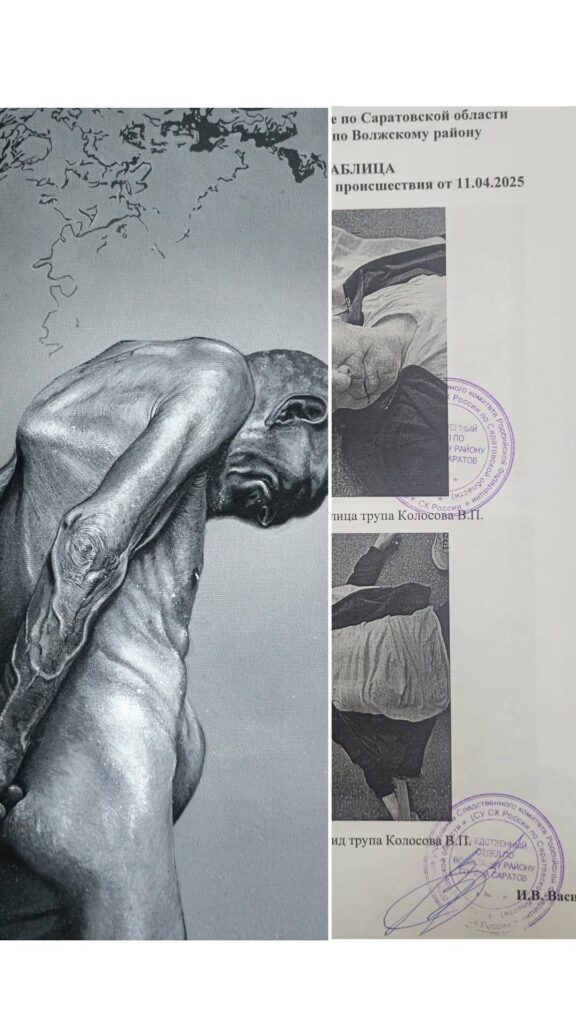
The standing figure quotes the condemned man in the faculty painting Jurisprudence by Gustav Klimt.7 Klimt’s figure appears as an old, emaciated man before an otherworldly tribunal whose judgement seems inescapable yet lies beyond any comprehensible legal order. The anonymous condemned man becomes a presence charged with family associations: not an unequivocal portrait, but a condensed evocation of age and poverty, pain and guilt, and of a judgement beyond this world whose standard remains unknown.
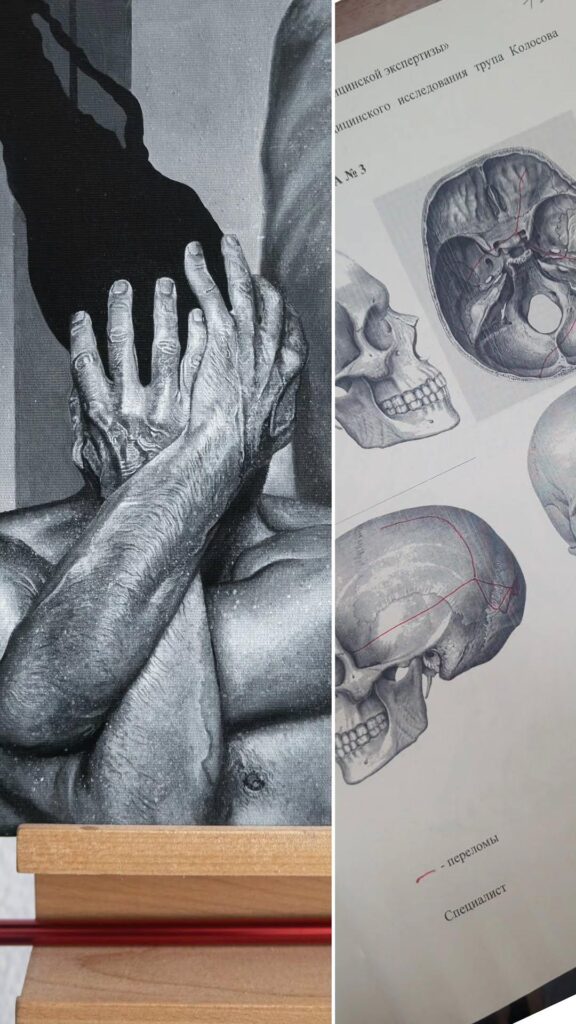
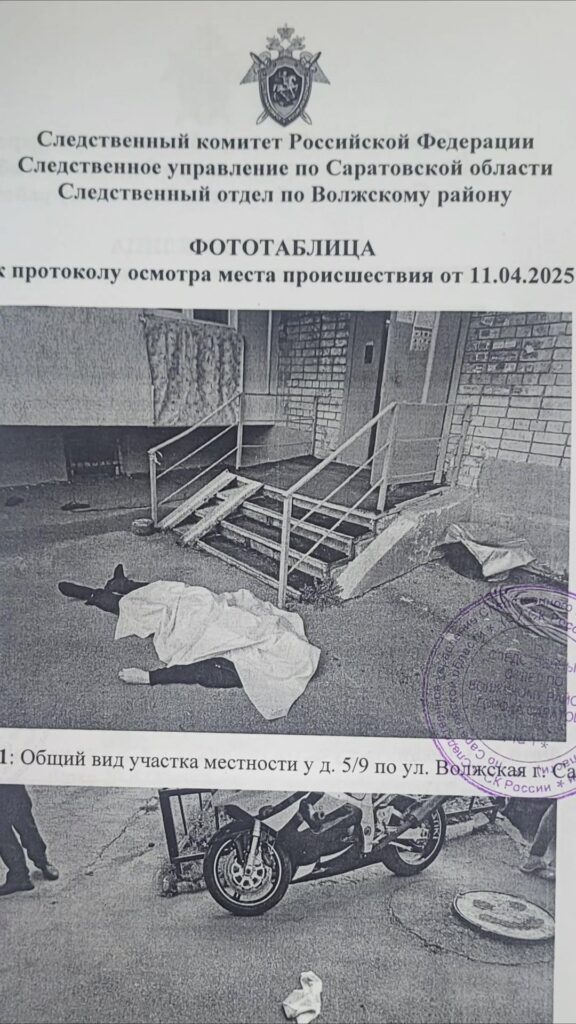
In this figure, the city’s history approaches its most intimate point. The painting grows out of a personal engagement with Saratov and my own family history: with my grandfather’s violent death by suicide, when he jumped from the eighth floor on the eve of Russian Orthodox Easter in 2025; with the unspoken wounds of the post-war generation; and with a post-Soviet melancholy of prefabricated blocks, patina and provincial pathos. Every psychological explanation of my grandfather’s suicide remains inadequate before its devastating finality. What becomes visible instead is what such a death leaves in the memory of those who come after: the drop of a lifetime measured in eight storeys and the distance to the ground. Added to this are the hardness of the asphalt, autopsy reports and photographs of the body, witness interviews and the indifference of local authorities towards a case that still defies complete clarification. Even those who did not see the moment carry its inner image with them.
The heroic departure from the earth turns into a fatal fall towards it; the controlled overcoming of gravity meets its destructive finality; a return celebrated as a triumph in world history is confronted with a death that leaves an unfillable void in my family. The formal affinity forces the events into a shared pictorial space and reveals the span of human ascent and fall.
The Volga carries the memory of the peoples along its banks, of the merchant city and its industrial transformation, of flight and expulsion. At the same time, it becomes a family’s bloodline. Between Gagarin’s landing and my grandfather’s fall lies not a comparison, but a height from which to fall. Saratov is an origin without an idyll of origins: between riverbank, family archive and the scene of an inner crime.


- Immediately south of present-day Saratov lie the remains of Ukek, known in Russian as Uvek, a city of the Golden Horde. Archaeological finds attest to trade contacts with Iran, Byzantium, the Empire of Trebizond in Crimea, the Mamluk territories, China and Central Asia. Imported goods include pottery, mirrors, jewellery, and glass and metal vessels; the greatest concentration of interregional trade is dated to the period between the 1270s and 1330s. See Dmitriy A. Kubankin and Andrey N. Maslovsky, “Objects of Importation Found at the Uvek Settlement (Accidental Finds Stored at the Saratov Regional Museum of Local Lore)”, in: Povolzhskaya Arkheologiya / The Volga River Region Archaeology, no. 4/2013, pp. 130–154, DOI: 10.24852/pa2013.4.6.130.154, https://archaeologie.pro/ (last accessed 29 July 2026). ↩︎
- An expression of the merchant city’s cultural confidence was the Radishchev Art Museum, opened in 1885 and regarded as the first public art museum in provincial Russia. Admission was free on its first regular opening day; 2,700 visitors arrived within five hours. Pavel Tretyakov’s Moscow collection was still privately owned at the time, while the Russian Museum in St Petersburg opened only thirteen years later. See the A. N. Radishchev Saratov State Art Museum, “А. П. Боголюбов” [A. P. Bogolyubov], section on the museum’s foundation, https://radmuseumart.ru/ (last accessed 29 July 2026). ↩︎
- Founded in 1924, the Volga German Autonomous Soviet Socialist Republic extended east of the Volga, with Engels, formerly Pokrovsk, as its capital. The decree of 28 August 1941 collectively accused the German population of the Volga region of harbouring numerous saboteurs and spies. The autonomous republic was dissolved and its inhabitants deported primarily to Siberia and Kazakhstan. By 25 December 1941, a total of 894,626 Germans from the European part of the Soviet Union and the Caucasus had been forcibly resettled. See Alfred Eisfeld, “Leben und Kultur der Deutschen in der Kasachischen SSR nach der Deportation”, Federal Agency for Civic Education, 30 October 2018, https://www.bpb.de/ (last accessed 29 July 2026). ↩︎
- Gagarin attended the Saratov Industrial Technical School and joined the local flying club, where he learned to fly light aircraft. After completing his technical training in 1955, he transferred to the military flying school in Orenburg. ↩︎
- At an altitude of approximately seven kilometres, Gagarin was ejected as planned from Vostok 1 and landed by parachute separately from the capsule. Among the first people he encountered after his return were a farm worker and her daughter, who initially saw a figure approaching in a bright orange suit and white helmet. The fact that Gagarin had left the capsule before landing was not initially disclosed, since the contemporary rules for recognising a flight record generally required the pilot to land inside his aircraft. ↩︎
- Chekhov identifies Anna Sergeyevna’s home only as the provincial town of “S.”; its identification with Saratov is conjectural. ↩︎
- Gustav Klimt’s Jurisprudence was one of the so-called Faculty Paintings commissioned in 1894 for the ceiling of the University of Vienna’s assembly hall. Rather than an affirmative allegory of law, Klimt depicted a condemned man in the grip of three Erinyes and an octopus, while Truth, Justice and Law appear almost unreachable above him. After years of protest, Klimt withdrew from the state commission in 1905 and repaid the fee he had received. The painting burned at Immendorf Castle in 1945 and survives only in black-and-white photographs and preparatory studies. ↩︎