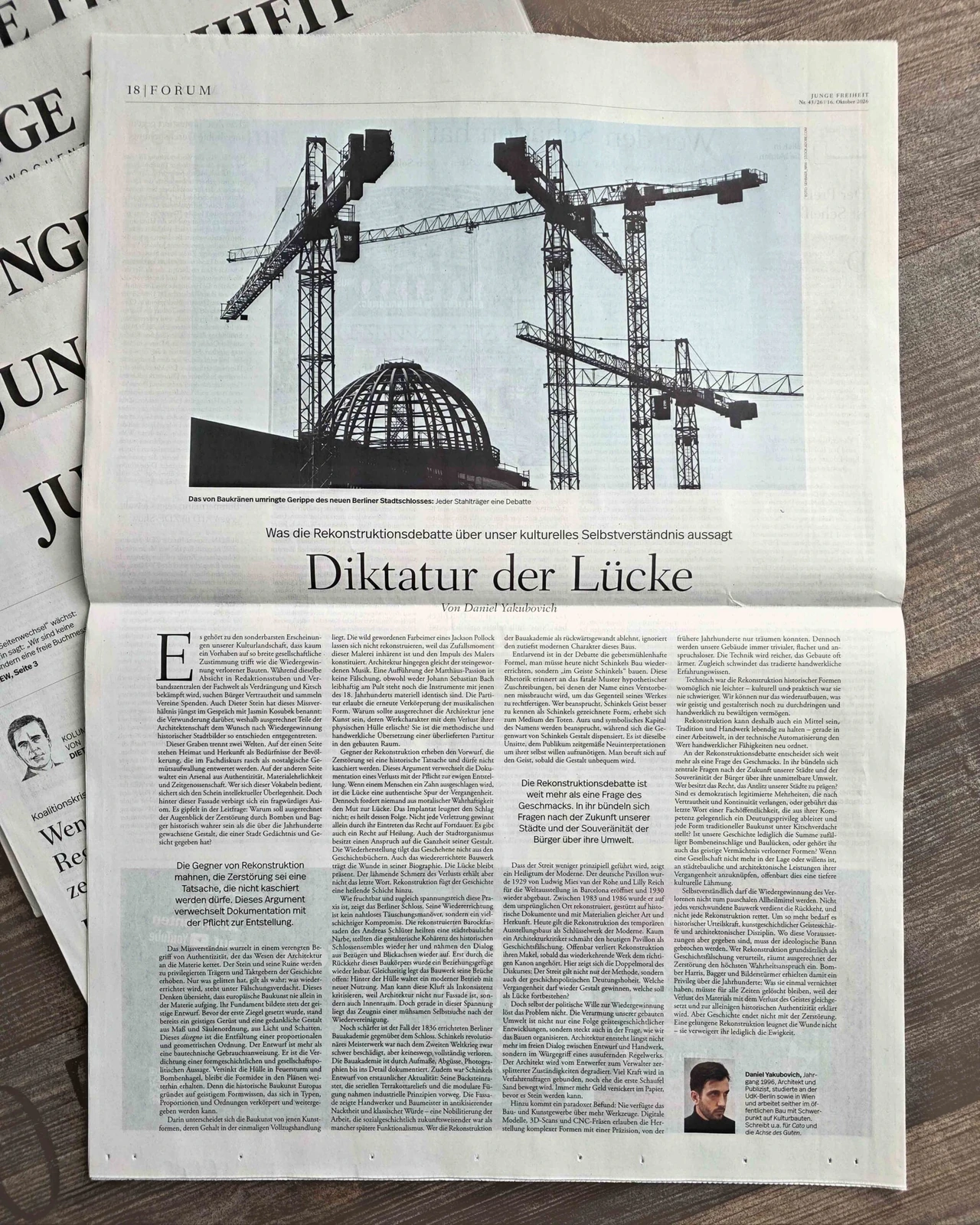
It is one of the strangest manifestations of our cultural landscape that hardly any project meets as broad social agreement as the recovery of lost buildings. While the same intention in editorial offices and association centers of the professional world is fought as displacement and kitsch, citizens seek familiarity and collect associations donations. Dieter Stein also recently named this disparity in conversation with Jasmin Kosubek: the wonder why parts of the architectural community are so decisively opposed to the desire for the recovery of historical cityscapes. This trench separates two worlds. On the one hand, home and origin stand as needs of the population, which are quickly devalued as nostalgic mood in the technical discourse. On the other hand, an arsenal of authenticity, material integrity and contemporaryness prevails. Whoever uses these vocabulary secures the appearance of intellectual superiority. But behind this facade hides a questionable axiom. It culminates in the guiding question: Why should the moment of destruction by bombs and excavators be historically more true than the figure that has grown over the centuries, which has given a city memory and face?
The misunderstanding is rooted in a narrow concept of authenticity, which chains the essence of architecture to matter. The stone and its ruins are raised to privileged bearers and clocks of history. Only what has suffered is considered true; what is restored is suspected of forgery. This thinking overlooks the fact that European architecture never arose in matter alone. Its foundation was always the intellectual design. Before the first brick was set up, there was already a spiritual framework and a mental form of measure and column order, of light and shadow. disegno The design is more than a construction-technical instruction. It is the condensation of a form-historical and socio-political statement. If the shell sinks into firestorm and bomb hail, the form idea remains in the plans. Because the historical architecture of Europe is based on spiritual formal knowledge, which can be embodied and passed on in types, proportions and orders.
In this way, architecture differs from those art forms whose content lies in the one-time execution. The wild colour bins of a Jackson Pollock cannot be reconstructed because the moment of chance of this painting is inherent and constitutes the artist’s impulse. Architecture, on the other hand, resembles the music that has become stone. A performance of Matthew’s Passion is not a forgery, although neither Johann Sebastian Bach stands physically at the desk nor the instruments are materially identical with those of the 18th century. The score allows the re-enactment of the musical form. Why should architecture, of all things, be the art whose work character disappears with the loss of its physical shell? It is the methodical and artisanal translation of a traditional score into the built space.
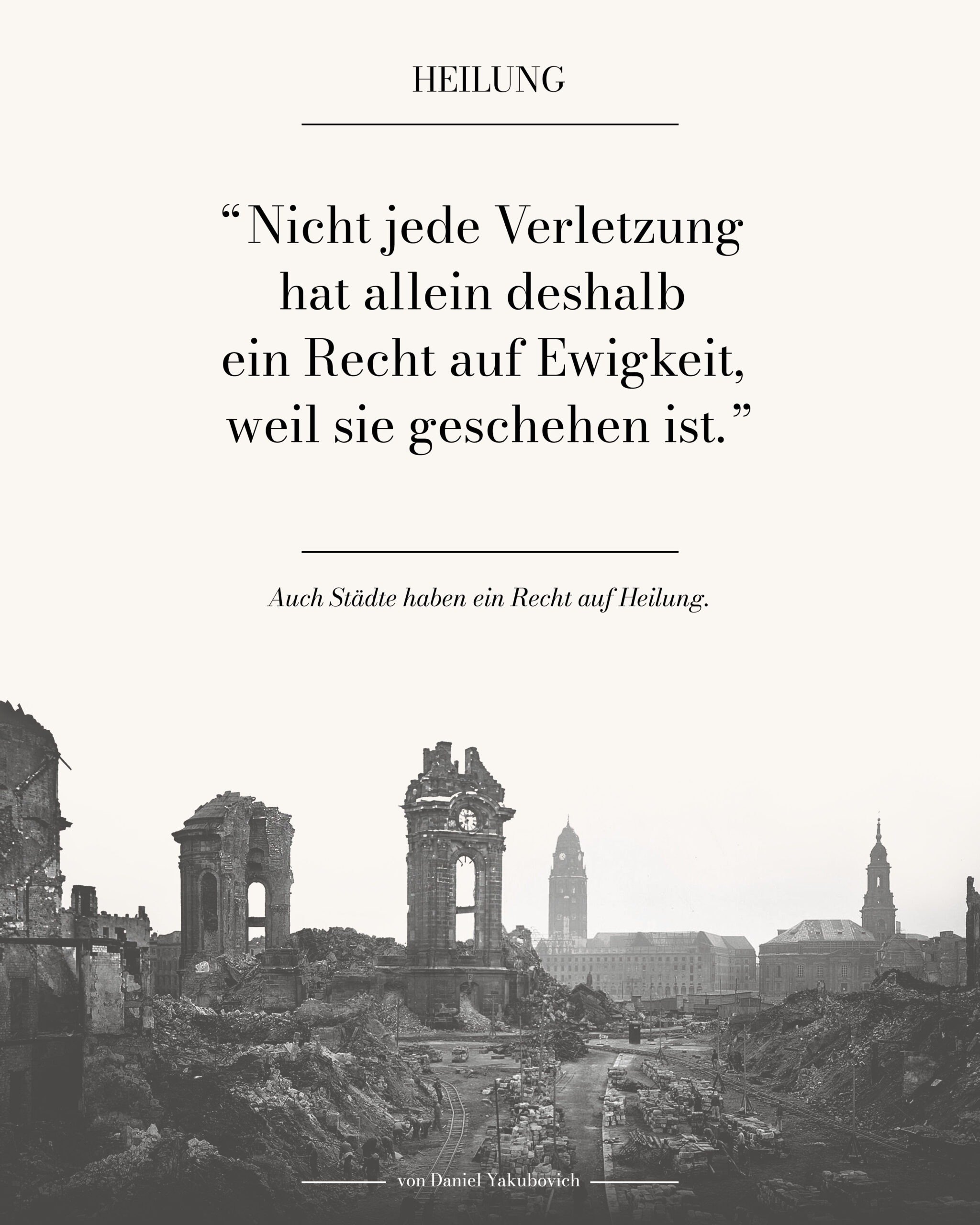
This argument confuses the documentation of a loss with the duty to eternal distortion. When a person is knocked out of a tooth, the gap is an authentic trace of the past. Nevertheless, no one asks for the courage to gap out of moral truthfulness. The implant does not deny the blow; it heals its consequence. Not every injury alone gains the right to perpetuity by entering it. There is also a right to cure. Also the city organism has a claim to the wholeness of its form. The restoration does not wipe out what happened from the history books. Also the reconstructed building carries the wound in its biography. The gap remains present. The paralyzing pain of loss does not get the last word. Reconstruction adds a healing layer to the story.
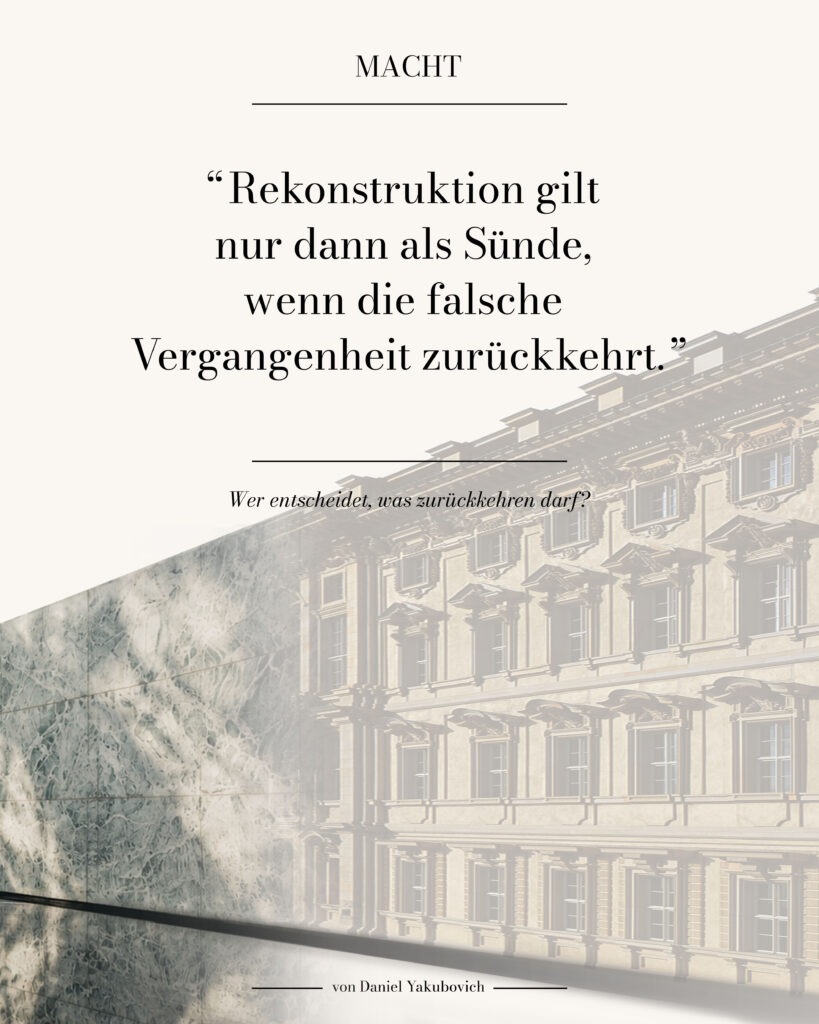
The Berlin castle shows how fruitful and at the same time exciting this practice is. Its restoration is not a seamless deception, but rather a multi-layered compromise. The reconstructed Baroque facades of Andreas Schlüter healed an urban scar, restored the design coherence of the historic castle ensemble and resumed dialogue from references and axes of view. Only through the return of this building did a structure of relationships become readable again. At the same time, the building reveals its breaks: behind the shell a modern operation with new use takes place. One can criticize this gap as inconsistency because architecture is not only a façade, but also an interior. But precisely in this tension lies the testimony of a laborious self-search for reunification.
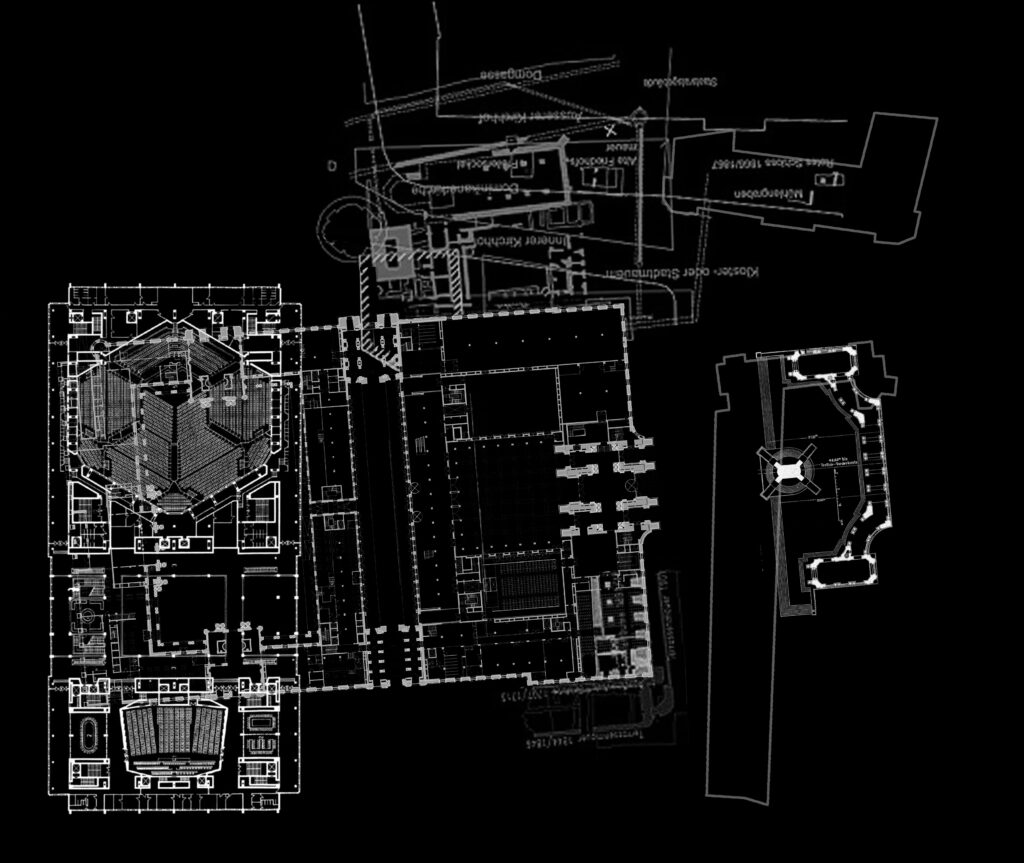
Schinkel’s revolutionary masterpiece was heavily damaged after the Second World War, but it was not completely lost. The building academy is documented in detail by measures, casts, photographs. In addition, Schinkel’s design was of astonishing topicality: his brick grids, the serial terracotta reliefs and the modular approach anticipated industrial principles. The façade showed craftsmen and builders in anticizing nudity and classical dignity – a nobilization of work that was more forward-looking in social history than some later functionalism. Anyone who rejects the reconstruction of the building academy as backward ignores the deeply modern character of this construction.
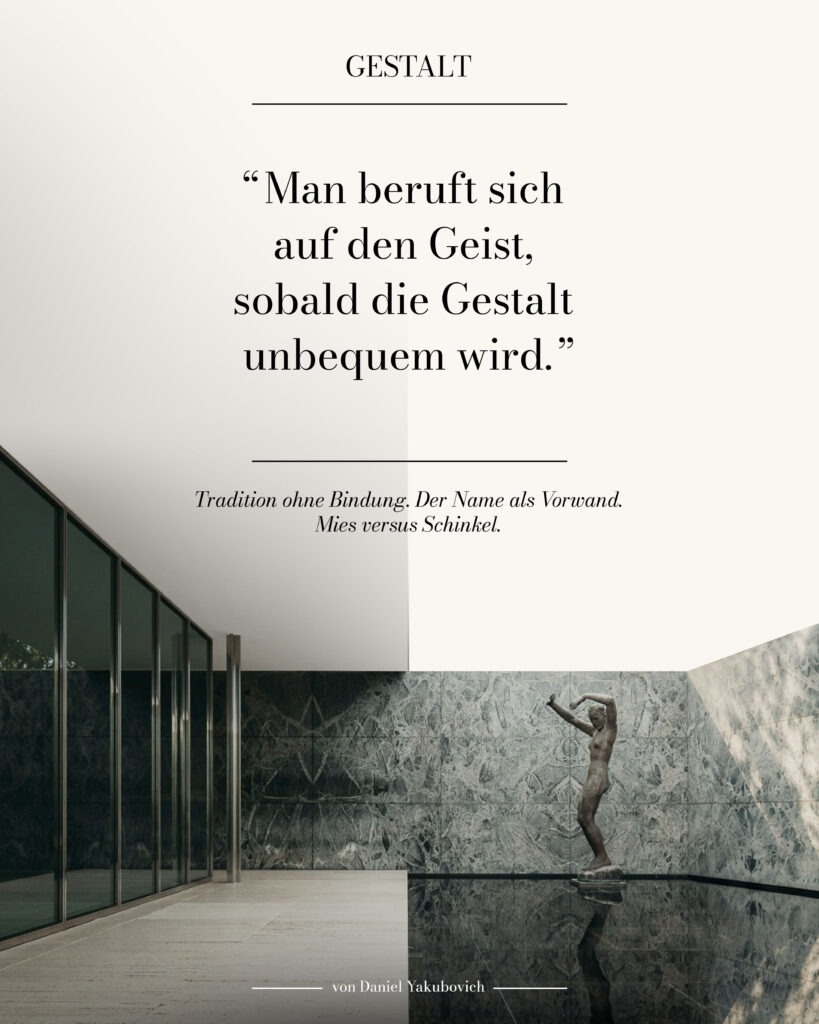
In the debate, unmasked is the prayer-milling formula that one must not rebuild Schinkel’s building today, but rather “build in the spirit of Schinkel.” This rhetoric recalls the fatal pattern of hypothetical attributions, in which the name of a deceased is abused to justify the opposite of his work. Whoever claims to know Schinkel’s spirit better than Schinkel’s drawn form, rises up as the medium of the dead. Aura and symbolic capital of the name are claimed, while the presence of Schinkel’s form is dispensing. It is the same immorality that contemporary reinterpretations are required by the audience for its own sake. One calls on the mind as soon as the figure becomes uncomfortable.
The German pavilion was opened in 1929 by Ludwig Mies van der Rohe and Lilly Reich for the world exhibition in Barcelona and dismantled in 1930. Between 1983 and 1986 it was reconstructed on the original site, based on historical documents and with materials of the same kind and origin. Today, the reconstruction of temporary exhibition construction is considered a key work of modernity. Hardly any architectural critic reproaches today’s pavilion as a forgery of history. Apparently, reconstruction loses its flaw as soon as the recurring work belongs to the correct canon. Here the double morale of the discourse shows itself: the dispute is not only about method, but also about historical political interpretation. Which past may gain shape again, which should continue as a gap?
But even the political will to recover does not solve the problem. The impoverishment of our built environment is not only a consequence of developments in intellectual history, but also lies in the question of how we organize construction. Architecture no longer arises in the free dialogue between design and craftsmanship, but rather in the stranglehold of an expansive set of rules. The architect is degraded from the designer to the administrator of fragmented responsibilities. Much strength is tied up in procedural questions before the first shovel sand is moved. More and more money leaks into paper before it can become stone.
In addition, there is a paradoxical finding: the construction and art trade has never had more tools. Digital models, 3D scans and CNC milling allow for the production of complex shapes with a precision that earlier centuries could only dream of. Nevertheless, our buildings become increasingly trivial, flatter and undemanding. The technology becomes richer, the built often poorer. At the same time, the traditional craftsmanship knowledge disappears.
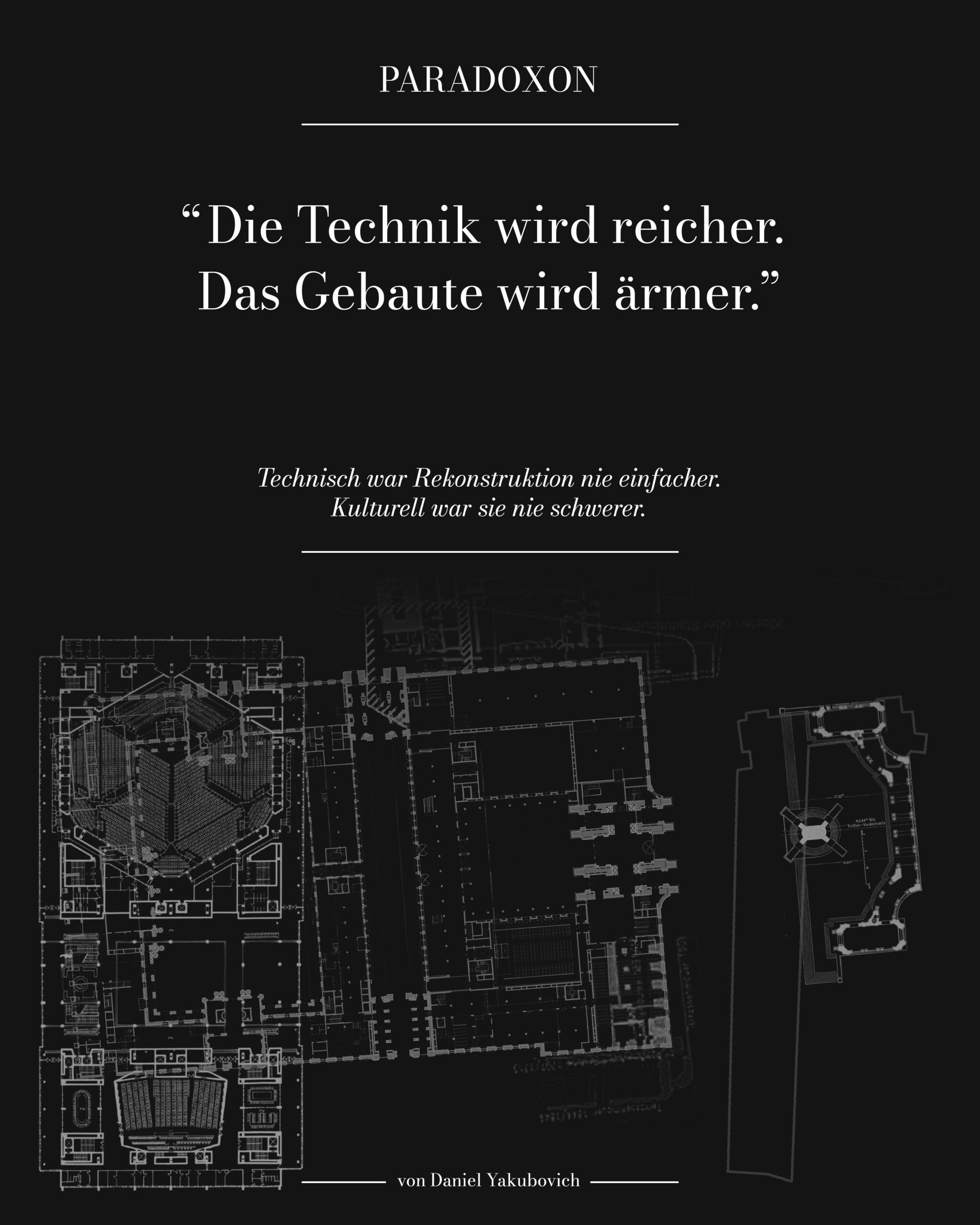
Technically, the reconstruction of historical forms was perhaps never easier – culturally and practically it was never more difficult. We can only rebuild what we are still able to penetrate mentally and creatively and master by hand.
Reconstruction can therefore also be a means of keeping tradition and craftsmanship alive – especially in a world of work where technical automation redefines the value of craft skills.
The debate on reconstruction is much more than a question of taste. In it, central questions about the future of our cities and the citizens’ sovereignty over their immediate environment are concentrated. Who has the right to shape the face of our cities? Are they democratically legitimate majorities who demand familiarity and continuity, or do they deserve the last word of a specialist public that occasionally derives from its competence a privilege of interpretation and places every form of traditional architecture under suspicion? Is our history merely the sum of random bomb attacks and building gaps, or does it also include the spiritual legacy of lost forms? When a society is no longer able or willing to link to urban and architectural achievements of its past, this reveals a deeper cultural paralysis.
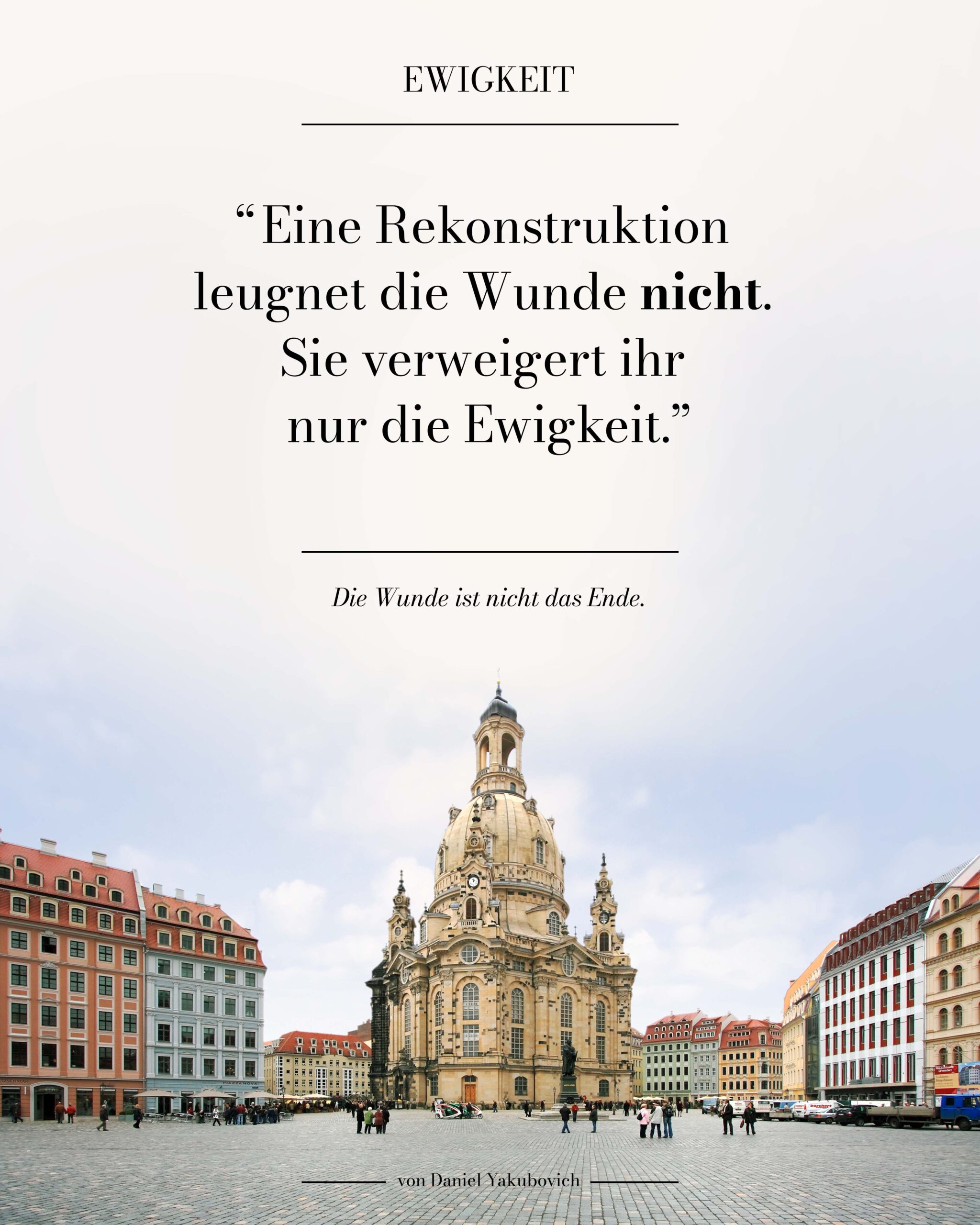
Of course, the recovery of the lost must not become a universal panacea. Not every missing building deserves to be returned and not every reconstruction is saved. All the more, historical judgment, art-historical sharpness of mind and architectural discipline are needed. Where these prerequisites are given, however, the ideological ban must be broken. Whoever basically condemns reconstruction as a forgery of history admits the highest claim of truth to destruction. Bomber Harris, excavators and painters thus received a privilege over the centuries: What they once destroyed would have to remain extinguished for all time, because the loss of the material is equated with the loss of the spirit and declared to be the sole historical authenticity. But history does not end with destruction. A successful reconstruction does not deny the wound – it only denies it for eternity.