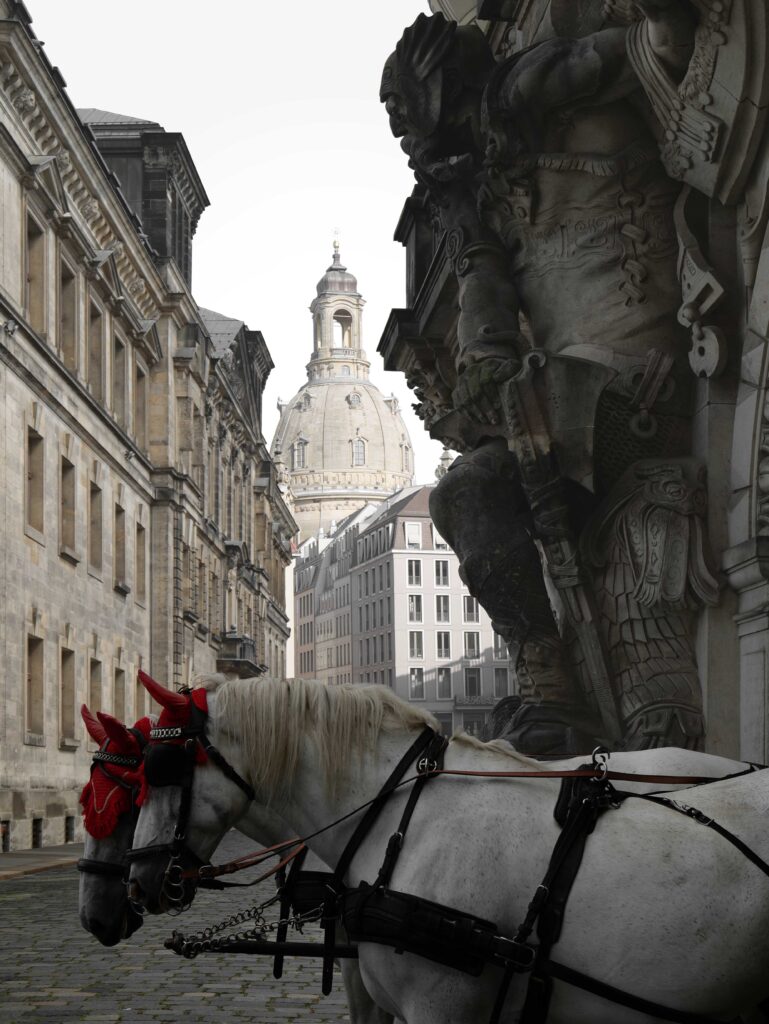
From the series “Ornament and Memory” – about the aesthetic impoverishment of modernity and the moral devaluation of ornaments – and about how city facades lose their memory.
Excerpt: The present series spans a historical arc into a contemporary diagnosis and shows that facade decoration was an indispensable part of the building culture; as an analogous layer of information, it fulfilled tectonic and social tasks alike. At the latest since Adolf Loos’ equation of ornament and crime, façade decoration is moralized and removed. Part II radicalises the image of 20th-century escalation waves as skinnings. It becomes clear that ornament is not superfluous decor, but above all a grammar that makes the structure readable, doctrinal and dimensional. Part III brings this to the point: In Berlin, “city repair” and new construction have a lifeless and backdrop-like effect; it is far from historical atmosphere and quality. The reasons for this lie in the density of standards, evidence and certification logics, insurances and awarding – a silent redistribution “from wall to paper.
Political reform impulse: (1) Decompress redundant evidence and technical rules, reduce double audit paths (reducing construction and non-construction costs); (2) convert awarding practice and criteria in such a way that quality is not systematically deleted at the beginning (optimization of construction costs); (3) align property policy so that small-scale development and medium-sized enterprises have opportunities again (analog to the construction boom of the Gründerzeit); (4) define design minimum standards (not as a style question, but value and city quality levers)
„Ornament does not waste anything, it preserves.“ – „No body can do without skin, but only in architecture is the smooth surface considered ideal.“ – „The real delicacy of modernism is not to have decorated houses, but to consider their ornaments as a delicacy.“ – „We live more efficiently today, but we appear less dignified.“
Long version: Part I–III