
When you look into a abyss for a long time, the abyss also looks into you
Friedrich Nietzsche
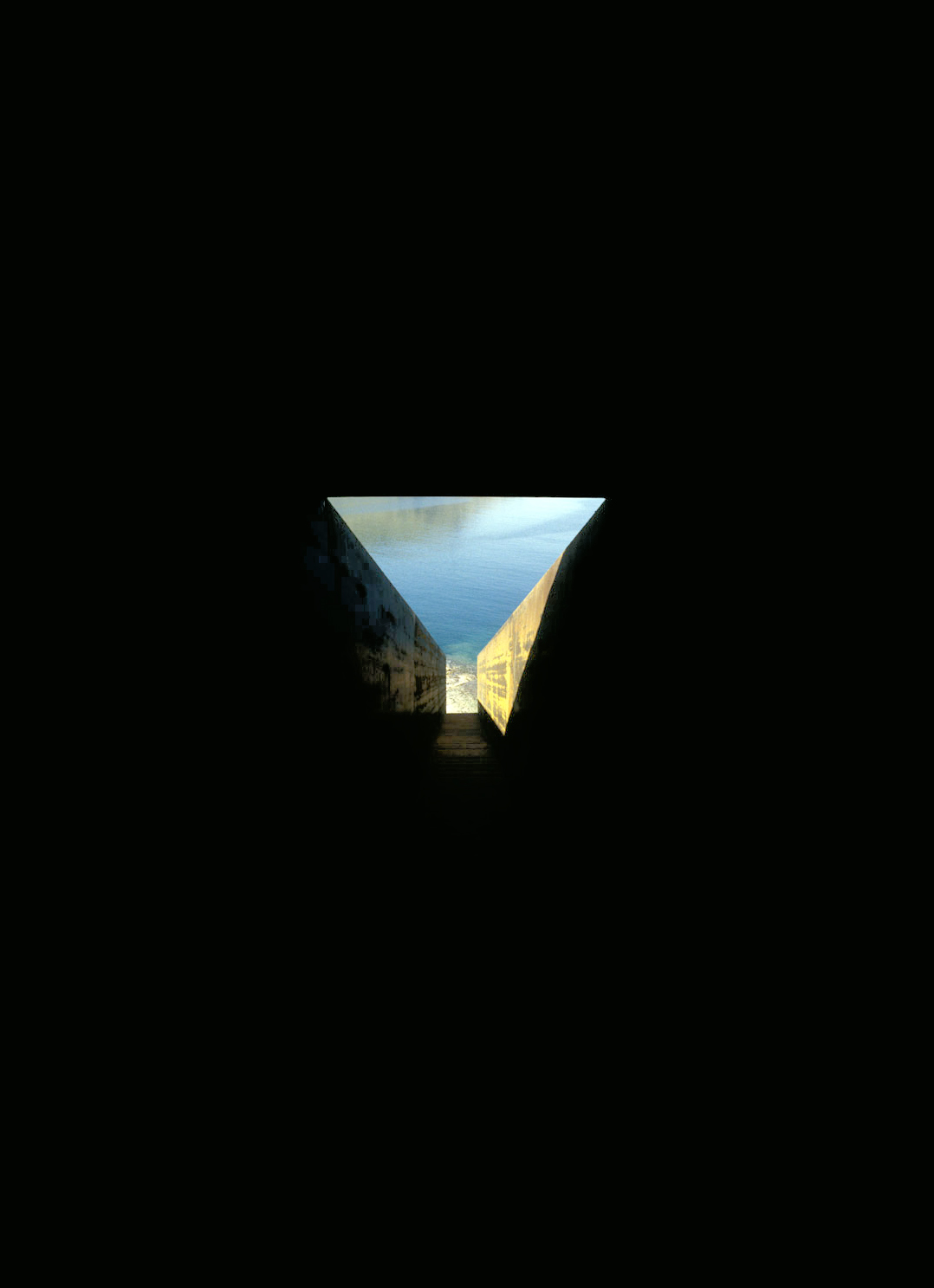
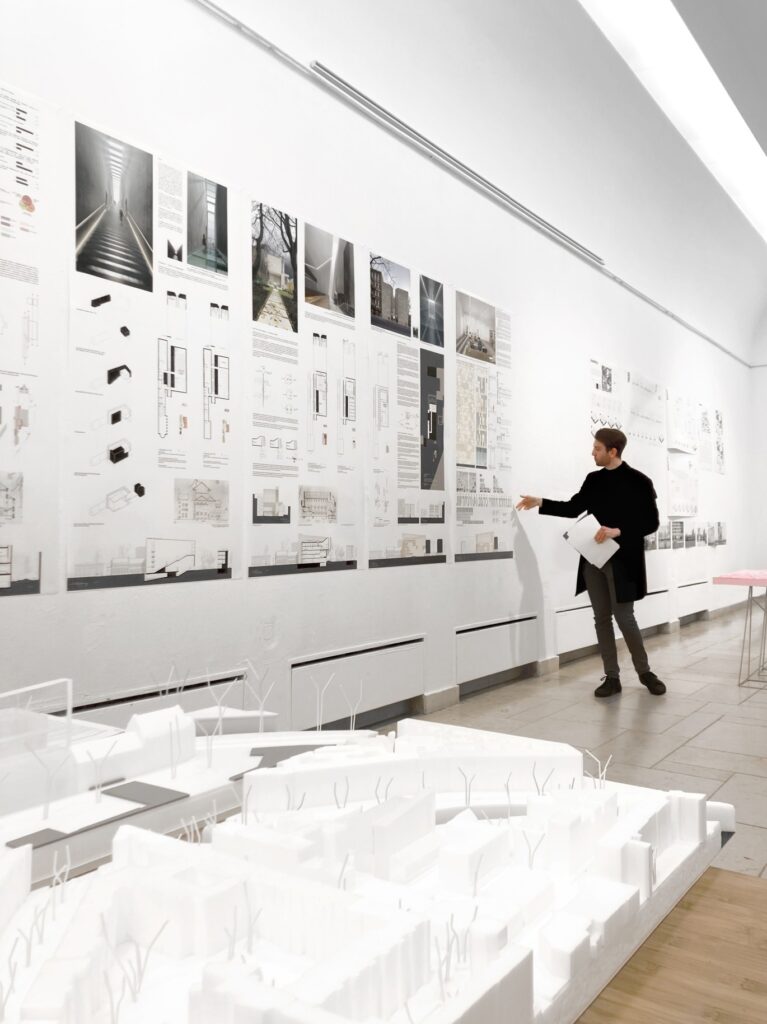
With the end of the staircase, the visitor finally reaches the last level before he Festival Synagogue He walks over a glass floor under which – as it were, as an echo of past times – possible remnants of the altar emerge, which he, like the memorial site, can see but cannot touch.1
This space is not a place in the conventional sense. It is a moment between being visible and hiding, between arriving and not touching.2 Like a walk-in memory, the interspace not only opens up architecturally, but inwardly.3 Those who stand here are standing above abysses – from glass, from history, from themselves. The raw concrete wall that touches the visitor is reminiscent of the Wailing Wall – and yet it is empty: without paper, without cracks, without texts. A wall of silence4Deprived of her liturgical function, she denies any projection surface and thus becomes a reflection of a memory that cannot be grasped.
Like Dani Karavans Passage in Portbou is not comforting with being lifted, but ends up in a symbolic impasse, so this room also refuses any mere narration. It is not the visitor who passes through the room – it is the room that checks the visitor.5 He puts it on the test of a quiet, almost imperceptible vibration in which every step is simultaneously a pause: a simple staircase leading down to the water, abruptly ending at a glass slab, reminds us today in Portbou of his fate. Visitors can descend the steps – but do not touch the sea. Yet freedom seems close to grasping.
The monument of the Israeli sculptor for Walter Benjamin – built near the Catalan portbou, where the philosopher took his own life – symbolizes in a simple and touching way the flight of the heart disease from the Gestapo: via France and Portugal towards the USA. A flight that he, weak in health, could only slowly make.
After the fugitives had been denied their journey in Spain due to a new decree – which would have meant a deportation back to France and thus an imminent arrest by the secret state police – they saw themselves Walter Benjamin so close to his escape target, crossing the Atlantic from Portugal to America, forced to take his life – apparently with an overdose of morphine tablets.
“In this hopeless situation, I have no other option but to end it. My life will end in a small village in the Pyrenees where nobody knows me.”6
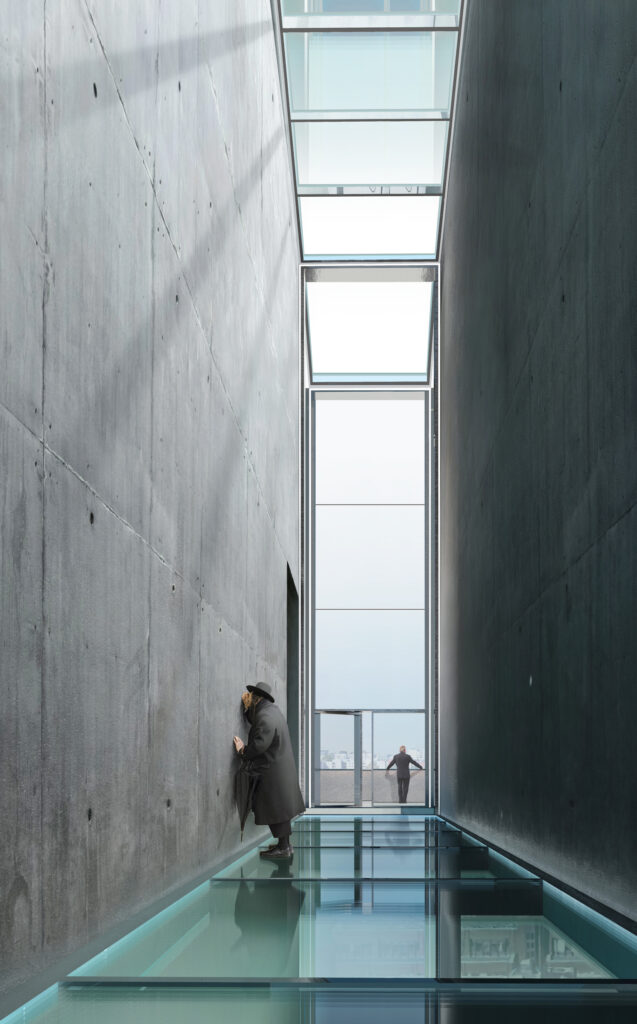
Even the glass plates under the feet of the synagogue seem to carry nothing.7 And precisely in this tactile walk – which is more like silence than step – that peculiar form of devotion arises, which cannot be prayed but can only be endured. Thus, the entree of the synagogue in many ways is the most radical of all spaces: the glass floor evokes the uncertainty of the present: every movement a decision, each step a venture.
Like over grave slabs in the ground of millennia-old cathedrals, whose inscriptions have been smoothed out by the countless steps of the centuries, visitors also pass over a shiny glass surface here – with a view of a gravelike hill. However, unlike in the cathedral, man does not enter the room here – but over. The glass floor is not an architectural element, but a touchstone. Anyone entering it enters memory – and loses the innocence of non-knowledge.
Overcoming fear also means getting closer to God, for God is overcoming fear. God is life.



See also:

- The transparent floor as a means of “seeing without touching” recalls museum viewing windows over excavations and Karavan’s Passages. Archaeological transparency as ethical distance. ↩︎
- The “in-between” as a threshold space (liminality) in Victor Turner’s sense; in architecture, controlled ambiguity rather than a single, fixed functional designation. ↩︎
- Memorial architecture that points “inwards”: Pierre Nora’s lieux de mémoire as collective repositories of memory, complemented by Aleida and Jan Assmann’s concept of cultural memory. ↩︎
- The “wall of silence”: James E. Young’s concept of the counter-monument or anti-monument — remembrance through absence rather than through a heroic figure. ↩︎
- See space as an agent: the phenomenological turn in Merleau-Ponty, in which the body is an “eloquent body”, affected by its spatial situation and moved to act. Maurice Merleau-Ponty, Phénoménologie de la perception (Paris: Gallimard, 1945), especially Part I, Chapter 3. ↩︎
- Ute Grasshoff / Ruth Sandhagen: Benjamin’s farewell letter from Port-Bou dated 25.9.1940,
Women’s Archive of the Faculty of Arts and Humanities, Heinrich-Heine-Universität Düsseldorf,
online at: https://wwwalt.phil.hhu.de/frauenarchiv/verboten/aus/benjamin_abschied.html
(cited November 28, 2025). ↩︎ - Glass as “load-bearing nothingness”: structural glass and laminated safety glass create cognitive dissonance between apparent emptiness and actual load-bearing capacity. ↩︎