
Series / Essay
Watercolour and mixed media · 2023–2024
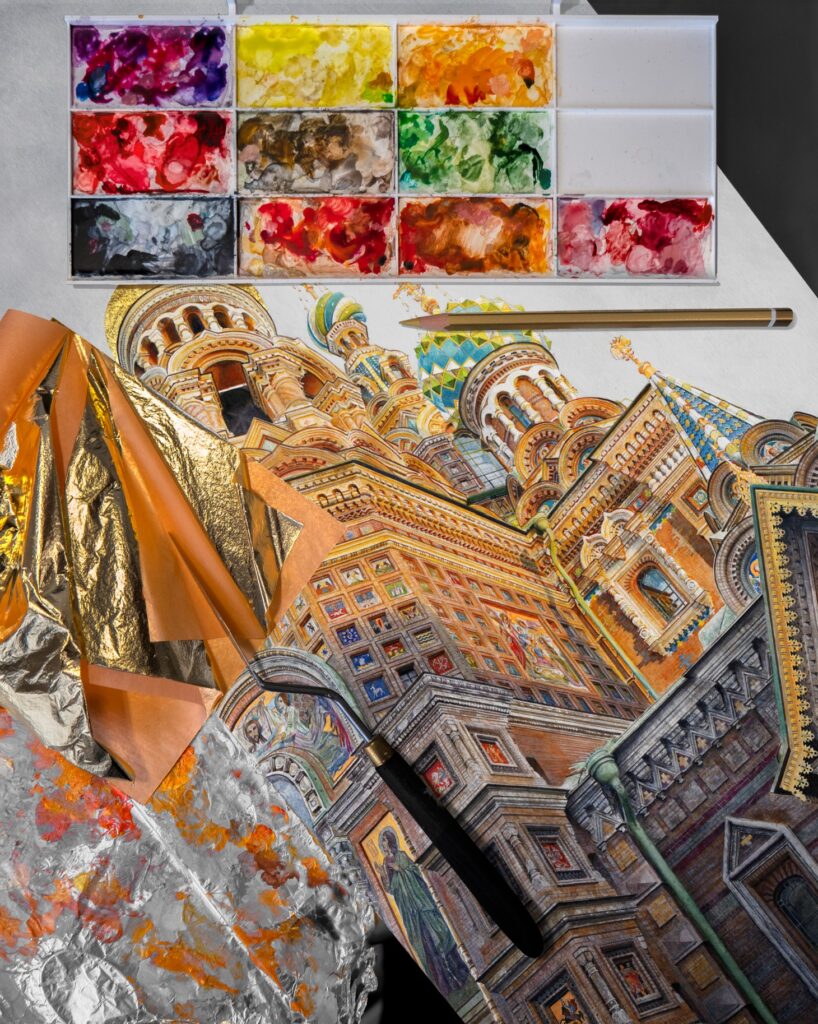
Mixed media: watercolour (“White Nights”, Nevskaya Palitra, honey-bound), acrylic (gold, silver, bronze, aquamarine, opaque white), graphite, coloured pencil (KOH-I-NOOR) and gold leaf on Hahnemühle card, 60 × 40 cm (sheet)
Signed lower right in white gel pen on a watercolour ground; inscribed on the reverse
Depiction of the Church of the Saviour on Spilled Blood (Спас на крови), St Petersburg
Inv. no. DY-2019-AQ-002
© Daniel Yakubovich.
There are cities whose holiest places commemorate not a miracle, but a crime. St Petersburg is one of them. Before a church stood here, a slowly congealing pool of blood lay on the wet cobblestones. The Church on Spilled Blood1 was an attempt to turn a politically motivated assassination into a narrative of salvation and interpret an attack on a head of state in metaphysical terms. On the spot where Alexander II was fatally wounded by the bombs of a revolutionary socialist group2 in 1881, his son had a stretch of embankment cut out of the urban fabric, the Catherine Canal3 narrowed, and a memorial church erected around the bloodstained patch of cobblestones onto which the monarch had fallen from his carriage after the attack. Beneath a precious canopy of gemstones and rock crystal, the original paving of the embankment remains visible: a frozen wound in the urban body, clothed in liturgical vestments. The church does not simply mark a place of remembrance; it sacralises an act of violence. The shed blood of the “Tsar Liberator”4 is encoded as the blood of a martyr. The empire elevates the dynastic body into a relic and literally seals off the possibility of a different, more constitutional future by covering it in mosaics.
A glance towards the Holy Land sharpens our understanding of how the overlay of earthly political power and religious metaphysical authority finds architectural expression:
Thus the Dome of the Rock is more than a mosque on Jerusalem’s Temple Mount, whose name in turn derives from the earlier Solomonic and Herodian temples. The Dome of the Rock serves as a shrine for equally charged ground: the Foundation Stone of Jewish temple tradition and, in Islamic tradition, the point of departure for the Prophet Muhammad’s Night Journey and ascent to heaven. As in St Petersburg, a meaningful patch of earth is framed, enclosed and sheltered. An octagonal ring of columns, ambulatories5 and inscriptions encircles a stone that itself remains untouched: architecturally, a kind of conceptual figure in which what lies beyond our disposal occupies the centre and may be approached only through rites, circuits and layers of text.
The principle of building around an untouchable landscape formation because metaphysical power is attributed to the earth itself had already found practical architectural expression in my final project at the Berlin University of the Arts. It is discussed in this essay:
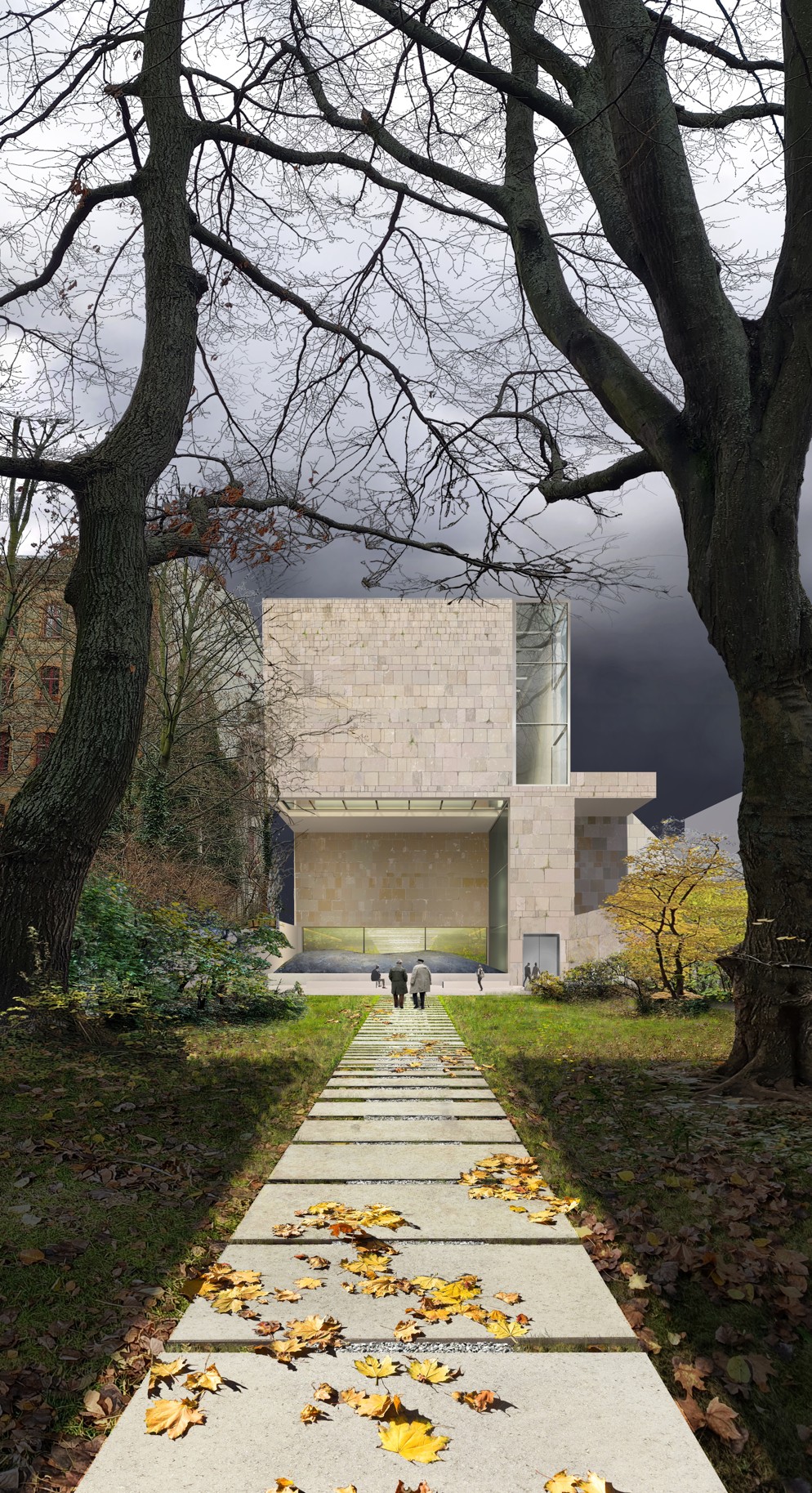

This principle also exists in Christianity: a minimal patch of earth, often soaked in blood, preserved as a relic beneath a maximal architectural apparatus. The most prominent example is also in the Holy City, not far from the Dome of the Rock. The Church of the Holy Sepulchre has architecturally subdued Jerusalem’s characteristic karst landscape of hills and caves, transforming it into a thoroughly reshaped cultural landscape. The church encloses the rock of Golgotha, the Stone of Anointing, the burial chamber and many other significant sites beneath its vaults. An altar now stands over the fissure in the rock at the place of crucifixion. The stone is touched through an opening in a marble slab; the rest lies behind glass. Within the same building, the aedicule6encloses the rock-cut burial niche like a stone capsule: a kind of nesting doll, a freestanding building within a larger building.
A second type consists of birthplaces and tombs fixed to a point in the ground. In the Church of the Nativity in Bethlehem , a fourteen-pointed silver star in the marble floor marks the birthplace of Jesus. Through the opening at its centre, pilgrims can touch the rock below. In Rome, the great basilicas over the apostles’ tombs were built as vertical axes: St Peter’s over Peter’s tomb in the former Vatican Necropolis, with the high altar directly above the burial place; St Paul’s Outside the Walls over his sarcophagus.7 Here, “holy ground” is not spectacularly visible as in Jerusalem, but the entire spatial composition is centred on a point beneath the altar: the earth itself becomes an invisible relic.
And then there are “materialised” stretches of a path, such as the Scala Sancta in Rome: the staircase said to come from Pilate’s praetorium, an imported topographical fragment. Its marble steps, bearing traces of Christ’s blood, were incorporated into a separate building and are now covered in wood; they may be ascended only on one’s knees. Sites of martyrdom, such as the place of Paul’s execution or the shrine of the twelfth-century martyr Thomas Becket in Canterbury , work similarly: a patch of earth, path, paving or rock is fixed, encrusted and charged with liturgical meaning.
The mechanism behind this practice of sacralisation seems clear. At the Dome of the Rock, the golden dome asserts that heaven and earth once touched here; at the Church on Spilled Blood, the golden dome of the bell tower elevates the murdered monarch into a saint within a national mythology of sacrifice. Different as their traditions are, both buildings transform raw fact—rock and paving—into a sacredly framed focus of collective identity. Architecture functions here less as the envelope of a cult than as an apparatus of exaltation. It freezes contingency, gilds it and declares it the unshakeable centre around which history, devotion and power must henceforth revolve.
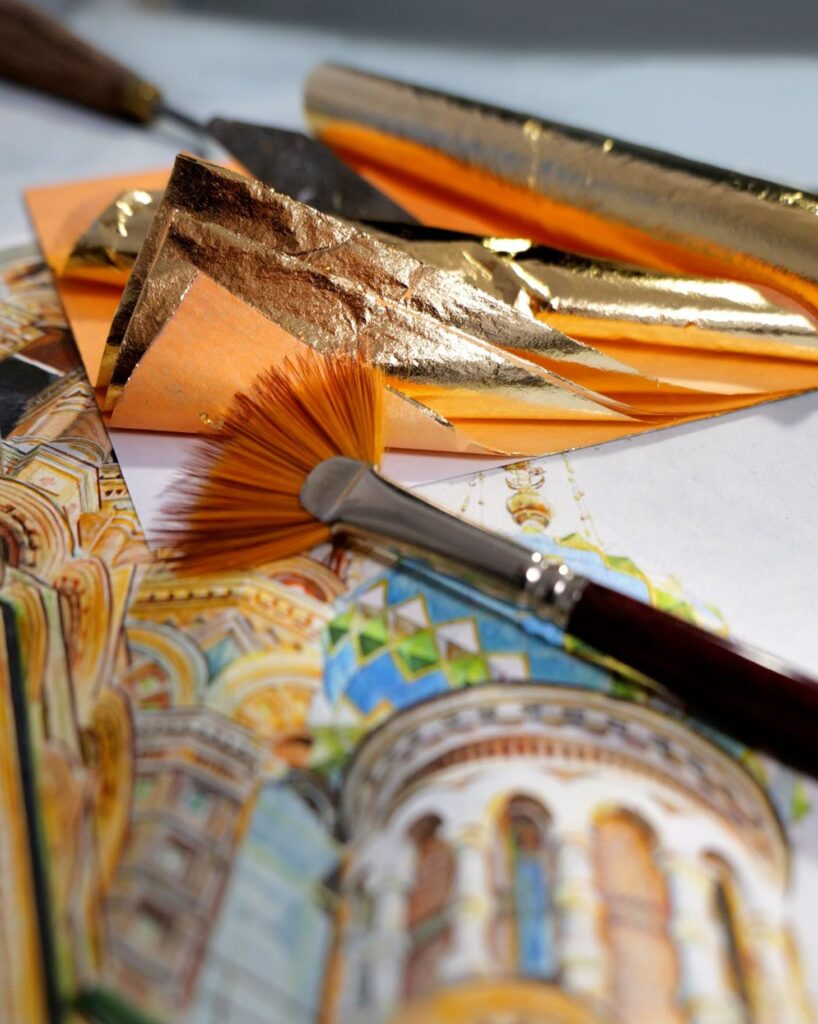
Materials and Technique
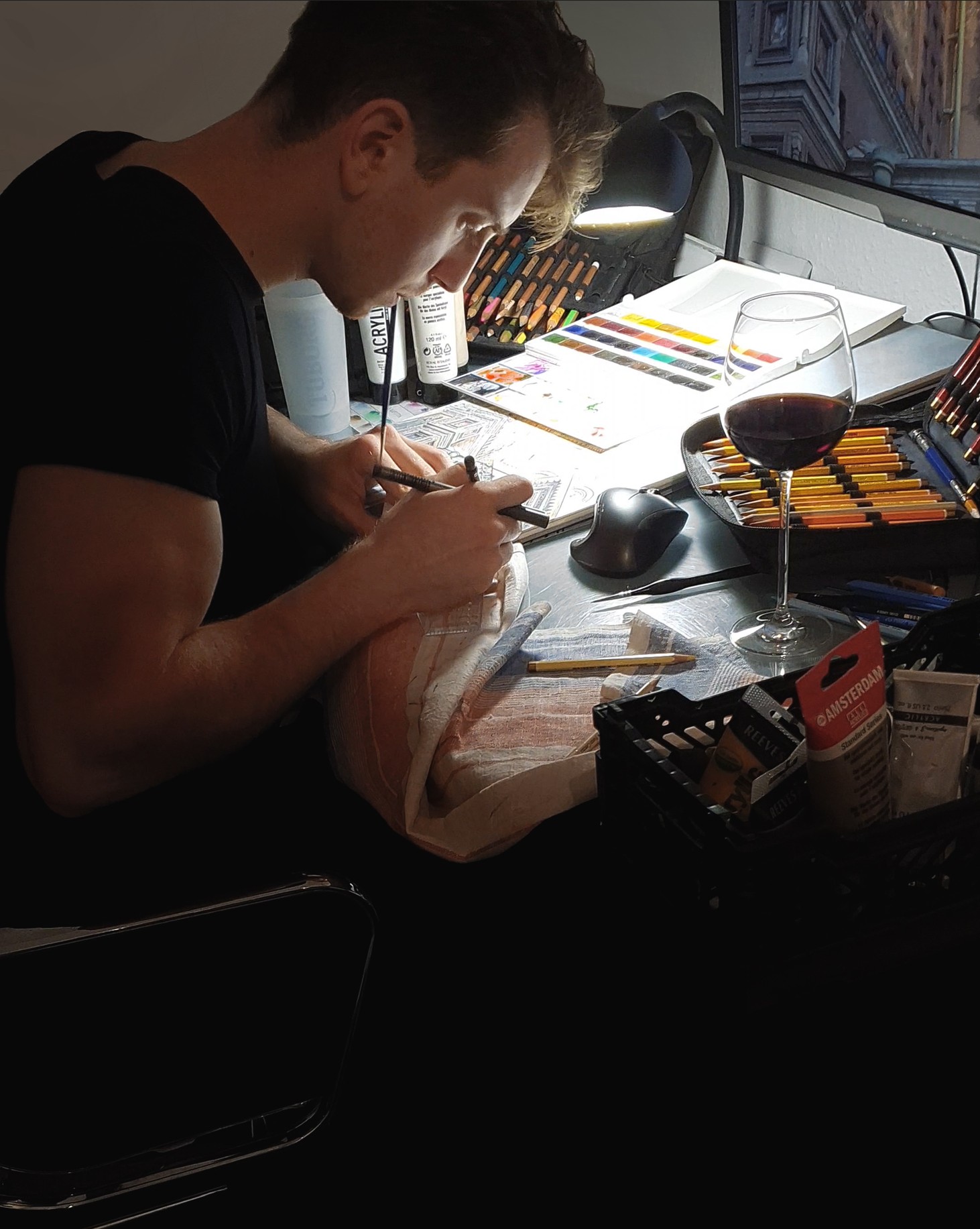
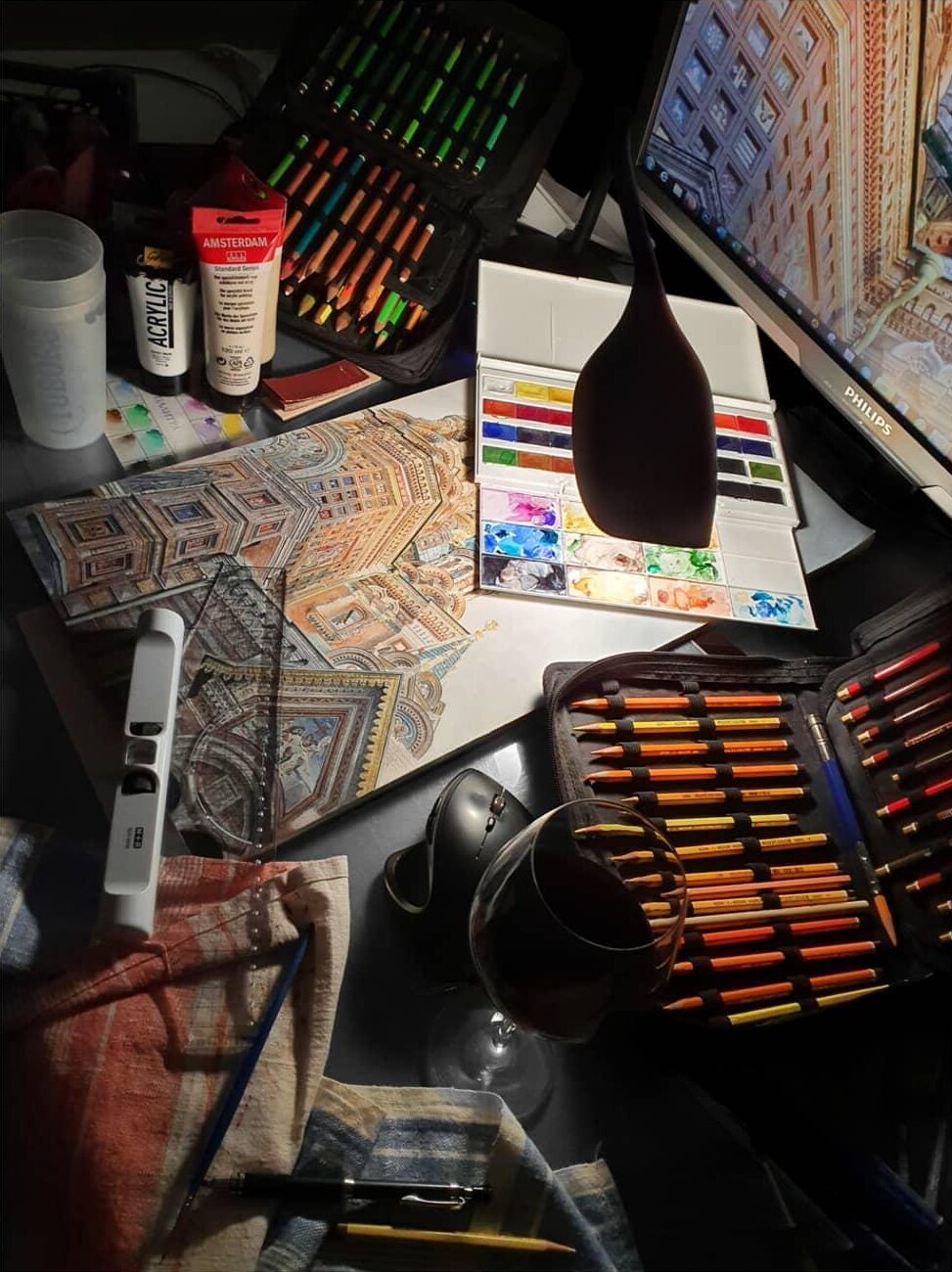
This watercolour was based on a photograph from my two-week holiday in St Petersburg in 2019. The work took three years in all and was completed in spring 2021, when it was cut free from the watercolour block. Compared with the church’s construction time, that was still very quick… The precious materials of the original subject, the Church on Spilled Blood, are echoed in the materials of the work: St Petersburg watercolours by Nevskaya Palitra on a special edition of particularly heavy, dense Hahnemühle paper, released to mark the premium watercolour-paper brand’s 375th anniversary and weighing exactly 375 g/m2 . The St Petersburg watercolours were made with traditional gum arabic and bee honey as binders, while many commercially available Western and non-European brands now replace honey with chemical humectants. The St Petersburg colours have a natural luminosity and are particularly UV-resistant. This mixed-media work was supplemented with polychrome pencils from a 144-piece set by the South Bohemian brand KOH-I-NOOR Hardtmuth . Acrylic paints by Schmincke PRIMAcryl and Lascaux Artistwere also used. For the numerous municipal coats of arms on the church façade in particular, the traditionally made watercolour was mixed with antique gold, silver, bronze, mother-of-pearl and various metallic shades based on synthetic acrylic resin. The work was heightened with gold leaf.
- Собор Спасa на крови [sɐ.ˈbor ˈspasə nɐ krɐ.ˈvʲi], meaning “Church of the Saviour on Spilled Blood” ↩︎
- Народная воля [nɐ.ˈrod.nə.jə ˈvo.lʲə], meaning “People’s Will” or “People’s Freedom”
The revolutionary socialist secret society combined an agrarian socialist, populist programme with a new intensity of political violence. It demanded an end to the Romanov monarchy, generally known as tsarist rule, although the title had no longer been officially used since Peter’s reforms of 1721. To enforce demands radical by the standards of the time, the conspiratorial group did not shy away from terrorism, including spectacular assassinations.
After its suppression, most of the group’s leaders were executed, sentenced to long terms in fortress prisons or driven into exile. The remainder were absorbed, personally and politically, into new currents of radical opposition and revolution. Nevertheless, the group’s influence endured, and it was later stylised as a precursor to a supposedly “revolutionary vanguard”.
Its self-presentation as a pure struggle for free elections and constitutional rights is therefore inadequate. Although its programme contains a remarkably modern catalogue of political freedoms, it is also saturated with overthrow and the seizure of power. A small, conspiratorial minority claims to speak “in the name of the people”, decides over the monarch’s life and death and hopes that shock and destabilisation will produce the order it desires. In this sense, the People’s Will movement stands somewhere between an idealistic liberation movement and a project for the seizure of power by a self-appointed revolutionary elite. The Church on Spilled Blood spatially preserves precisely this ambivalence by transforming the assassination into a sacred dynastic legend of the Romanovs. ↩︎ - Named after Catherine the Great at the time of the assassination of Alexander II, the canal was renamed in 1923 after Александр Сергеевич Грибоедов [ɐlʲɪkˈsandrə sʲɪrˈɡʲe(j)ɪvʲɪt͡ɕ ɡrʲɪbɐˈjedəf] (Alexander Griboyedov), a diplomat, playwright, linguist and composer: in short, a polymath whose life, like Alexander II’s, ended violently in connection with his political activities. Griboyedov’s death resulted from an explosive mixture of Persian war reparations and the Russian refusal, perceived as a sacrilegious provocation, to hand over an Armenian eunuch who had escaped from the Shah’s harem, together with fugitive Armenian women. Armenia was under the Russian crown. ↩︎
- In Russian historical memory, Alexander II is known as the “Tsar Liberator” (Царь-Освободитель [t͡sarʲ ɐsvɐbɐˈdʲitʲɪlʲ]) because he abolished serfdom in 1861, fundamentally improved the position of the peasantry through extensive judicial, administrative and military reforms, and contributed decisively to Bulgaria’s liberation from Ottoman rule through the Russo-Turkish War of 1877–1878. ↩︎
- Here I take the liberty of using a term from Christian sacred architecture to describe a mosque. An ambulatory (from the Latin ambulare , “to walk”) is an additional layer of space around the choir. It occurs most often in churches with several aisles, where the side aisles continue around the altar to form a passage around the choir. ↩︎
- Originally a Roman household shrine, the aedicule became a motif for numerous tombs. The term is a diminutive of the word for a temple. Aedes in Latin originally denotes a sacred building or temple. ↩︎
- The reference here is to the church of St Paul Outside the Walls in Rome. ↩︎