
Series / Essay
Painting on canvas · Acrylic on canvas · 2021–2022
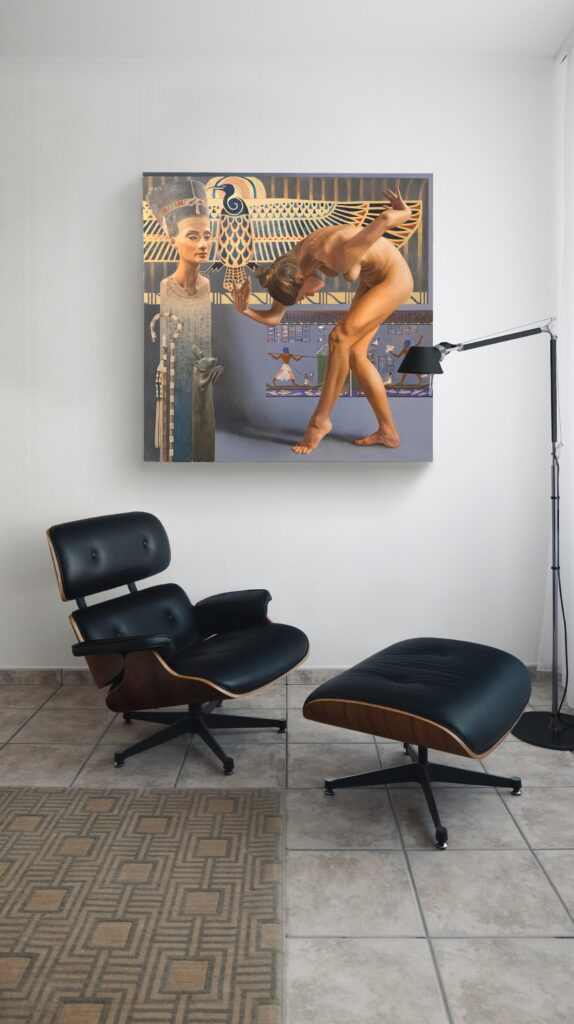
Acrylic on cotton-blend canvas, on a self-supporting 4 cm stretcher, 80 × 80 cm; inscribed and signed on the reverse in black fineliner on an acrylic ground
Female nude against a decorative, abstracted background
Inv. no. DY-2021-A-001
© Daniel Yakubovich.
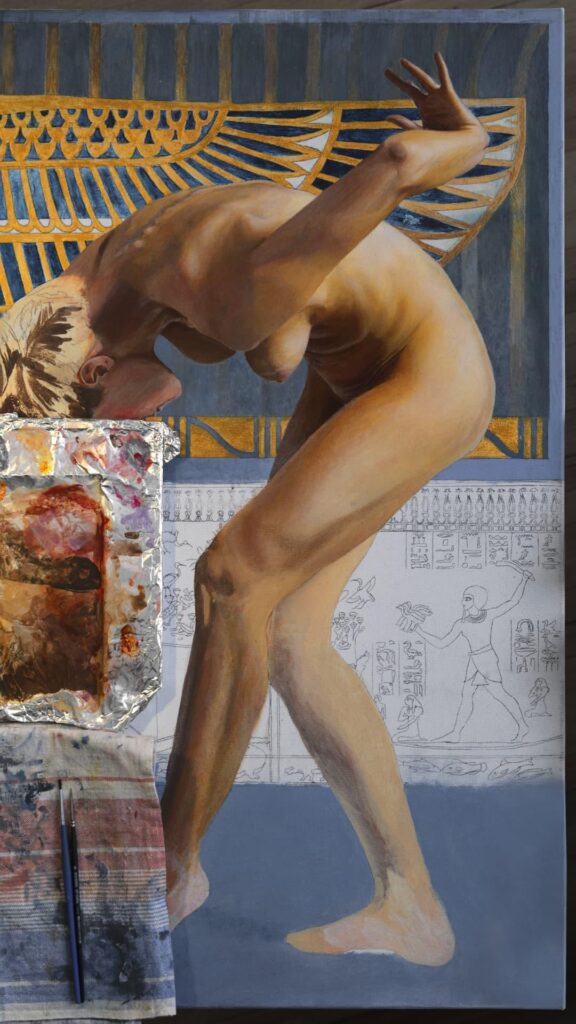
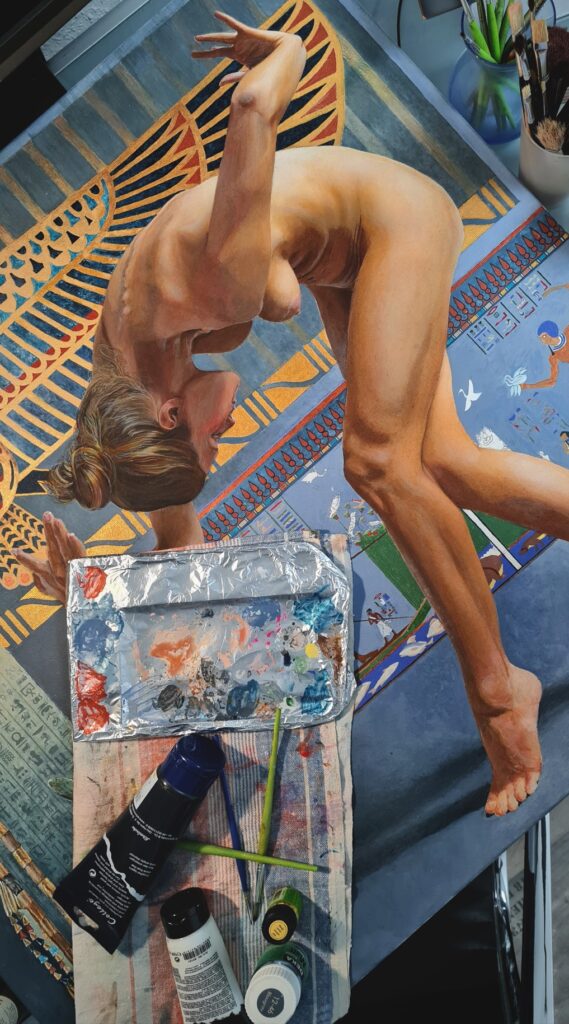
In this painting, Egypt exists only as wallpaper. No Nile, no temple, no sand: instead, the painting speaks of the carefully air-conditioned atmosphere of a Viennese museum gallery, a Berlin icon and a bare back of our own time. A young woman bends so far forwards into herself that her body becomes more sign than body, her arms spread as if in prayer. Between them unfolds a gold-and-blue mesh of feathers, ribbons and hieroglyphic signs: an ornamentally condensed quotation from Western museum history and nineteenth-century Egyptomania. “Elifên” does not present Egypt directly, but at a second, third, fourth remove…
The Wallpaper: Beni Hassan in Vienna
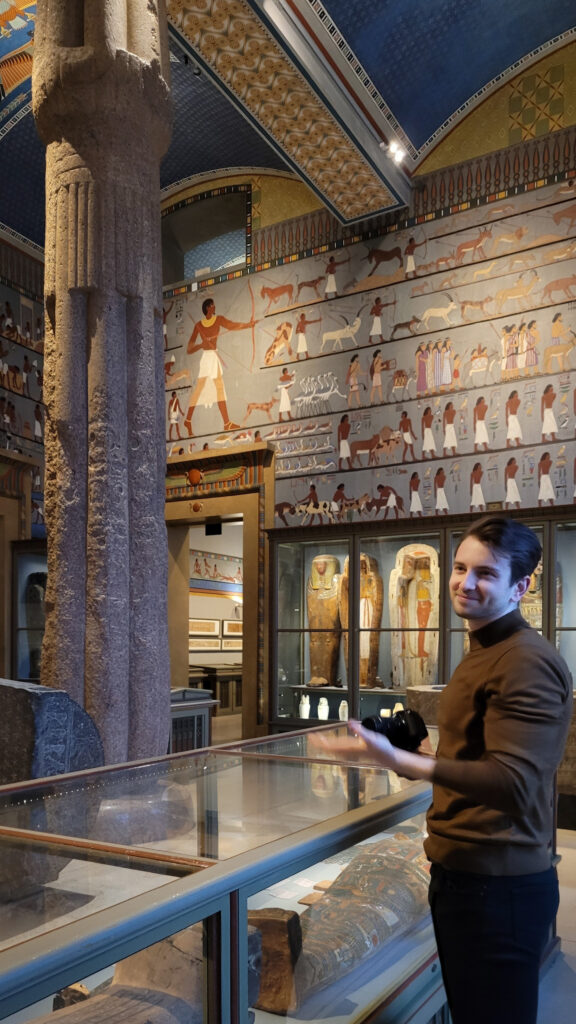
The ornamental wall behind the figure is a deliberately estranged rendering of the famous “wallpapers” that have lined Galleries I, II and V of the Egyptian collection at Vienna’s Kunsthistorisches Museum since 1891. These, in turn, are exact reproductions of wall paintings from the rock-cut tomb of the provincial governor Khnumhotep II at Beni Hassan in Middle Egypt (Middle Kingdom, c. 1870 BC). The German painter Ernst Weidenbach copied the originals directly inside the tomb during the Prussian expedition to Egypt and Nubia1 in 1842–1845.
For the Vienna World’s Fair of 1873, these drawings were transferred onto cardboard and assembled into large panels, which were used to present a complete reconstruction of the tomb in the Rotunda. After the exhibition closed, the painted cardboard panels were moved to the newly built Kunsthistorisches Museum, where they remain to this day, fixed with paste like wallpaper.
The original tomb paintings at Beni Hassan display the full repertoire of Middle Egyptian imagery: desert hunts with fantastical creatures, draught animals, wrestlers, musicians, craftsmen, processions and a caravan of “Asiatics of Shu”2, depicted as foreign traders in brightly patterned garments, accompanied by children and livestock. Their distinctive features are flat areas of mineral colour—ochre, red, blue and green—with clear black outlines and no modelling through light and shade. This manner of representation recalls the Orthodox icon painting of the Eastern Churches, whose visual language and characteristic depictions of saints and angels renounce earthly corporeality and therefore cast no shadows. Orthodoxy has a strictly regulated canon governing gesture, facial expression and a restricted palette. Like Egyptian tomb painting, icon painting also dispenses with perspective. Even differences in the size of figures are better read as metaphors for hierarchical relationships than as distances from the viewer expressed through perspectival depth. Icon painting even employs reverse perspective, in which distant objects are shown, contrary to logic, as larger.

For more than a hundred years, these cardboard panels remained almost untouched, until their first comprehensive restoration between 2019 and 2023. Condition surveys had shown that they were heavily soiled, at risk of detaching from their backing in many places, and marked by darkened earlier retouching. In 2021, some panels were removed, cleaned in the workshop, reinforced from behind and then reattached to the repaired walls; the historic ceiling paintings were cleaned at the same time. The conservators followed a strict code: retouching was to be carried out only in fine dots or, alternatively, networks of lines, never as continuous overpainting, so that future generations could identify the interventions and they would remain reversible.
In “Elifên”, this museum décor is mirrored and condensed. The concern is no longer the painted reproduction of specific narrative scenes, but an ornamental rhythm that encloses the female body between vertical gold stripes, as if in a cage.

Klimt: The Bird in the Stairwell
The large bird behind the figure—somewhere between falcon, vulture and eagle—points to a second Viennese encounter with Egypt: Gustav Klimt’s spandrel painting3 in the grand staircase4 of the Kunsthistorisches Museum (KHM). In 1890–1891, Klimt, his brother Ernst and Franz Matsch decorated the spaces above the arcades with personifications of the principal periods of art history. The Egyptian allegory shows a standing nude woman against an ornamental background that combines architectural motifs, hieroglyphs, the gods Horus and Thoth, and the vulture of the goddess Nekhbet into a gleaming golden mesh. The adjacent intercolumniation, devoted to the same artistic period, presents a composition of Egyptian objects, including sarcophagi, statues and papyrus scrolls.
Klimt painted a modern European nude—a radical departure from ancient Egyptian convention, which permitted naked bodies almost exclusively in depictions of children or the vanquished. At the same time, he merges her features with the faces of the depicted funerary figures and coffins, alluding to the porous boundaries between living body, statue and cult image.
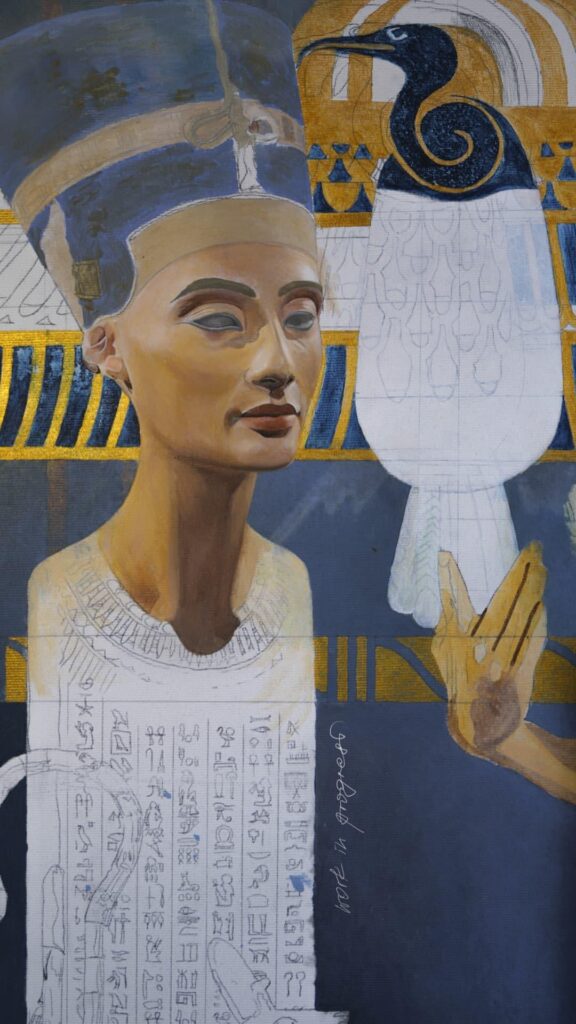
“Elifên” borrows not the whole scene from Klimt’s world, but a detail: the large, symmetrical bird with its colourful wings. Combined with the Beni Hassan wallpapers, the bird becomes a blend of nostalgic longing for distant places, art-historical precision and a delight in decoration in the tradition of nineteenth-century Salon painting.
Nefertiti: Between Restitution Demands and Common Sense
On the left of the painting, the bust of Nefertiti gazes into the distance. Berlin’s most beautiful woman, a painted limestone and stucco sculpture from the Amarna workshop of the sculptor Thutmose (c. 1345 BC), was discovered by a German expedition at Tell el-Amarna in 1912 and has been in Berlin since 1913; today it is housed in the Neues Museum. Like most of Thutmose’s works, the bust of Nefertiti remained unfinished. It is regarded as one of the most frequently copied sculptures in the world and as the embodiment of a European ideal of female beauty—and, at the same time, as a test of whether Europe may preserve its historically accumulated museum collections without dismantling itself in a gesture of belatedly discovered, left-wing populist self-accusation. This particular object could exemplify how cultural heritage is not “healed” by symbolic returns, but sustained by the institutions that have guaranteed its preservation, appreciation, study and public accessibility for more than a century. It is striking how rarely advocates of an ostensibly historically sensitive, empathetic restitution of Nefertiti ask the converse question: whether this bust, present in Berlin for over a century, has long since become part of a specifically Berlin identity—an urban memory that cannot simply be put up for disposal. One might equally understand her as Egypt’s ambassador to Germany, a permanently accredited envoy of another cultural world at the Neues Museum, as a diplomat put it on the occasion of the opening of the Grand Egyptian Museum in Cairo—and thus as a figure whose transnational biography calls for more nuanced answers than a simplistic demand for repatriation to a “country of origin” conceived in nation-state terms.
The recent restitution of the Benin Bronzes demonstrated just how simplistic such demands for repatriation and their political staging can be. In 2022, the German federal government, with Foreign Minister Annalena Baerbock and Minister of State for Culture Claudia Roth, agreed to an “unconditional return” to Nigeria without securing binding clarification of who would have custody of this collection, regarded as part of the world’s cultural heritage, or how its public accessibility would be guaranteed in the long term. A few months later, Nigeria’s then president, Buhari, transferred ownership of the bronzes by decree to the Oba of Benin: the head of the royal family that had itself historically been implicated in the slave trade and violence. The move was criticised in Germany, including in the Bundestag, as a “debacle” and the result of a lack of foresight, since the objects now risk effectively passing into a royal private domain. Against the background of such symbolic politics, Nefertiti as a transnational actor seems almost a counterproposal. Precisely through her complex biography, she demonstrates that a responsible approach to cultural heritage requires more than performative gestures of moral purification: it requires dependable institutional arrangements that recognise multiple affiliations, secure access and address historical responsibility through lasting structures rather than media-friendly moments.
Moreover, the modern state of Egypt is connected only indirectly with the pharaonic “Egypt” whose intellectual and visual world produced a bust of such singular perfection—just as present-day Rome cannot be equated with the Roman Empire, nor the modern Greek republic seamlessly identified with the world of the Attic city-states. The ancient cultures that modern states like to invoke are distant genealogical points of reference rather than owners to whom property can unequivocally be assigned in law. Seen in this light, keeping the bust in Berlin appears not as a denial of justice, but as a case for shared responsibility: Egypt and Europe, Cairo and Berlin, share the duty to study this object in Berlin, place it in context and keep it accessible, without either side surrendering its memory entirely to the other.
While Nefertiti remains untouched and iconic, the living body before her seems to buckle, as though bowing to an unattainable standard of beauty. There is something reverential about the gesture, but also something violent. One might also say that two claims to presence are being negotiated here: that of a globally circulating icon and that of an individual body. Perhaps the painting’s real provocation is that it forces us to decide which of the two deserves our allegiance.
Elifên: A Desert Dream
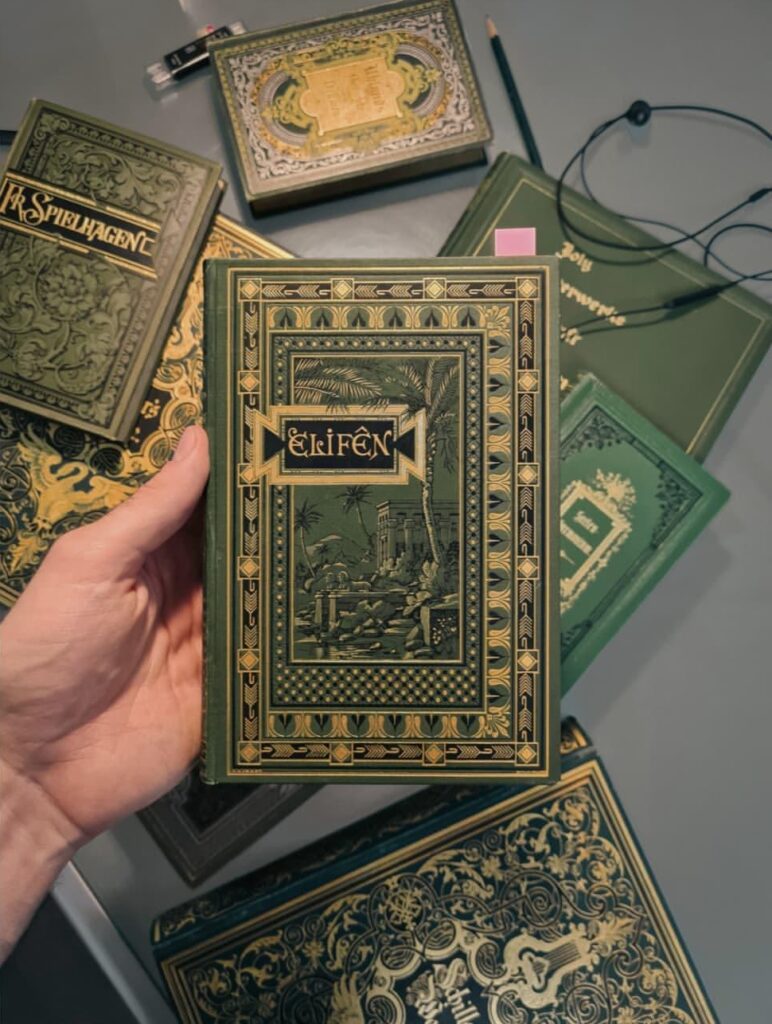
The title “Elifên” comes from a slim volume by the German Egyptologist and writer Georg Ebers (1837–1898). Known for historical novels such as “An Egyptian Princess” and “Cleopatra”, as well as for his edition of the medical Ebers Papyrus5, Ebers published the poetic tale “Elifên. Ein Wüstentraum” (“Elifên: A Desert Dream”) with Deutsche Verlags-Anstalt in 1887. It belongs to a form of literature that oscillated between methodical, scholarly Egyptology and a desert fantasy intensified by sunstroke into a diagnosable “overheating of the head”: camels and caravans, starry nights and sandstorms.
The painting takes up not the book’s specific plot, but its underlying atmosphere: the dreamlike quality of a desert imagined from Europe.
Between Object and Body
In this layering of Beni Hassan wallpapers, quotations from Klimt, Nefertiti and Ebers’s “Desert Dream”, the painting ultimately addresses a simple question: what do these exalted worlds of imagery do to a body in the present? The figure in the foreground is neither victim nor heroine, neither archaeological reconstruction nor decorative ornament. She stands—or bows—exactly where we ourselves stand: between fascination with the beauty of objects and the awareness that this beauty has always already been filtered, reproduced and musealised.
“Elifên” is thus less a homage to Egypt than a reflection on what remains of great civilisations: wallpapers, stairwell paintings, bestselling novels, statuettes and fridge magnets “Made in China”—the final destination of every great civilisation before, in true Spenglerian fashion, its exhausted stock of symbols ends up in the dustbin of history.
- “Nubia” denotes a historical region roughly corresponding to parts of present-day Sudan, somewhere between the first and sixth cataracts of the Nile—stretches of rapids that are difficult to navigate. ↩︎
- The “Asiatics of Shu” were probably a group of West Asian traders depicted on the north wall of the tomb at Beni Hassan. In something resembling a delivery list, the accompanying inscription records 37 “Asiatics of Shu” bringing eye paint (mesdemet) to Egypt under the leadership of a local prince’s son. For some, this is an early and visually compelling indication of diplomatic and economic contacts between the Twelfth Dynasty and the southern Levant; for others, proof that eyeliner has always been en mode. The specific designation “of Shu” is discussed, among others, by Christian Wastlhuber, who quotes and comments on the passage in his dissertation on relations between Egypt and the Levant (a list of the “Asiatics of Shu”, totalling 37).
See Christian Wastlhuber, Die Beziehungen zwischen Ägypten und der Levante während der 12. Dynastie. – Ökonomie und Prestige in Außenpolitik und Handel – [Relations between Egypt and the Levant during the Twelfth Dynasty: Economics and Prestige in Foreign Policy and Trade], doctoral dissertation, Ludwig Maximilian University of Munich, Munich, 2010, p. 86. Wastlhuber explicitly translates the wording as “Asiatics of Shu, total number 37”. ↩︎ - A “spandrel” is the triangular space between two round arches, or the space between a round arch and its rectangular frame. The term was borrowed by evolutionary theory to describe evolutionary developments in which by-products of an adaptation essential to survival subsequently prove functional and useful. Function follows form, if you like. ↩︎
- In German, we simply call it a “Treppe”—the everyday word for “stairs”, rather than the Austrian Stiege… ↩︎
- Discovered in Luxor by Georg Ebers and named after him, this medical papyrus—a compilation from the sixteenth century BC, some 18–20 metres long, with 108 columns and hundreds of prescriptions—is regarded as the most extensive source on ancient Egyptian medicine. It combines remarkably sober observations on the heart, blood vessels, parasites, eye and skin diseases with incantations against demons, advice on contraception and remedies for hair loss. One might call it an early all-in-one package of specialist medical practice, “Dr Sommer” sex advice with a touch of veterinary medicine, a pharmacy magazine and an esoteric newsletter—only on papyrus, and now in Leipzig University Library rather than a waiting room. ↩︎