
← back to overview of “Ornament and Memory”

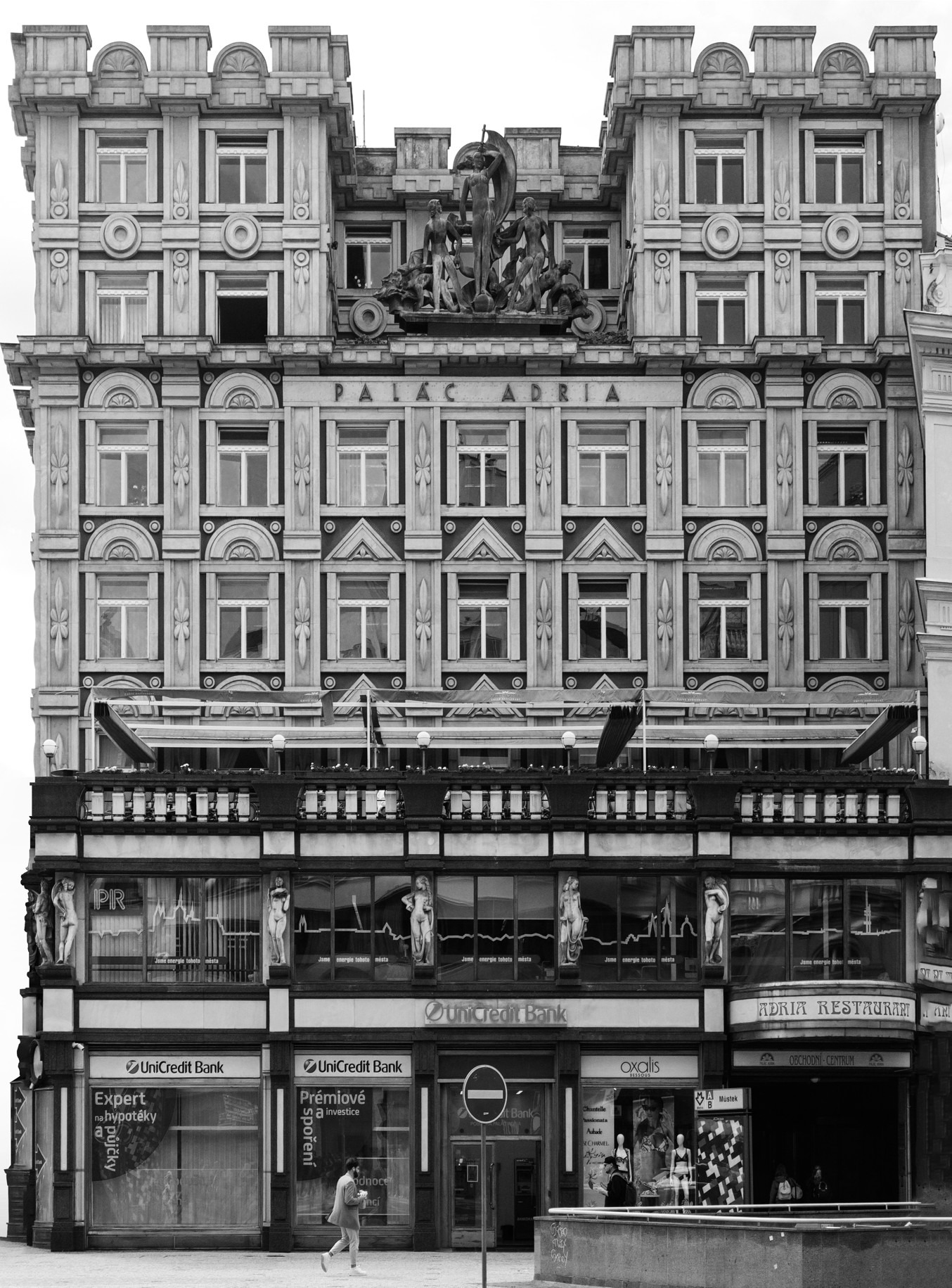
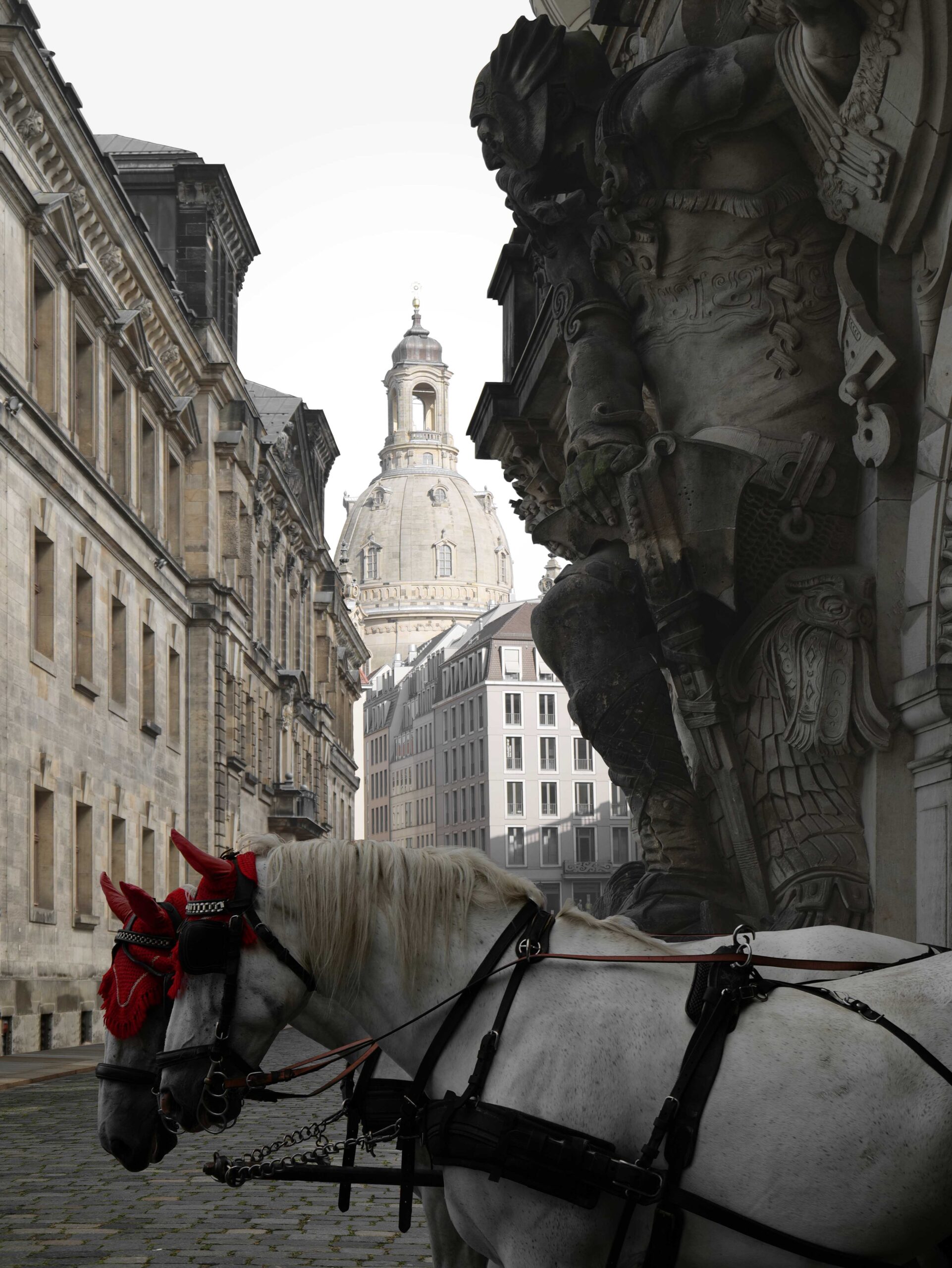
Ornament and Memory – Part I.
About the city as an archive, the ornament as a memory, the deconstruction as a collective amnesia
He saw Vienna for the first time, when others saw it for the last time: from the hatch of a tank, between smoke, soot and bursting walls. My great-grandfather, Mikhail Sitnikov (Михаил Ситников; 1923–1993)1“He was involved in the capture of Vienna by the Red Army. Although, like so many of his generation, he rarely and reluctantly talked about the war, he later mentioned to my mother how beautiful the city had been. It is worth noting above all the ability to take a powerful look that makes this statement possible: still to recognize the beauty – between rising flags of smoke and dust, despite fires and collapses, under continuous fire and in constant danger of life. Steppe front and the Southwest Front, which – since 1943 designated as the 2nd and 3rd Ukrainian Front of the Red Army2 – after bitter street fights, Vienna took over; on 13 April the guns muted – the transition of the Danube metropolis from Nazi rule under Soviet and thus allied control in the course of the Vienna operation ==References==
If not forcibly the Second World War and the war-related mobilization, under which numerous fates and biographies also in the Soviet Union came, my great-grandfather would probably never have been able to fight against “Japanese militarism” in Königsberg, Prague, Budapest, Vienna, Berlin and then in the Far East. Wars are now eminent driving forces of acceleration – cultural upheavals, social upheavals and ethnic-linguistic border shifts that rarely stop in front of individual fates.
But war is more than a human drama. War tests the city with steel and fire – an inexorable editor who shortens and takes away. He destroys historical silhouettes, wipes out stone witnesses, erases material memory bearers, leaves marginalities in the cityscape and sometimes tears out whole sides. From these remnants of beauty my great-grandfather read an image whose monumentality and splendor were less embellished than testified. This rest of beauty directs the view away from the battlescape to the shadowscape – and from this finding to a city that reveals itself as an archive of epochs. Each facade is a reference work of time, each sim of the marginalization of an epoch, each stucco element a comment glint, each ris a donkey’s ear in the book of the city’s memory, each graffiti a palimpsest that overwrites the context of creation.
In this archive, ornaments are not a luxury of the superfluous, but a storage medium – an analogue, weatherproof memory of society. Masswork, cartouches, guild marks and household stamps encode professions, privileges, worlds of faith; traces of usage, cracks, joints, fades and coloured overpaintings bear timestamps. The Power to the Sea (Rudolf Weyr, 1895) and The Power on Land (Edmund Hellmer, 1897) not only are “adornments, but iconographic official signatures of past claims to power made of stone; along the Ringstraße portals, friezes, emblems and figures arrange programs and functions, they mark addresses, hierarchies, affiliations. Vienna is a UNESCO World Heritage Site not only because of its monuments, but because of the legibility of their harmoniously building and complementary architectural historical layers. This readability is a public resource.3
If these ornaments can be considered as public memory carriers, the question arises all the more urgently as to how it could come about that in the 20th century they became suspects.
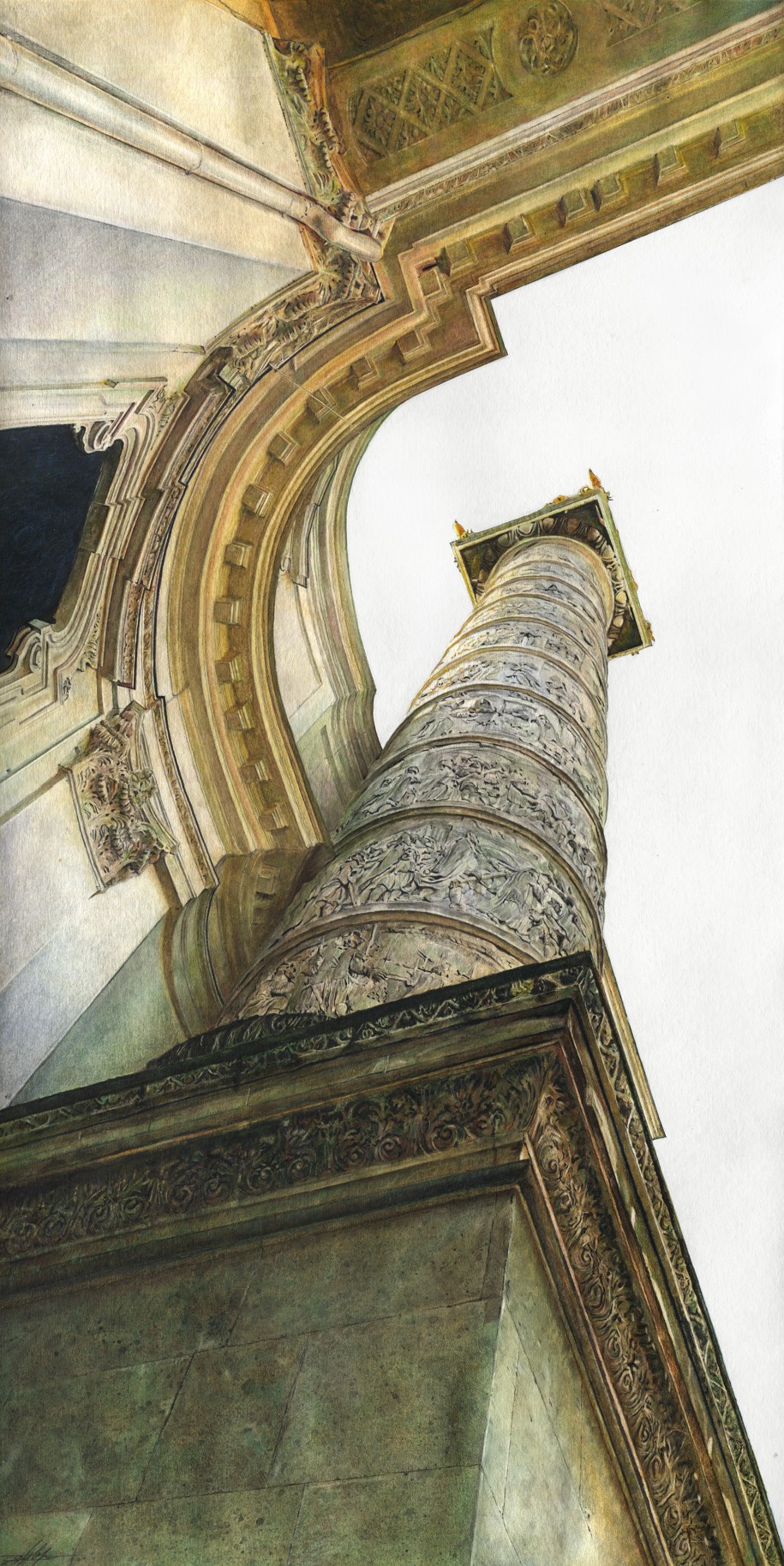
Mixed technique: watercolour, graphite and coloured pencil on cardboard, 60 × 40 cm (sheet), signed and l.; representation of the Karlskirche (Karlsplatz), Vienna.
Inv. no. DY-2018-AQ-005
© 2018 Daniel Yakubovich
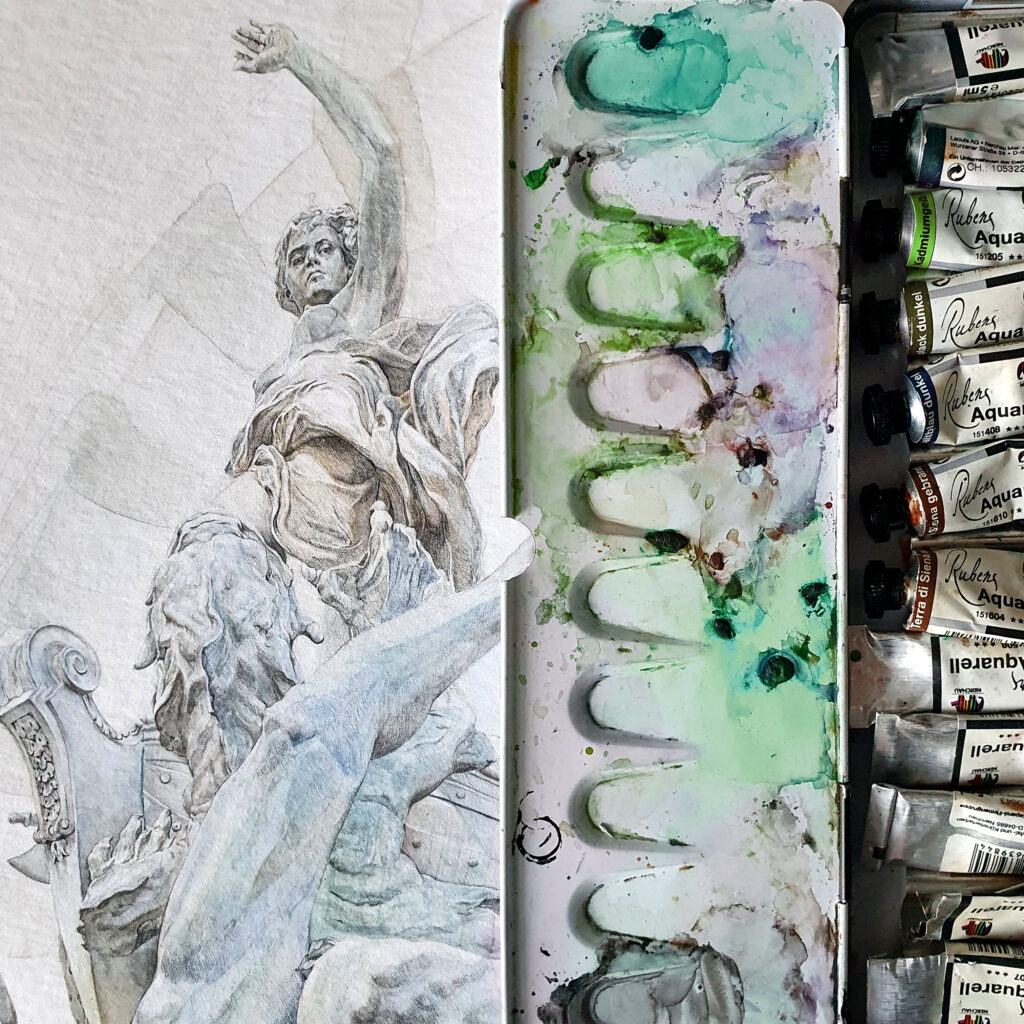
Watercolour on cardboard, 30 × 40 cm (sheet), signed and so on.
Inv. no. DY-2018-AQ-001
© 2018 Daniel Yakubovich
So how is this condemnation of the ornament to be explained?
Adolf Loos, one of the most controversial voices of the turn of the century in Vienna – architect, practitioner of a new philosophy of construction, stylish essayist and culturally critical polemicist – formulated his famous lecture Ornament and crimewho later as an essay4 In this short, contentually dense writing, which is less theoretical point than cultural moral broad side, Loos, ornaments of wasted labor power, material and capital asserted; they led to an early “ageing of objects and burdened economy as well as public health” in the recursion to closed eras. At the same time, he moralizes by declaring the tattooed to be a “latent criminal.” Consequently, the architect and pioneer of modern architecture concludes that “cultural progress” must mean the elimination of the ornament from the objects of use. Of course, it would be contrary to the fact that it is a highly controversial thesis to what extent progress is synonymous with a reduction and purification of the language of forms. A comparative juxtaposition of cultures shows – in the sense of Oswald Spengler – that their maturity rate does not consist of an ornamental simplification and impoverishment, but rather of a comparative juxtaposition of cultures. more correlated with an increasingly differentiated and complex formal language, which is reflected in the echo of increasingly complex social structures and legal structures also in architecture and objects of use.5 As plausible as this “cultural curve” may seem, this biologistic-organismically inspired figure of thought remains problematic, which relativizes historical coincidences and caesuras (contingency) in favour of a seemingly natural legal rise and descent.6
Thus, a process that began with the industrialization, mechanisation of construction production and emancipation of crafts, led to the battle announcement which was later to be reflected in the area-like destemming of facades. Loos– polemics and cultural criticism were directed against the historical eclecticism of the Gründerzeit as well as against the Art Nouveau style and the Secession, which – despite partial continuation of the historicist repertoire of forms – was already understood as a reform and counter-movement. This critique became a reference framework within which the purism of classical modernism could unfold. About the Bauhaus founded in Weimar in 1919 and the New Objectivity emerging since the mid-1920s, a canon of flat facades emerged as a form and towards rationalization as well as standardization of coordinated planning. The ornament became the epiphany of an epoch whose image stocks seem exhausted, and fell into the defensive corner of abundance and excess. This devaluation took place over post-war modern, serial mass housing construction in prefabricated parts7 and rehabilitated inner cities until deep into the late 20th century, where it passes into those seemingly self-evident design maxims that still make every visible splendor subject to legal production.
What is the balance to be drawn a hundred years later?
Has the renunciation of ornament actually made the economy richer, or is there an aesthetic and urban impoverishment in all material growths, while the planning and construction practice became more complex and technically complex, therefore more expensive but not necessarily more quality? Has this renunciation promoted health or has it just been a testament to neighborhoods with an intact early age structure that atmosphere, materiality and craft legibility contribute to well-being? Was ornamentation a mere waste of time — or was it a school for hand, eye and head whose loss is noticeable in everyday life of a digital dispersal economy? And if time saving was considered a reason – what was the time gained actually spent on?
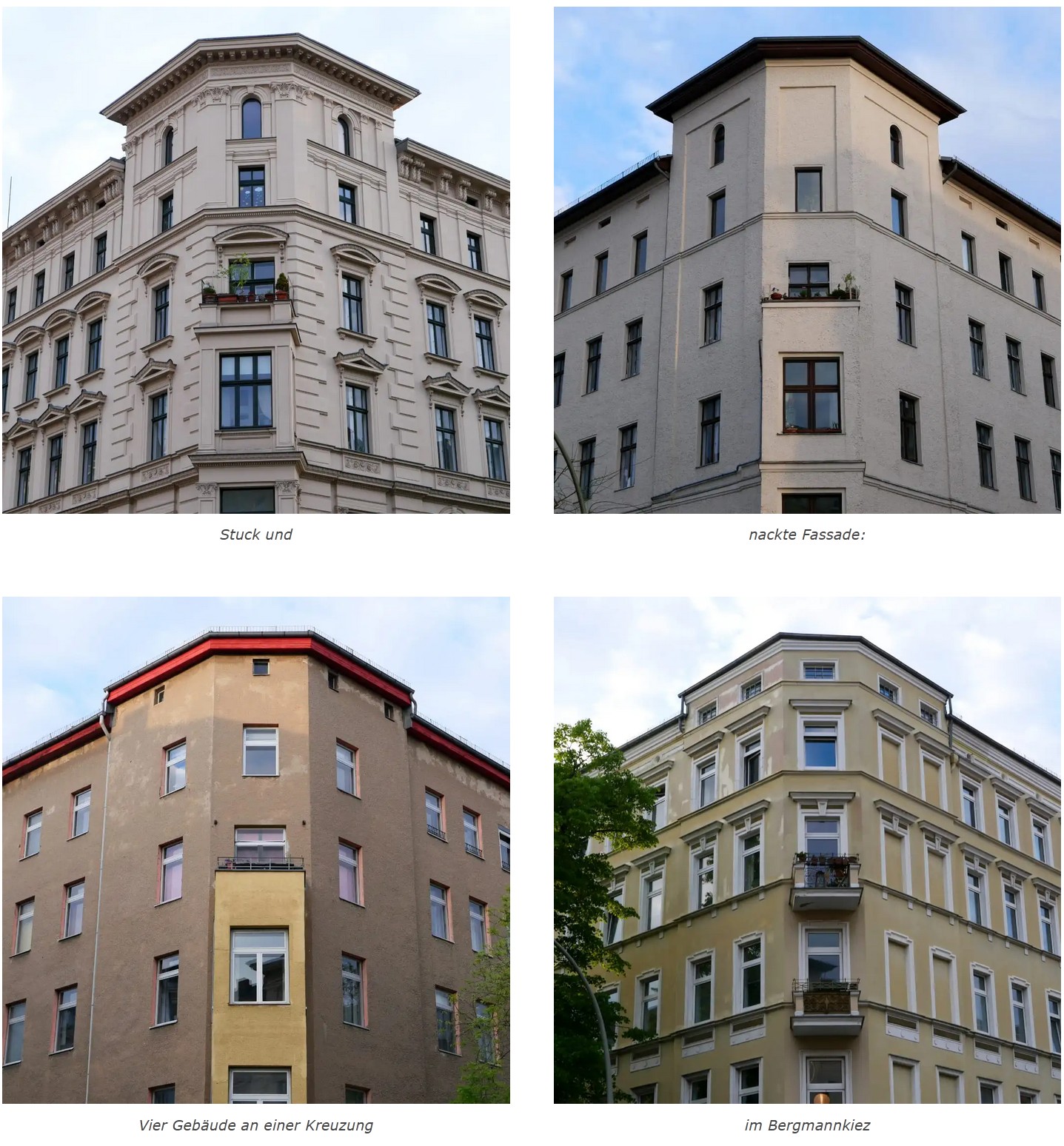
A harder argument can be formulated against Loos: Ornament does not waste anything, it preserves. It preserves from “the extinction of what is actually a city that lasted from Babylon to the imperial Berlin and made possible a special feeling of living, namely: the emotional city experience. “8 Its material value is lower than its information value. It collates facades like textual witnesses. The look to Berlin shows: Since Wolf Jobst Siedler9, Elisabeth Niggemeyer and Gina Angress in The Murdered City (1964) the post-war urban construction and the Destiny as an act of collective amnesia In history, however, the active destemming began in Berlin in the 1920s, among other things by protagonists of New Building. However, the big bald blow was to be used in East and West especially in the 1950s to the 1970s – with partly ideological, partly security-related, partly fashion aesthetic motives. In isolated cases, Berlin’s construction offices even paid for destemming; a formal, comprehensive “destemming program” did not exist, however.10 At the same time, 1964 – in the same year as Siedler’s book11 – under Senatsbaudirektor Werner Düttmann, a turning point: the urban development policy guideline shifted in favour of the preservation of historical facades; first “protected building areas” were designated and subsidies for repair were granted; in East Berlin the attitude fluctuated similarly between smoothing “bourgeois masquerade” and later, partly exemplary restoration of an intact city fabric by imitating a historical continuity by means of small-scale parceled construction with predominantly gabled houses (Nikolaiviertel) or the old building renovations in Sophien and Husemannstraße12 In retrospect, Berlin remains a negative example mainly because of the extent of its redemption: entire street trains that lost their Anlitz and were “deadly modernized” according to the zeitgeist.13; with them those relief layers disappeared from window roofs, closing stones, girdles, lizards, boss quadrants, balustrades, rosettes, toothed and ovarian profiles, repair seams and traces of soot and war in which a typical Berlin identity and the memory of the rapid industrial upswing of the imperial era ==References==
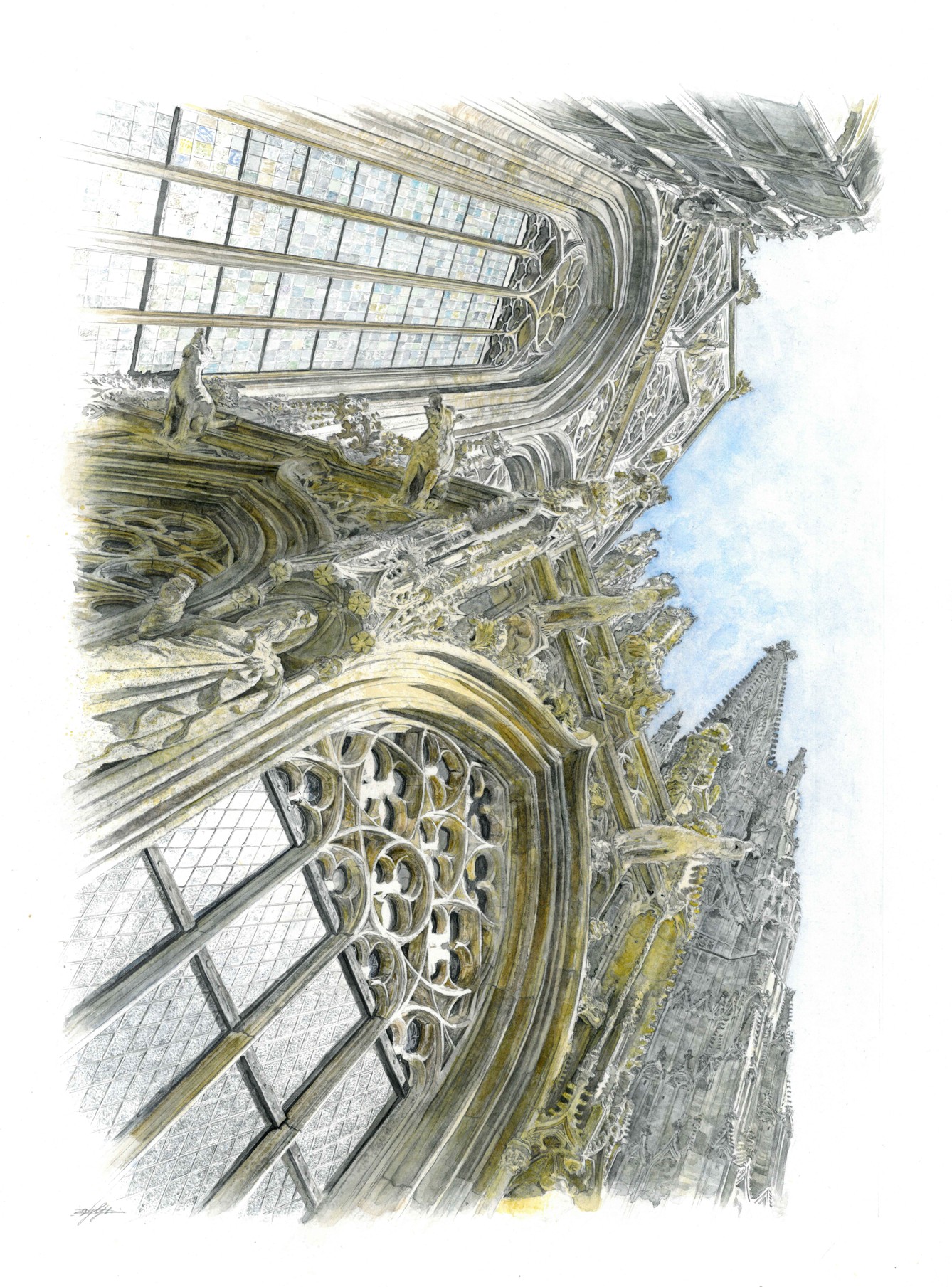
Watercolour on cardboard, 30 × 40 cm (sheet), signed and l.
Inv. no. DY-2018-AQ-002
© 2018 Daniel Yakubovich
What seems to be an aesthetic vein-lease in Berlin’s street space is more than a question of taste: where facades were smoothed and ornaments removed, not only decor was removed, but syntax was erased from the city memory; the houses lost that second language, in which they once told of loads, forces, rank orders and hopes. Destiny thus proves to be a double operation – a physical redemption of relief and semantic emptying – and leads to an urban present in which the dispute about ornament and “jewelry” is often negotiated as a mere question of style. Although in truth the question is at stake, whether architecture still has something to shareIn order to understand exactly what is being destroyed, when cornices, profiles and cartouches are defamed and cut off as abundance, it is necessary to take a step back: the origin of the ornament, in order to assess whether the supposed “crime of modernity” is perhaps precisely that which misunderstood this grammar.


- Mikhail Andrianovich Sitnikov ==References== Михаил Андрианович Ситников, [mʲɪˈxajl ɐndrʲɪɐˈnovʲɪt͡ɕ ˈsʲitnʲɪkəf], *20.11.1923, †23.11.1993) was a non-commissioned officer. mladšij seržant (младший сержант) of the Red Army, radio specialist of a small radio station and senior radio telegraphist (старший радиотелеграфист) From 1942 to 1947 he was in active military service; in April 1945 he was injured by injuries to the chest and to the right thigh. His back was covered with small fragments of injuries throughout his life. Order of the Red Star (орден «Красная Звезда) and awarded with several medals and medals, including the medals “For battle earnings” (медаль «За боевые заслуги»), “For bravery (медаль «За отвагу»), “For the capture of Budapest (медаль «За взятие Будапешта»), “For the capture of Königsberg (медаль «За взятие Кёнигсберга»), “For the liberation of Prague (медаль «За освобождение Праги»), “For the victory over Germany (медаль «За победу над Германией’) and “For the victory over Japan (медаль «За победу над Японией»). ↩︎
- The Soviet “fronts” were armies whose designations were usually based on geographical spaces and operational directions, which had been in the area south of Kursk since summer 1943 and along the “steppe belt” near Voronezh. Воронеж [vɐˈronʲɪʂ]), and Steppe front and the Southwest Section of the Eastern Front Southwest Front In the course of the Dnieper offensive and the progressive liberation of Ukraine, the High Command of the Red Army ordered a renaming of the southern fronts on 20 October 1943: from the steppe front, the 2. Ukrainian FrontFrom the south-west front the 3. Ukrainian FrontIn order to mark the now central operational area of Ukraine and the beginning of a new phase of war in the south of the East Army also conceptually. ↩︎
- UNESCO World Heritage Centre, “Historical Centre of Vienna” (World Heritage List, Property 1033), UNESCO World Heritage Centre, https://whc.unesco.org/ (Accessed on: 5 October 2025). ↩︎
- 1908; published in a version from 1910 to 1913 ↩︎
- Historically, it can be observed for many high cultures that with the increasing complexity of government and bureaucracy, beliefs and social labels, division of labour and production, the formal language is also more differentiated:
– Egypt: from simple grave forms to highly complex temples and tombs with richly developed pictorial language.
– Greece: Development of archaic forms towards elaborate orders (dorish – ionic – Corinthian), differentiated proportion theory, figurative sculpture decoration.
– Gothic vs. Early Romanesqueism, Baroque vs. Renaissance: increase in movement, richness of detail, spatial and iconographic density.
– Also in the arts and crafts: ceramics, textiles, metal works are often decorated more complexly with increasing specialisation.
Oswald Spengler In his bibliography of the “Departure of the West,” which was declared the main work, he argues with such analogies: cultures unfold in the “Ascension” their peculiar symbolism and ornamentation more and more richly and differentiated; only after the crossing of a centiform begins a phase of “civilizing solidification” that leads to rationalization, abstraction and fatigue of forms.
But there were also counter-movements and conscious simplifications – the classicistic calming against late lightenism as well as as ascetic strands of modernity. Therefore, it would be uncomplicated to say that all cultures in progress aspired to ornamentation and complexity. Such counter-movements and conscious simplifications – the classicistic calming against late lightenism as well as as ascetic strands of modernity – appear on a larger historical scale rather than short-term price fluctuations on a long-term curve, which describes the life cycle of cultures in the sense of Spengler: with eruptions and intrusions, but a clearly recognizable tendency towards increasingly complex systems of form and sign before the “civilisatory winter” begins. ↩︎ - Likewise, it could be argued that man as part of nature carries out his spiritual and cultural development like nature itself, namely as a movement along the slightest resistance towards situative adaptations. Forms and structures that contain immense complexity in their apparent simplicity; However, an elaboration of this thought would completely exceed the scope of this scripture. ↩︎
- In this context, Nikita Khrushchev’s reckoning with the “overflows in Soviet construction: in party resolution” is paradigmatic. “On the elimination of exaggerations in design and construction (R.E.)Об устранении излишеств в проектировании и строительстве“ – [ɐb ʊstrɐˈnʲenʲɪɪ ɪzʲˈlʲiʂɨstv v prʲɪktʲɪrɐˈvanʲɪɪ ɪ strɐʲɪˈtʲelʲstvʲɪ], 1955) were decorative “излишества==References== [ɪzʲˈlʲiʂɨstvə] – literally “overflows”, “exaggerations”), explicitly condemned by the Stalinist era, and in the course of the Destalinisation as well as official criticism of personality cult, a sober, standardized, industrialized construction method was raised to the doctrinal norm – a politically decreed shouldering of cost pressure, ideology and anti-ornamental rhetoric, which raised the devaluation of the decorative surplus to a new, large-scale effective level. ↩︎
- Elisabeth Niggemeyer / Wolf Jobst Siedler / Gina Angress, The murdered city. Singing on putte and street, square and tree, Berlin: Herbig 1964, p. 7: “…the obliteration of the actually urban, which lasted from Babylon to imperial Berlin and made possible a special feeling of living, namely: the emotional city experience.” – cit. according to Rainer Haubrich, “Architecture: When Germany drove its cities to death,” in: The world, 13.03.2014, online at: https://www.welt.de/kultur/kunst-und-architektur/ (Accessible on: 4 December 2025). ↩︎
- Certainly, as a result of his publication of Albert Speer’s diaries, the historical distortion of Siedler’s history makes it clear that he is criticizing a fundamental historical revisionist note to the former Reichsminister and GBI of the imperial capital. We leave it at this point in particular to cite Siedler’s nostalgic publications here on a sinking West, to which he has been repeatedly speaking in many publications throughout his life. This tone permeated his writings like a red thread until his death in 2013. ↩︎
- Voigt, Andreas W., “Memories of the great baldness of the Berlin Stuck, TenantMagazin Online, Issue 6/2023, Berliner Tenantenverein, https://www.berliner-mieterverein.de/ (Accessed on: 5 October 2025).
Brief overview: Overview article on Berlin’s urbanization with contemporary voices (among others Theodor Goecke 1896; Albert Gut) and the reference that in the 1950s in West Berlin up to 5,000 DM were paid for urbanisations in individual cases; there was no comprehensive programme.
“From the factory villa to the rental barracks, all the houses wanted to be like a palace. Almost every Berlin house that was built in the Imperial period had a plaster facade with stucco ornaments. This facade dizzy was either ridiculed or severely criticized. The furor, with which the stucco was cut off from the houses in the East and West from the 1950s onwards, however, seems extremely strange today. The cityscape has suffered serious damage due to the rigour of the excavation. […] Stuck increased the loan value of the house.
“‘Not only the ordinary, but also the so-called stately Miethshaus still stands in the fir of a monumental architecture glued to cast plaster stucco’, writes architect Theodor Goecke in the standard work Berlin and its buildings From 1896. This also had economic reasons: “The extensive design of the show pages, the stairwells and rooms often spring only from the drive to achieve as high an assessment as possible of the fire cask and thus the postponement of the loan limit”, says Goecke. Extensive facade design increased construction costs by about two percent, but increased the loan value of the house by up to 20 percent.“
“‘The rental barracks already characterized by their face that it had sunk down to the specular object, in the residential areas of small people through loveless barracks architecture, in which the rich by provocative accumulation of stuccos’, also criticized Albert Gut. ‘In any case, the vast majority of Berlin’s residential facades stood on such a low level that they could no longer claim artistic valuation.’ […] The decimation wave of the 1950s was the most successful for the Berlin cityscape. Individual house owners were apparently paid up to 5000 marks by the West Berlin building offices so that they could free their building from stucco and clean it up again. However, there was no real “disposal program”. In any case, the Senate had planned to eliminate most old buildings sooner or later. Funding for facade cosmetics would have been thrown out of it. ↩︎ - Settler, Wolf Jobst; Niggemeyer, Elisabeth; Angress, Gina, The murdered city. Singing on putte and street, square and tree (Berlin/Munich/Vienna: F. A. Herbig, 3rd edition, 1967), in particular pp. 13 et seq., 44 et seq. ↩︎
- In East Berlin, Sophienstraße in Mitte and Husemannstraße in Prenzlauer Berg were regarded as model lines of a “socialist old town renovation”: both streets were restored with great effort in the mid-1980s in the run-up to the 750th anniversary celebrations in 1987 or largely reconstructed faithfully in original form and staged as historic artisans’ and founder-age streets, which served as a representative backdrop for the GDR leadership for domestic and foreign guests. ↩︎
- Voigt, Andreas W., “Fassadenrekonstruktion: Owners give back old buildings the jewelry, The world, 27 April 2013, online at https://www.welt.de/ (Accessed on: 09 February 2026). ↩︎