
Publication note: A shortened and modified version appeared in FIUME, issue 2, 2026.
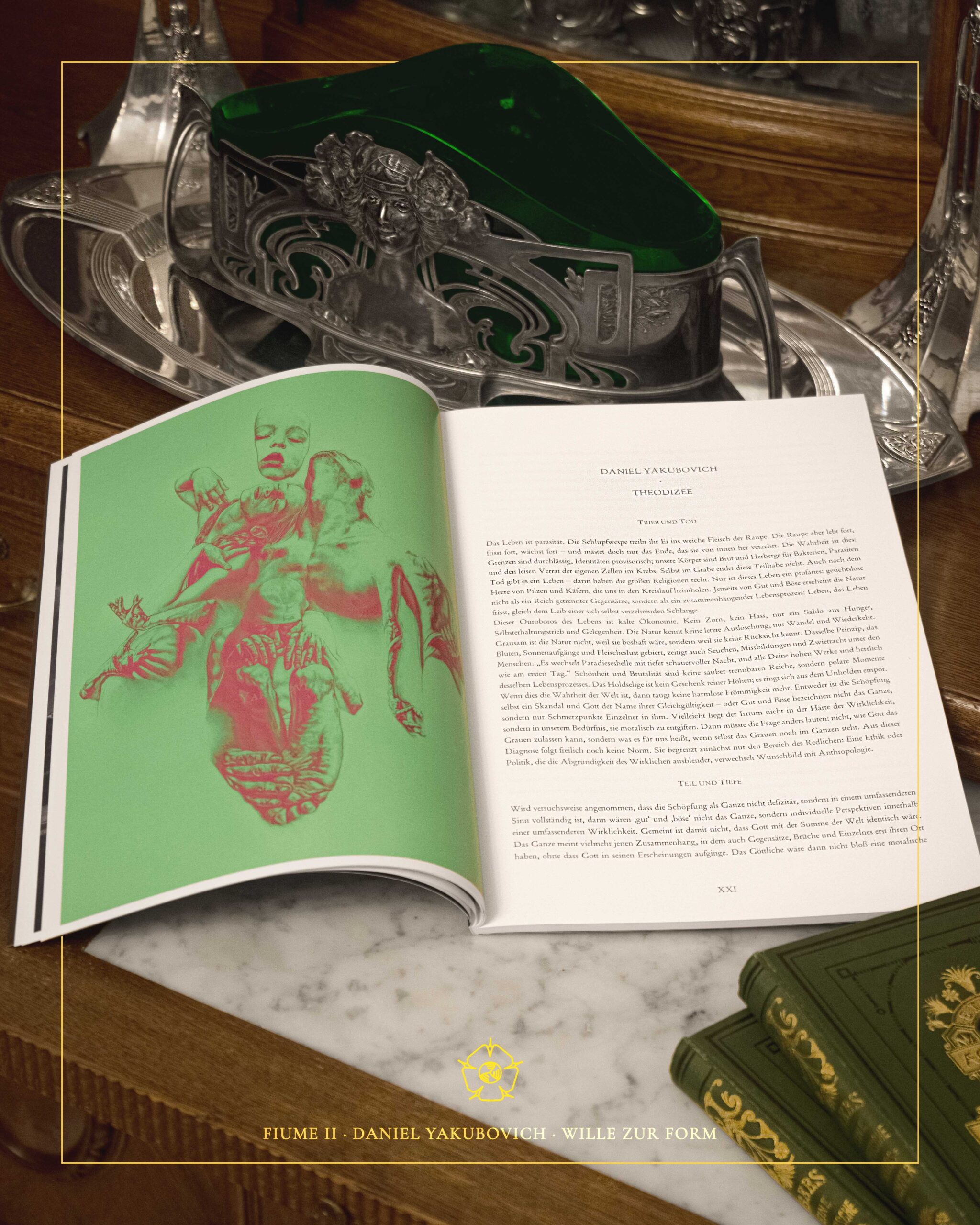
I. Drive and death
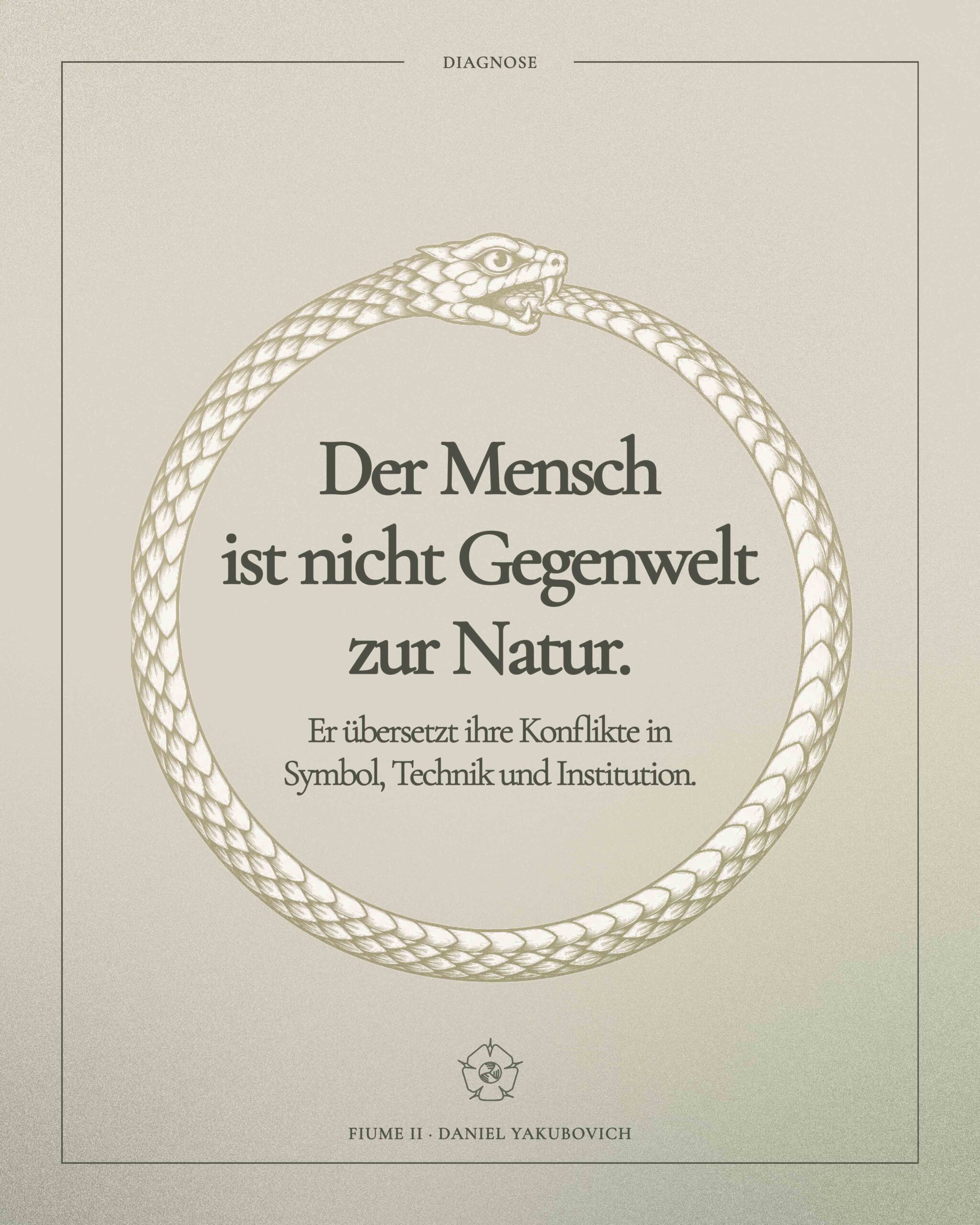
Life is parasitic. The sluppy wep drives her egg into the soft flesh of the caterpillar. But the caterpillar lives on, eats away, grows on – and makes only the end that it consumes from within. The truth is this: boundaries are permeable, identities provisional; our bodies are brood and shelter for bacteria, parasites, and the quiet betrayal of their own cells in cancer. Even in the grave, this participation does not end. Even after death there is a life – the great religions are right in that. Only this life is a profane: faceless armies of fungi and beetles that bring us home in the cycle. Beyond good and evil Nature does not appear as a realm of separate opposites, but rather as a coherent process of life: life that eats life, like the body of a serpent consuming itself.
This Ouroboros of life is cold economy. No anger, no hatred, just a balance of hunger, self-preservation and opportunity. Nature knows no last extinction, only change and return. Nature is cruel not because it would be malicious, but because it knows no consideration. The same principle that gives birth to blossoms, sunrises and carnal pleasures also causes pestilences, malformations and discord among people. “It changes Paradise light with a deep, gruesome night, and all your high works are glorious as on the first day.” Beauty and brutality are not cleanly separable realms, but polar moments of the same process of life. The Hold Blessed is not a gift of pure heights; it wrestles from the unholy.
Thus food and eros are not innocent processes. Both live on appropriation, border crossing and transformation; in pleasure as well as in pleasure, surrender and access, receptivity and power mix together. Ascetic acid the will to deny that indissoluble entanglement of pleasure and suffering and to impute to life a purity which it has never possessed.
Life appears as a garden, where hunger, fear and struggle in Eternal Return Man is regarded as a social being and bearer of untouchable dignity; but every generation brings the proof of Plautus’ old Sentence anew: “lupus est homo homini.
Under the shining surface of solidarity formulas and social rituals, not only a silent social Darwinism, but also that resentmentThe powerlessness turns into moral superiority and condemns the strong because it is not up to them. We displace, compete, make alliances for revocation; we speak of community, yet we are always inclined to disregard weakness and worship strength. In this perspective, the human world is not the counter-design to nature, but its logical worm development by other means: instead of teeth and claws, we have developed files and applications, networks and narratives, money and validity.
Man does not simply continue nature; he translates its conflicts into symbol, technique and institution. It is precisely in this that he becomes more dangerous than any predator. He remembered laws of destruction, erected neck-shots and built furnaces for His likes. In human crime, the cold economy of self-preservation, disposition and enmity returns under the conditions of language, planning and justification. When man comes to power, what makes power out of him shows itself: it deports, dehumanizes, exposes; it makes killing like administration and administration look like necessity. The cruelst thing about it is the normality with which people learn to participate, to look away or to duck away – as if destruction were merely one possibility among many. The appalling rarely takes place out of wickedness alone, but also out of the inertia of mass, the lack of action for virtue and adjustment for decency. Not only the violence, also the scale of their judgment, is shaped by man until the destructive appears to be sacred commandment, purification or world-historical necessity.
If this is the truth of the world, then harmless piety no longer works. Either creation itself is a scandal, and God is the name of its indifference – or good and evil does not refer to the whole, but only to pain points of individuals within it. Perhaps the error is not in the hardness of reality, but in our need to detoxify it morally. Then the question would have to be different: not how God can allow horror, but what it means for us, if even horror still stands in the whole? Of course, no norm follows from this diagnosis. It initially limits only the realm of honesty: an ethics or politics that hides the abysmalness of the real confuses the image of desire with anthropology.


II. Part and depth
If, at trial, it is assumed that creation as a whole is not deficient but complete in a broader sense, then ‘good’ and ‘evil’ would not be the whole, but individual perspectives within a wider reality. This does not mean that God is identical with the sum of the world. Rather, the whole means that connection in which also opposites, breaks and individuals have their place, without God arising in his appearances. The Divine would then be not merely a moral category above the world, but the bearing reality that remains present through those forms that condemn or fear most. “How everything weaves to the whole, one in the other works and livesIn this perspective, there are no isolated contrasts, but only tensions and their discharges within a broader order. Suffering would then arise not as divine punishment, but as a consequence of separation, fear and identification with the lesser; salvation would not mean that God should finally make the world more harmless, but that man should remember to be part of God’s body. In fleshly incarnation and cross it is revealed that God is not merely the originator of creation, but its compassionate one: He enters himself into the flesh, mortality and abandonment and brings home what is separated from within.
We are part of the Body of God. Our lives are temporary figures who feel their fleeting individual consciousness and therefore know fear and hunger, pride and hurt. Like a member receives his life-force not from itself but from the body to which it belongs, we also remain related to the same reality that carries us without the finite, fragile form disappears in it. Man carries the whole within himself, but he does not experience it as a whole as long as he considers his limit to be his being.
What “return” means is then not simply annihilation, but a return to a context that has never ceased to carry us. Being separate is a possibility of the self-experience of the whole; the whole remains the deeper truth of what appears in detail only fragmentary. “I and the Father are oneIn this word and fate, the truth condenses itself that even the most extreme abandonment does not cancel out the connection with the whole. And that is precisely what the comfort lies in, without beautifying the cruelty: that even the most hopeless, the most rejected, the most lost does not fall from the whole, but only temporarily forgets whose part he is partakers of.
The Christian response to the hardships of this world does not consist in trivialization, but in participation in suffering. In the cross lies the promise that death and injustice do not retain the last word. The raw strength remains not to deny the inevitable but to endure it. Suffering is then not only a cause for complaint, but also a test stone for whether man in the torn can still recognize a connection which extends beyond him.
The agonizing death of the caterpillar is neither “beautiful” nor “bad”; it is the way of being. In man, it becomes a moral question only because we possess, in addition to instinct, imagination, memory and language, the ability not only to experience suffering but also to anticipate, interpret and potentiate it. That is why man is the being in which the separated person becomes aware of himself – and in which he must decide whether consciousness turns into mere justification of terror or into a deeper bond with the whole. It is precisely from this that the norm of self-limitation arises: whoever recognizes in the other, not merely competition, but belonging to the same whole, can no longer understand power as a barrierless disposition.
III. Measure and Power
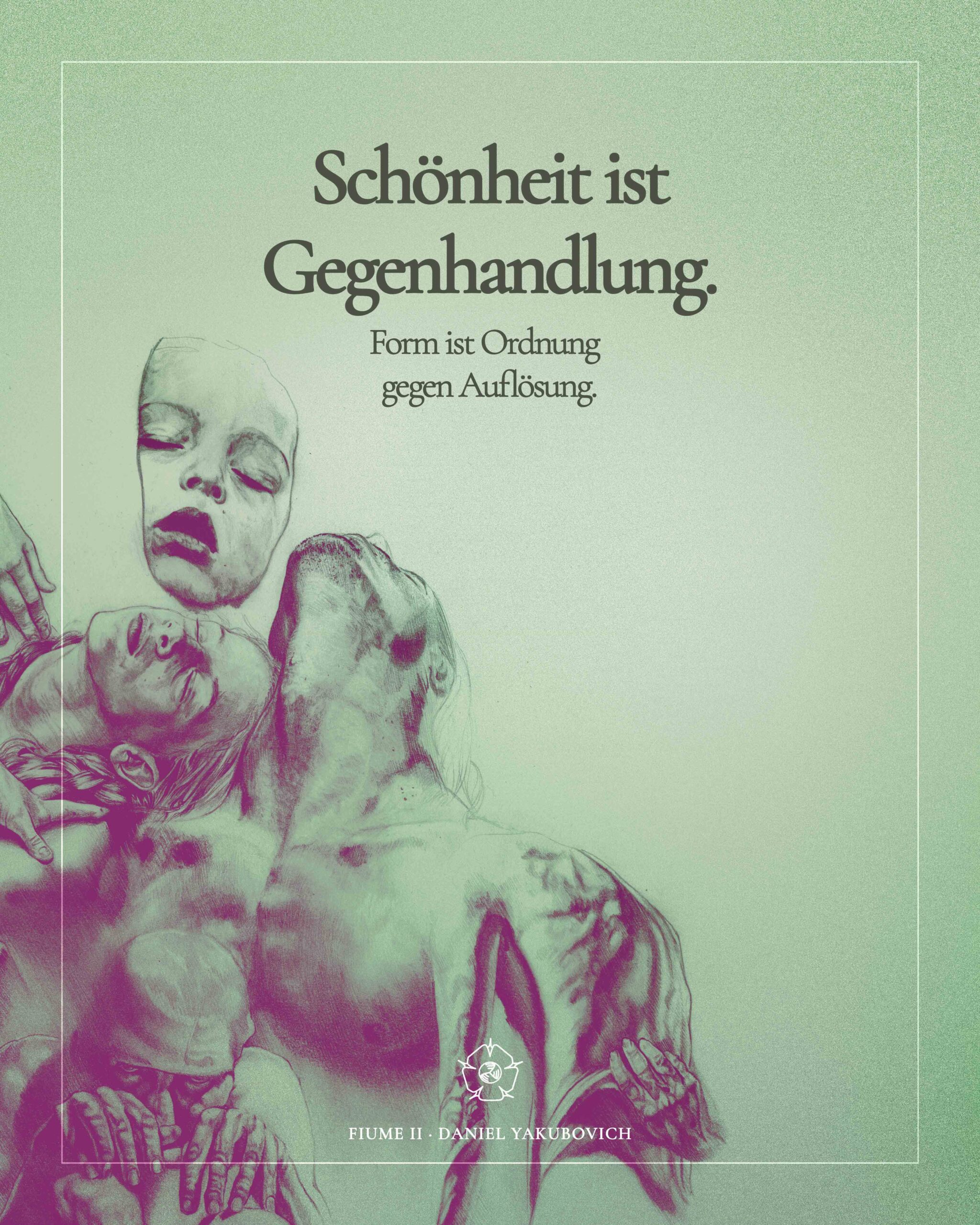
Where death and mourning, misery and the end are unavoidable, beauty becomes the hardest counter-action. Beauty is not an ornament, but rather the tangible expression of a successful form that inhibits decay, sets standards and makes vulnerability habitable. In turn, form is order against dissolution. Descriptively it means form and structures, normatively it means measure and containment, metaphysically the participation of the finite in an order that reaches deeper than its mere appearance. Therefore, great architectural art, sublime sculpture, academic painting and classical literature work in their strongest manifestations with measure, hierarchy and tension. The will to form stands against entropy, against drive and against the ideological lack of form of the present. It is the restrained and defiled counter-form to the will to power. Power not as domination, but as self-control. Not as overtake, but as access. Not as arbitrary, but as a skill.
Thus beauty appears as a sensually tangible form of the will to form. Form sets a framework of law and order, limits and protection against the unherited. Form is not only consolation but also Amor fati: the most radical affirmation of what is necessary without transfiguring its horrors. Form is an order that is wrested from the world, although the world itself is not coherent.
When the caterpillar is eaten up from within, there is no beauty in the event itself. What can be wrested from it is a look that can still read a form of metamorphosis in decay. When cancer eats up from within, there is no beauty in the event itself. What can be wrestled from it is the form of hospice, affection and farewell ritual that gives the agony measure and dignity. When blood melts to genocidal rivers, there is no beauty in the event itself. What remains to be faced with horror is not transfiguration, but the form of right, inhibition, attitude and threshold that restrains it. Where sense does not appear immediately given, it must be shaped in human execution.
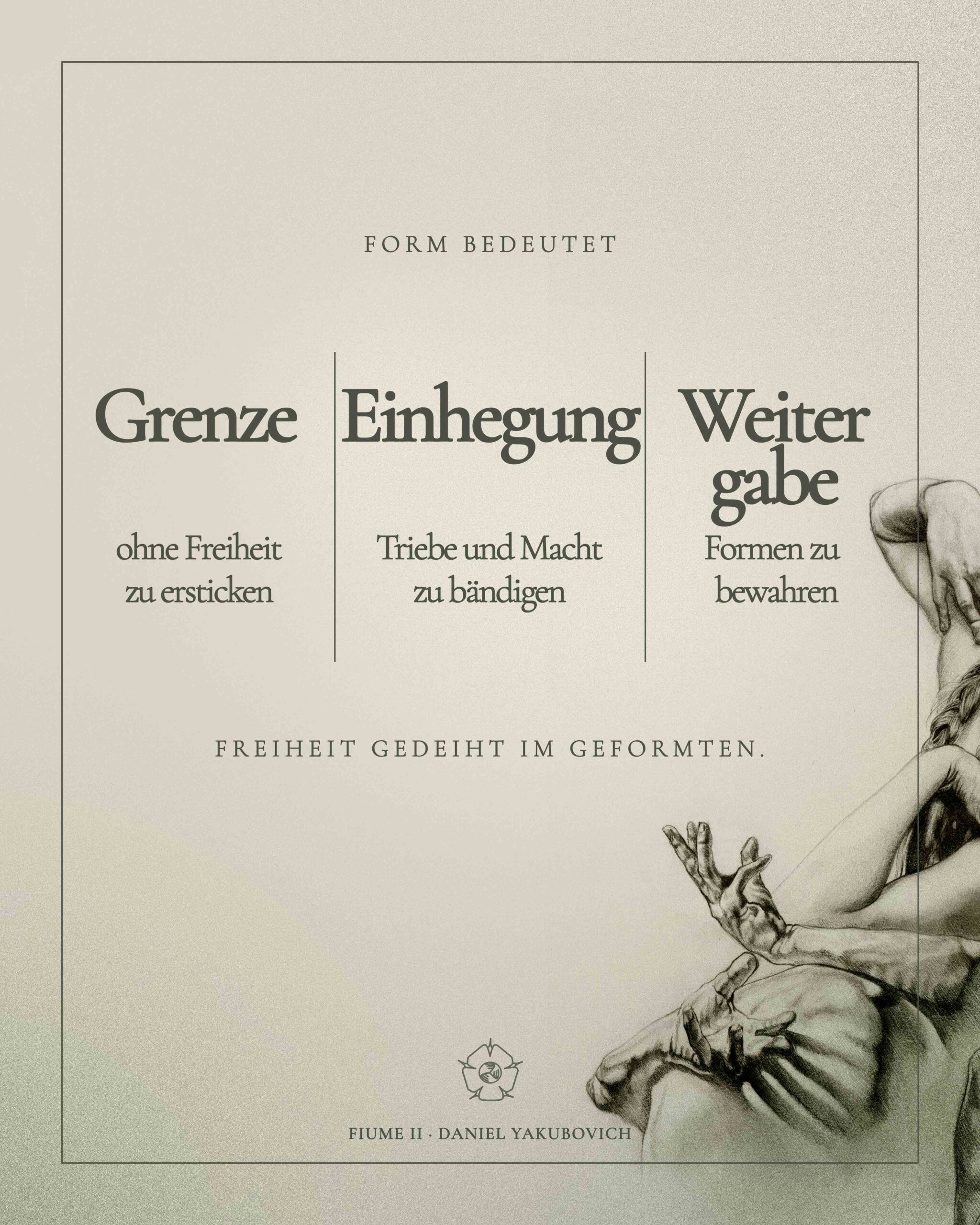
Form not only arranges images, books and buildings, but also laws, borders and communities. Human, too human If this inconstant mixture of drive and vulnerability is present, repetition and retention create a form of permanence. Any policy that considers man to be malleable but not dangerous enough will be surprised by his cruelty; any policy that takes its abysmalness seriously will insist on form, boundary and containment. Whoever takes the abyss seriously will never separate freedom from form. Genuine freedom thrives in the molded.
From this insight, it does not follow that every traditional form would be good for that reason. However, it follows that lasting forms of living together are irreplaceable because they direct drive, power and affect into repeatable paths. Not every tradition is true; but every resilient freedom needs forms of training, retention and transmission. Therefore, family, custom, tradition, homeland and institutions are not only paradigmatic carriers of such containment that have defended themselves. These basic concepts of conservatism are not repressive methods, but cultural techniques against the fall back into the formless. They are the insistence on the form towards deadly arbitrariness. Conservative thinking begins where form is understood not as mere coercion, but as a condition of humanity.
This political containment is necessary, but not final. It protects against the abyss. And when you look long into an abyss, the abyss also looks into youWhere form should be more than self-preservation, it necessarily opens up to metaphysics. Form begins aesthetically, proves itself ethically, strengthens itself politically and can be metaphysically deepened. In this perspective, God is not the moral controller behind the stars, who must justify himself before suffering, but rather the reason for the whole: not an existing one alongside other, but the bearing origin in which also the broken thing does not fall out of all order. He is present not only beyond the world, but in its depth; not as an excuse of terror, but as a possibility that the terrible form, border and lastly reconciliation can be wrestled away. Reconciliation does not mean the redemption of guilt or the escaping of pain, but the rebinding of the torn thing into a context that does not deny truth, wound and difference. Therefore, the will to form is a weak, finite, Over-human Participation in an order that reaches deeper than man himself.
Therefore, the question of theodicea does not dissolve in a justification of every single suffering. A finite and free world does not exclude the possibility of guilt, pain and tornness. The thought of salvation presupposes this possibility; it does not sanctify it, but responds to it. Thus, suffering is not approved, but recognized as something that cannot be thought away from reality and can still be answered in form, limit, and reconciliation. Here Christian passion thinking and a Dionysian affirmation of reality touch each other without being identical. Suffering is no proof of refutation against life; it belongs to the conditions of a finite existence which can only be free as vulnerable.
Beauty is the triumph of form. Politics is the chisel of form. God is the origin of all form. God is not a being apart from other things, but the reason for the whole, in which also the broken thing does not fall out of being without God being identical with every execution of terror. Nor are the stings of the wasp and the torment of the caterpillar outside this ground; but in the crucified one it becomes apparent that God’s last truth is reconciliation. The question of theology loses its old form as soon as we realize that we are not merely spectators of an erroneous process of creation, but co-operators who are given choice and freedom to defecate a meaningful form of chaos.
This is the most radical affirmation: God is not good because he prevents evil, but because he becomes flesh with us in the abyss of the world, does not perish in evil and gives us the strength to oppose entropy. In the completion of form man becomes the place where blind nature is not denied, but answered in freedom, measure and love.
That is why conservatism, well understood, is not nostalgia, but the political seriousness of the thought of form. On the right begins where man does not raise himself up to the master of creation, but becomes the guardian of form.