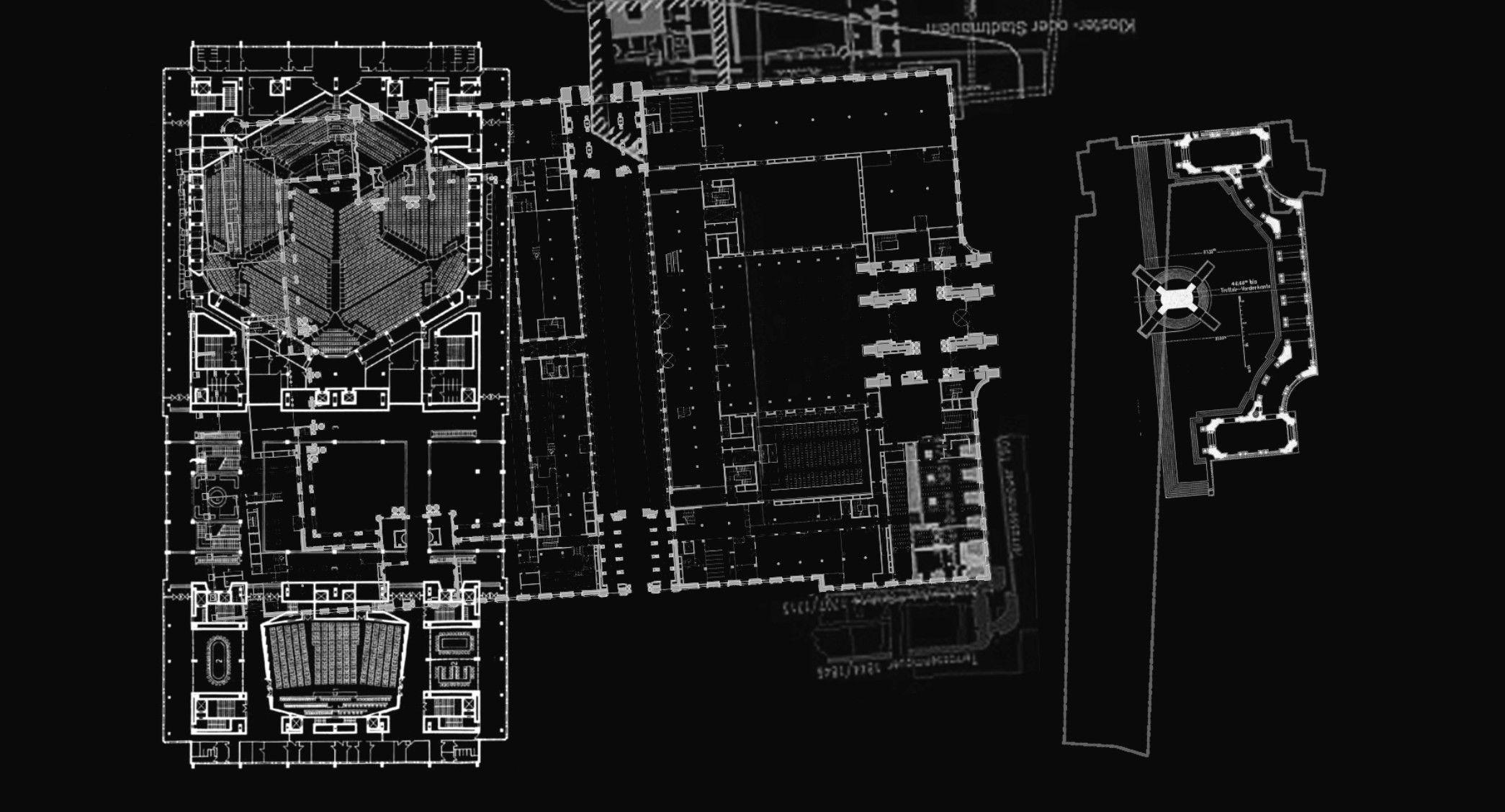
The Berlin Palace and its architectural surroundings are a Ship of Theseus in urban space: a ship whose planks and components are gradually replaced, one by one, until the question finally arises whether, with the same form, it is still the same ship or merely a copy bearing the imprint of memory. The ship of state behaves in much the same way, except that it constructs its national interests (Staatsraison) out of stone rather than wood: on Schlossplatz, continuity is neither preserved nor created — it is proclaimed.
The demolition of the GDR’s Palace of the Republic (Palast der Republik) and the return of the baroque shell are less a question of stylistic preferences than of whose cultural and political interpretation of history prevails, and what metaphysical understanding of its own essence the state chooses for itself. In this sense, a remark heard amid the clamour of everyday politics suddenly takes on the quality of evidence one would rather not file in the “Schlossplatz” case: when Russia’s foreign minister recently claimed, in effect, that the GDR had been annexed by the Federal Republic, it was clearly intended as a provocation. Yet provocations have a peculiar precision, because they touch a sore point in the politics of memory and inadvertently force people to take a position. Whether the word is indignantly rejected, affirmed or silently noted, it compels us to regard reunification not only as a legal act but also as an act of interpretation: who writes the history of continuity, who administers memory, who decides which past counts as a line of continuity and which disappears as a disturbance?
In the case of the Berlin Palace, reconciliation across Germany was promised, but it became tied to a kind of “memory test” for East Germans: which segment of the population is destined to “come home”, and who must accept that parts of their recent past are treated as an anomaly and erased from the cityscape? Against this background, the demolition of the Palace of the Republic casts more than one shadow: it appears not simply as the loss of a building, but as a revision of one’s own history, an architectural expression of tectonic geopolitical shifts. On Schlossplatz, continuity is not merely recreated — the past is reinterpreted with a lulling faith that stone can close conflicts history has left open. Other places in this city — from the Kaiser Wilhelm Memorial Church to the visible scars on the façades of individual streets — derive their vitality precisely from the wound remaining open. Where representation, debates about colonialism and symbolic politics overlap in the Berlin Palace, it becomes clear: reconstruction does not save the past; it produces the right to interpret history
Key thesis (in progress): Recreating lost architectural works and a culture of replicas are political procedures through which society constructs, rather than finds, its identity — through demolition, scenery, programme and the comforting illusion that conflicts can be resolved through form. Does a city become truly self-assured through the precision with which it replicates the past, or through the honesty with which it allows its fractures to be read?
Aim: to develop a catalogue of objectively assessable criteria for decisions on recreating lost structures. This instrument should distinguish expert judgements from mere stylistic preferences, lobbying pressure and the changing political uses of history. Reconstruction should be tied to verifiable standards of urban function, historical honesty and the capacity of memory culture to withstand conflict. This would simplify decisions on construction and the politics of commemoration and make them more transparent.
Project in progress.