
Study series / Commentary
Drawing and studies · 2023–2024
According to the art historian August Schmarsow (1853–1936), an early pioneer of a modern theory of space grounded in bodily experience and perception, built space can arise only through the imagined movement of the human body. Conversely, human movement in interaction with the physical environment, and human action itself, are prerequisites for the formation of space: an individual’s spaces of movement, experience, play and action are enclosed as envelopes of subjective perception. The architectural emphasis thus shifts almost imperceptibly from finished form to the act of moving itself. For Schmarsow, space is no neutral receptacle, no mere container for functions, but a process unfolding in time—a bodily inscribed traversal. A person is not simply the user of a stage that already exists, but a co-producer of the stage space that takes shape only through walking, standing, turning and being in space.
More precisely: “As soon as the residues of sensory experience—to which the muscular sensations of our body, the sensitivity of our skin and the structure of our entire body contribute—combine into the result we call our form of spatial intuition, […] as soon as we have learned to feel ourselves, and ourselves alone, as the centre of this space, whose directional axes intersect within us, the valuable core is given and the capital, as it were, of architectural creation is established […].”1
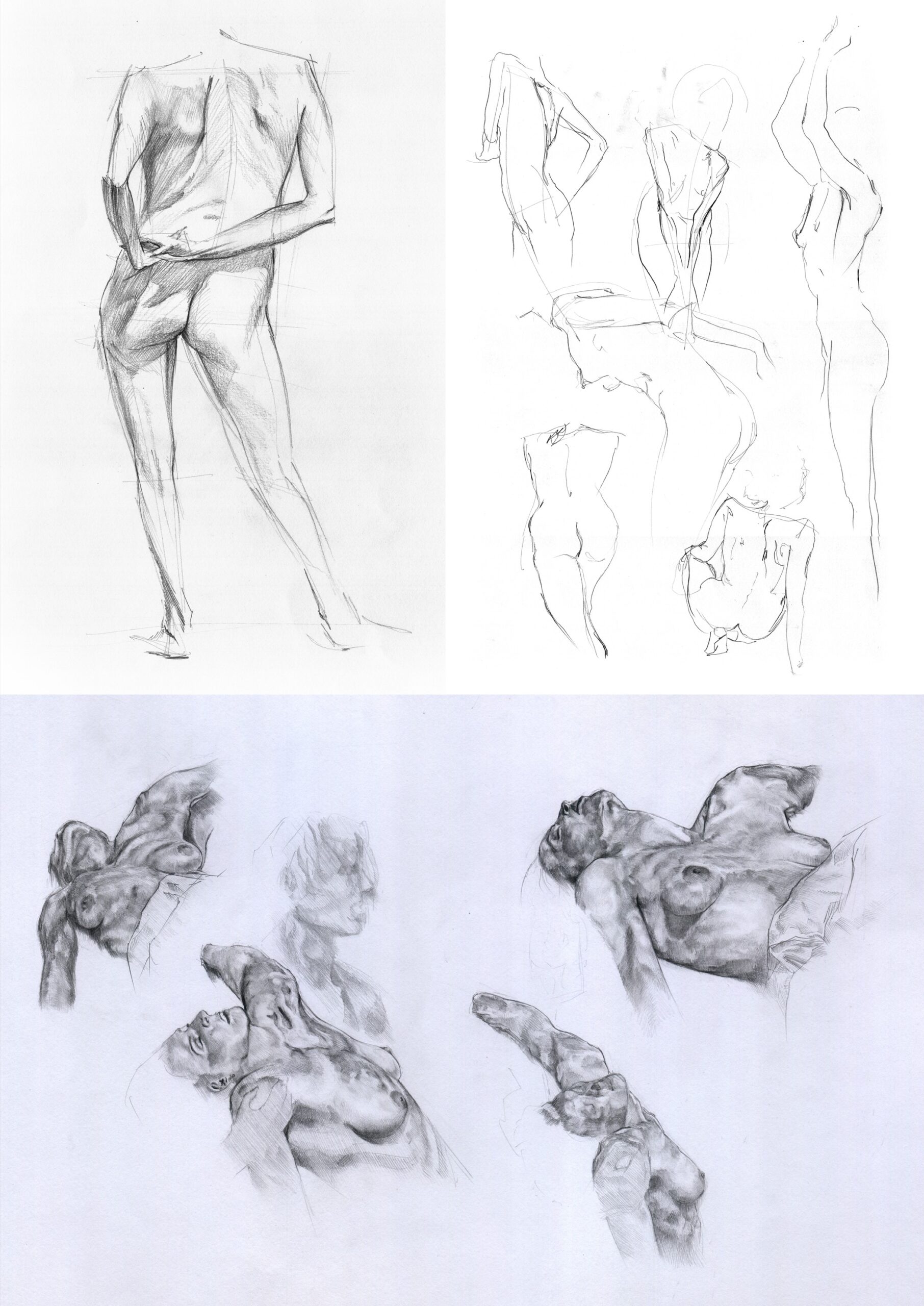
We know these ideas of the individual as the starting point for a subjectivised, psychologised perception of space from Vitruvian Man and from the somewhat later Neufert handbook or the Modulor concept, in which space was first conceived anew through the bodily capabilities and needs of a geometrised, average human being. This is why engagement with the human body and its parameters is of such immense importance to architecture—and not only to pathology. Yet these guiding models of the “properly proportioned human”, from the Vitruvian ideal through Neufert’s tables to the Modulor of Jeanneret-Gris,2 also reveal the problematic reverse of such bodily centrality. Space is calibrated to a standardised, healthy adult body that knows neither wasting nor infirmity, neither weakness nor fragility, implying something totalitarian, as the body cult of the 1930s made clear. Against this background, Schmarsow’s emphasis on individual sensation offers a subtle corrective. It reminds us that no single body can be the measure of all things; instead, there is a multiplicity of bodily situations giving rise to an equally diverse experience of architecture.

Schmarsow’s ideas also resonate in contemporary building practice, which increasingly accommodates accessibility, partly for demographic reasons. New schools and offices seek to replace earlier plan types with “learning landscapes” and open working areas, making room for informal conversations, changing postures and the essential connection between movement and concentration. Exhibition and museum architecture focuses less on supplementing exhibits with stylised interiors3 than on staging a bodily dramaturgy, from the subdued, almost sacred entrance to the overlit exit with its museum shop. Schmarsow’s image of space emerging only as it is traversed could almost be placed alongside as a direct design maxim. Airports, stations and shopping centres use sightlines, glimpses through spaces, storey heights, lowered ceilings and fields of light to reduce overload and allow intuitive orientation. This too is a form of bodily spatial planning: designing for the disoriented, tired, burdened body that must understand “where to go” in the shortest possible time. Schmarsow’s thesis that space comes into being only through human movement is thus less a marginal historical observation than an invitation, still far from exhausted, to take architecture seriously as the art of bodily situated perception.
The stylised interiors of museum buildings bring to mind the many theatrical “Egyptian rooms” created in the nineteenth century. They echo not only in historicist museum architecture, including in Berlin and Vienna, but also in a work of mine that takes up and varies Egyptomania’s historicising visual language:


- quoted from: Schmarsow, August
Inaugural lecture delivered in the assembly hall of the Royal University of Leipzig on 8 November 1893; Leipzig: Hiersemann, 1894, 30 pp. ↩︎ - better known as Le Corbusier ↩︎
- Among stylised interiors, particular mention should be made of the many Egyptian museums whose emergence was closely connected with nineteenth-century Egyptomania. This led to extensive Egyptian collections and the display by European colonial powers of objects discovered and excavated in Egypt. Napoleon’s Egyptian campaign (1798–1801), which lastingly intensified Europe’s fascination with the pharaonic world, was an important catalyst. ↩︎