
Stamp, debt and stone
← back to overview of “Debt and Evidence”


You are here: Part III.
The Code of Hammurabi –
Stamp, debt and stone
Change of mentality to more responsibility and less fear

I. Actions instead of acts
In ancient Babylon laws were cut less in the soft tone of the tablets, but rather with a hard whip in the skin. Where punishment was no longer sufficient, the axe spoke1 the last sentence:
Codex Hammurabi, § 229 If a builder builds a house and does not carry out his work firmly enough, so that it collapses and kills the owner, then that builder himself is to kill.2
The Codex knew little atonement and Wergeld3It was the radical form of a debt-independent liability for success.4To which all differences between negligence and intent were alien within the facts of the case: it was simply hardly a matter whether the builder acted to the best of his knowledge; the decisive factor was that the collapse of the house also sealed the life of its author, where the structure of the load did not withstand. This archaic inexorability may crush the individual, but it sanctifies the immensity of the order. Thus it was decided. In this intuitively perceived symmetry of justice – that unrelenting talion principle of the “Aug um Auge”, which at the latest wiped out the further development of the Enlightenment – there was no separation between the integrity of a work and the existence of its author. What may frighten modern man is the Total and radical Absence of any escape.
The supposedly civilized man, on the other hand, has long since replaced blood with ink; but under the polished surface of our legal procedures, the ability to stand up for his own actions – also against resistance. Of course, functionally speaking, it is a civilian achievement that we no longer have to kill (must). Finally, the transition from retribution to resocialization replaces an animal-emotional impulse of revenge with a functional-rational expedientity. But while the modern rule of law punishes the act, it seems increasingly dissolves the category of the person responsible. Whether these civilizing self-limitations represent a moral “progress” remains a question of perspective. Perhaps we have simply forgotten what killing meant: the recognition of guilt. Price for sovereignty over one’s own actions. The The Code of Hammurabi breathes between its columns and registers, the predecessors of modern lines of writing, precisely this hardness: Those who wanted to change the world had to be willing to carry the burden of responsibility literally on their shoulders and die under the ruins of his work if necessary.
Our epoch has the cruelties of The Code of Hammurabi This erosion of responsibility is not an abstract legal problem, but the substance that decomposes our social cohesion and stability. An economic system plunges down into the pricelessness of real estate. No one is responsible – but everyone has worked correctly. Building under the burden of standards becomes confusingly complex and unaffordable for small and medium-sized enterprises. Nobody is responsible – but all have maintained their responsibility. Energy prices drive up material prices. No one is responsible – but everything ran according to regulations. Migration exacerbates the shortage of housing and overburdens police, justice and municipalities. No one is responsible – but everyone has decided in accordance with rules. It is the paradox of modernity: the project fails due to the sum of correctly fulfilled partial aspects, not to the violation of the rules, but to their sterile perfection. This is not progress. We experience the final delegation of sovereignty to nowhere.
While we are disintegrating the individual through norms, the state is increasingly losing its power to assert the monopoly of violence and maintain core competencies: We write down security and usage concepts for Christmas markets, knife-ban zones and railway stations in constantly growing file mountains – yet experience that the public space is only managed and not protected. Approval and detection chains to self-parody – and then stand in front of blocked bridges, overloaded rails and unbuilt living space because the procedures have become a ritual end in themselves and devour the goal like a creeping sealtum. We normalize organized irresponsibility in air-conditioned meeting rooms, while the backbone of individual entrepreneurial activity breaks under the burden of legal culture. We live in a legal system that fears the error so obsessively that it makes success impossible. We live in an age of organized innocence, where ruins and human lives are just file operations and physical failure disappears behind procedural correctness. Right without effective attribution remains non-binding prose. An order in which no one can be held accountable is no longer an order, but an organized irresponsibility. And where wrongdoing is right, contradiction becomes a duty.

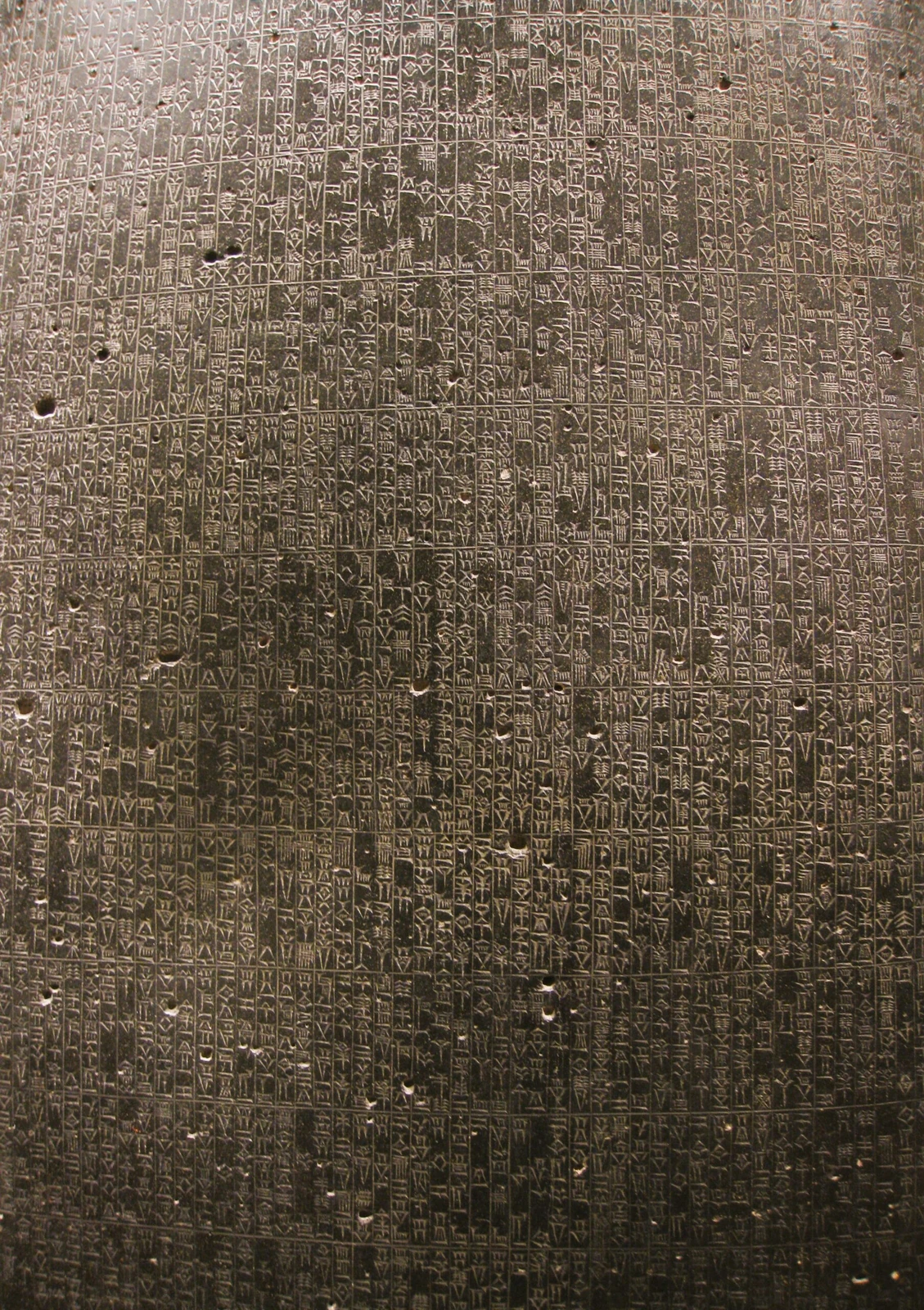
Stele bearing the Code of Hammurabi. Photograph: ridaeology (Flickr), Wikimedia Commons, CC BY 2.0. | Photograph: Mbzt, Wikimedia Commons, CC BY 3.0. | Cropping and colour correction by Daniel Yakubovich.
II. Domestication to the wheel
One and a half centuries ago, an engineer stood up for his work personally: in 1884 the circus entrepreneur Phineas Taylor Barnum left 21 elephants in public.5 about the newly opened Brooklyn Bridge of engineer Johann August Röbling from Thuringia6 In 1937, after the completion of the Second Reichsbrücke in Vienna, 84 trucks and 28 tram cars loaded with stones were set up for several days – either to stop or not to stop.7 Responsibility was publicly celebrated here; success and failure were evident. It was the unity of risk and decision.
It is precisely because this test was so hard and so visible that a long, unspectacular line – a Genealogy of Domestication8 – from the heroism of individuals to the wheel in the drive of our present. The development proceeded gradually. Already in the 1920s the Orders for contracts and contracts for works In the 1970s, a wave of social and security laws overrun the country; the oil crisis in 1973 brought first heat protection regulations and the Honorary regulations for architects and engineers (HOAI) with its defined performance phases. In the 1990s and 2000s, the apparatus continued to grow through EU procurement guidelines and compliance requirements. Each scandal brought with it stricter rules: collapses such as those of Bad Reichenhall (2006) led to stricter monitoring regulations. At the same time, construction projects became technically more complex. As a result, there are today for every aspect specialists with partial services, insurances that require collateral, and public lenders who stack evidence. But complexity must never serve as an intellectual hiding place for irresponsibility and arrogance in decision-making: those who decide today often bear no risk; those who carry the risk have often not decided.
This shift is not a coincidence, but rather the product of incentives. Our right to service and liability makes personal individuality dangerous, while following regulations is considered the safest way. At the same time, new goals are set in parallel politically – climate protection, accessibility, monument protection, budget closures – without setting priorities. Each instance acts out of its particular rationality, increases the number of audit and control loops for its own relief and disguises caution as a sense of responsibility. It is institutional fear of singular responsibility – a pre-emptive defense of guilt.9
If up to 9 instances tying to an invoice"Failure arises as a systemic group product of an increasingly fragile system because responsibility and decision-making power eroded without anyone expressing this loss. Thus, the annual report 2025 of the Berlin Court of Auditors shows that out of 37 civil protection authorities five did not even know that they are part of civil protection.10 The attack on the maraudous infrastructure in the capital at the beginning of 2026 once again illustrated this state failure. It is the expression of an order that suppresses the emergency: a highly complex system would need a tip that speaks the last word in doubt.
III. Anatomy of cowardice
Helmut Schmidt once remarked that the Germans had a tendency to be afraid.11 The old chancellor linked this tendency of fear with the experience "since the end of Nazi times and war" and illustrated it with later anxiety debates – mad cow disease, forest deaths, the concern for a nuclear accident. Fortunately, the Hamburger, who died in 2015, was spared his century-long life. Last generation as a genealogical continuation of this chain. With certainty, in a psychological reading by Helmut Schmidt's reflection on so many German peculiarities the trace of a Transgenerational trauma I'm sorry.
But it is the bitter irony of our time that the safety instinct turns into its opposite: From the conservative concept of security as a vital defensiveness and stability, a bourgeois-liberal all-encompassing wish – hypertrophic in an overpowering state – was made. When the protection of the citizen mutates into a complete surveillance and security system, the order suffocates exactly that life force which it was supposed to preserve. A sovereign state provides the framework and trusts in the resilience and power of its citizens; Weak State However, his mistrust tries to compensate by a wist of decrees, in which in the end both order and freedom suffocate.12 A healthy state organism is characterized by the clarity of its few, but indisputable principles – not by the mass of its carcinomatous proliferating regulations. Today's rule-wreath and regulation-cracks are the sign of exhaustion of a debilitating state body that has lost control over the essentials and transforms somnambul into a future without goal.
This is not about the longing for legal arbitrariness or a return to the further development of the law in recent decades, but about a future-oriented change of the human image which has a healing effect on the regulatory level in the long term. It's about rediscovering professional honor. It can be rightly objected that "honour is not a legal term and "honor killings" are an imported phenomenon. But precisely here lies the error: Where the inner corrective breaks away, the state must inevitably repair with external coercion – a expensive and ultimately doomed replacement for a solid individual.
In addition, after decades of neglect of wealth, a risk-averse society has formed. In the private sector, this may be limited by competition, but in the public sector, where it is primarily about fulfilling obligations, this mentality has fully developed.13 It is hardly possible at this point not to think of the contemporary wisdom of the American writer Michael Hopf, who in his post-apocalyptic novel in 2016 had one of his characters found meaningfully after the collapse of civilization: Difficult times create strong people, strong people create good times, good times create weak people, weak people create hard times.14
Today, culture of error often means not to admit mistakes at all, but to prevent them by means of processes. On the one hand, this has provided us with a very high level of technical standard security – buildings in Germany rarely collapse, but rarely burn light. However, complexity must not be an excuse for moral diffusion; technical division of labor does not exempt us from the obligation to make personal decision-making – almost eschatological – last resort.
The modern state has a great debt-telling of Dostoyevsky, which is the name of this series of texts Guilt and Evidence15 influenced, into the ad absurdum wrong: We carry today the complete proof in order not to let the guilt arise at all. We must learn again to trembl before the (own) works, not out of fear of disciplinary proceedings, but out of reverence for the (own) creation. In the sense of the great Russian writer, we need a return of the sinner, who does not deny his guilt behind paragraphs, but presents himself as a special fate. At the last moment, we will not be asked whether we have respected every time limit and obeyed every law. In the final instance, we are asked: Did you work or have you merely managed your existence? Did you sit on stone or hide behind excuses and laws? Freely after Dostoyevsky the last truth awaits in the deepest sense, which no paragraph can ever grasp: We are really free only where we are willing to become guilty. Whoever flees from the burden of responsibility flees from life itself. Only those who are ready to fall have the right to stand.
Codex Hammurabi, § 232 He who has not fixed the house that he has built, and has come to mind, will build out of his own wealth the house that has fallen.16

- The exact method of execution method to Enforcement of the death penalty According to § 229 it is not known. However, it can be assumed that most executions are carried out with the axe. The Code of Hammurabi was created around 1800 BC in the middle of the Bronze AgeTherefore, weapons were cast mainly from bronze, which made them heavier than later materials such as iron but also brittle. Since the possibilities for producing long and at the same time break-resistant blades were limited, most "sworders" corresponded to rather long daggers or short swords (ca. 30 to 50 cm). A special feature was the sickle sword – a hybrid form of axe and sword. However, for the execution of death sentences, the axe might have been the most economical and practical choice. For further tips — please read more. ↩︎
- L. W. King (over): The Code of Hammurabi (London: Luzac and Co., 1902), § 229 ("If a builder build a house for a man and do not make its construction firm, and the house which he has built collapse and cause the death of the owner of the house, that builder shall be put to death.) ↩︎
- As an archaic instrument of peacekeeping, the "Advertisement" in the Germanic and early medieval right to avert the spiral of blood revenge by material atonement for a murder or assault offence against the survivors. What can be regarded as an earlier attempt at life-necessary turning away from physical retribution today is known as civil redress to the survivors. ↩︎
- In contrast to the intent and negligence as a modern measure of liability (cf. § 276 BGB), which examines subjective reproachability, only the objective violation of order counts in the Talion principle. ↩︎
- David McCullough: The Great Bridge: The Epic Story of the Building of the Brooklyn Bridge==References====External links== ↩︎
- Johann August Röbling (1806–1869) was an engineer from Thuringia and died before the construction began; his son and wife subsequently took over the execution. ↩︎
- See Friedrich Schneider: The Reichsbrücke. The fateful history of a 110-year Danube crossing. 1876–1986, Vienna 1987, p. 57 f. ↩︎
- See Friedrich Nietzsche: The genealogy of morality., 1887 ↩︎
- See Standards Control Board Baden-Württemberg: Relieving bureaucracy and building costs by optimising fire protection. Recommendation report of the Standards Control Board Baden-Württemberg, Stuttgart, 2021. Available online at: https://www.normenkontrollrat-bw.de/ (last access 30.12.2025) ↩︎
- See Court of Auditors of Berlin: Press release on the Annual Report 2025 – Berlin must now reroute: Uferless expenditures endanger Berlin's future. Management deficits, income losses and waste of money in administration, 27.11.2025. Available online at: https://www.berlin.de/rechnungshof/presse/ (last access: 04.02.2026) ↩︎
- See Helmut Schmidt: The Germans tend to Angst, Interview with FOCUS Online, 04.04.2011. Available online at: https://www.focus.de/politik/deutschland/ (last access: 05.02.2026). ↩︎
- See Publius Cornelius Tacitus: Annales, Book III, 27 ("corruptissima re publica plurimae leges" – meaning: the more corrupt the state, the more numerous the laws). ↩︎
- See Family Business Foundation (eds.): Cultural Causes of Overbureaucratization (Study), 13 May 2025, p. 6: "Where there is room for manoeuvre, they are interpreted restrictively and risk-aversely in the enforcement administration. https://www.familienunternehmen.de/ (last access: 05.02.2026) ↩︎
- See Hopf, G. Michael: Those Who Remain: A Postapocalyptic Novel (The New World Series, vol. 7). CreateSpace Independent Publishing Platform, 2016. ↩︎
- Fyodor Dostoevsky wrote the novel Guilt and Atonement (Original Russian title: Преступление и наказание [prʲɪstʊˈplʲenʲɪje i nəkɐˈzanʲɪje]In 1866, he was first a follow-up novel. The focus is on the impoverished student Raskolnikov, who murdered a pawnbroker and then rubbed under the pressure of guilt, persecution and internal collapse. ↩︎
- See feet. 2 ↩︎